What is the Kitten Milk Replacer Calculator?
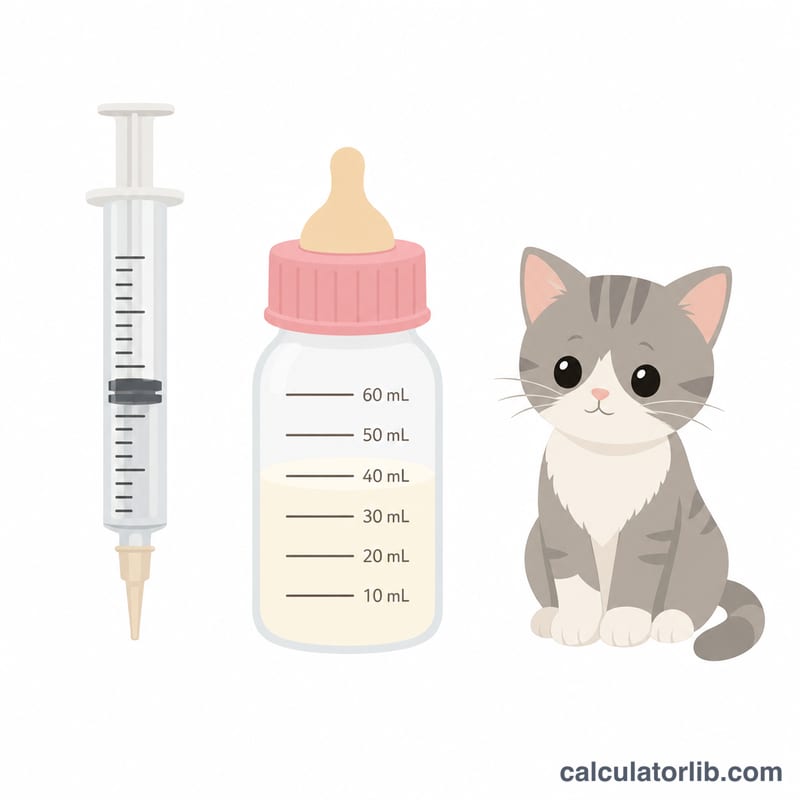
Orphaned or hand-reared kittens need a commercial kitten milk replacer (KMR) because cow's milk lacks the protein and fat they require and often causes diarrhea. This calculator estimates how much reconstituted KMR to offer each day and how to split that into individual feedings, using a widely cited guideline of roughly 20 mL of milk replacer per 100 g of body weight per day.
How to use it
Weigh your kitten on a kitchen or gram scale and enter the weight in grams. Then enter how many feedings you plan per day. Newborns (week 1) usually feed every 2–3 hours (about 8–10 feedings), tapering to 4–5 feedings by weeks 3–4. The calculator returns the total daily volume and the amount per feeding.
The formula explained
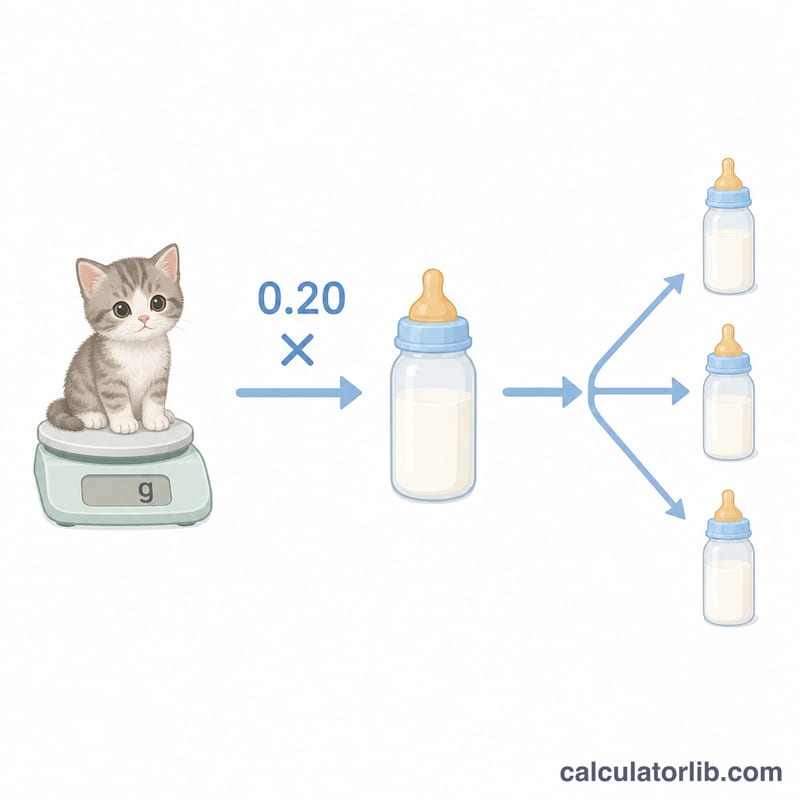
The estimate is based on energy needs: a neonatal kitten needs roughly 22–26 kcal per 100 g of body weight daily, and most reconstituted KMR supplies about 1 kcal/mL, which works out to close to 0.20 mL per gram of body weight. So daily mL = weight (g) \(\times 0.20\), and per-feeding mL = daily mL \(\div\) feedings.
$$\text{mL per Feeding} = \frac{0.20 \times \text{Weight (g)}}{\text{Feedings per Day}}$$
Worked example
A 200 g kitten: daily volume = \(200 \times 0.20 = 40\) mL/day. Split across 5 feedings, that is $$40 \div 5 = 8 \text{ mL per feeding.}$$
Kitten Feeding Schedule by Age and Weight
A widely used guideline for bottle-fed kittens is about 20 mL of prepared milk replacer per 100 g of body weight per day (0.20 mL per gram), divided across the day's feedings. The table below applies that guideline to typical age bands. Weights and intervals are approximate and vary between kittens and between products. These are general guidelines drawn from common veterinary and KMR product guidance, not individualized advice.
| Age | Typical weight (g) | Feedings per day | Interval (hours) | Approx. mL per feeding |
|---|---|---|---|---|
| Week 1 | 100–200 | 8–12 | 2–3 | 2–4 |
| Week 2 | 200–300 | 8 | about 3 | 5–8 |
| Week 3 | 300–400 | 6 | 3–4 | 10–13 |
| Week 4 | 400–500 | 5 | 4–5 | 16–20 |
| Weeks 5–8 | 500–900 | 4 | 5–6 | 25–45 (less as solid food replaces milk) |
The mL figures come from daily volume = weight × 0.20, divided by the number of feedings (week 1 assumes about 10 feedings). During weaning (starting around 4 weeks), kittens begin eating moist kitten food, so the milk portion usually shrinks. Follow your product label and your veterinarian's advice.
Scenario Comparison: Daily and Per-Feeding Volumes
These examples use \(\text{Daily mL} = 0.20 \times \text{Weight (g)}\) and \(\text{mL per feeding} = \text{Daily mL} \div \text{Feedings per day}\).
| Weight (g) | Feedings per day | Daily mL (weight × 0.20) | mL per feeding |
|---|---|---|---|
| 100 | 8 | 0.20 × 100 = 20 | 20 ÷ 8 = 2.5 |
| 200 | 6 | 0.20 × 200 = 40 | 40 ÷ 6 ≈ 6.7 |
| 300 | 5 | 0.20 × 300 = 60 | 60 ÷ 5 = 12 |
| 450 | 4 | 0.20 × 450 = 90 | 90 ÷ 4 = 22.5 |
Notice that the daily total stays the same however many feedings you use. More feedings just mean smaller portions each time. For example, a 300 g kitten needing 60 mL per day gets 12 mL at 5 feedings, or 10 mL at 6 feedings.
Interpreting Your Result
The calculator gives an estimated total daily intake of prepared milk replacer, then splits it into equal feedings. The 20 mL per 100 g rule rests on two commonly cited figures: prepared KMR provides roughly 1 kcal per mL, and growing kittens need roughly 22–26 kcal per 100 g of body weight per day. At about 1 kcal/mL, 20 mL per 100 g supplies about 20 kcal per 100 g, a conservative starting estimate at or just under that range.
- Label directions may differ. Products vary in concentration and calorie density, so the feeding chart on your specific KMR label can give somewhat different volumes.
- Weight gain is the usual indicator. Healthy neonates are commonly cited as gaining about 10–15 g per day. Steady daily weighing, ideally at the same time each day, is how intake is usually judged, rather than the calculated volume alone.
- Stomach capacity limits each feeding. A kitten's stomach is small, so a larger portion cannot simply replace extra feedings. Overfilling can cause diarrhea, bloating or milk entering the airway.
This is general information, not veterinary advice. Sick, premature, cold, very weak or not-gaining kittens, or any kitten with diarrhea or trouble swallowing, need prompt veterinary attention, and feeding amounts for them should be set by a veterinarian.
FAQ
Is this a substitute for a vet? No. This is an estimate. Always follow the mixing and feeding directions on your KMR product and consult a veterinarian, especially for sick or premature kittens.
How warm should the milk be? Warm KMR to about body temperature (around 38 °C / 100 °F) and never microwave it directly.
What if the kitten won't finish the amount? Don't force feed. Feed slowly, watch for a rounded but not bloated belly, and weigh daily to confirm steady weight gain.