

What is a calorie deficit?
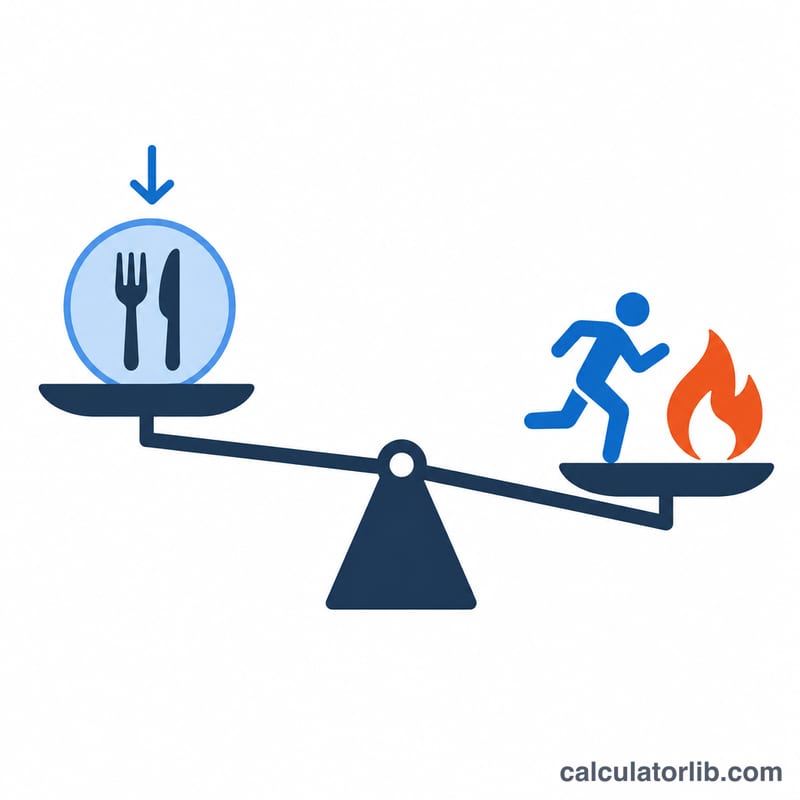
A calorie deficit happens when you consume fewer calories than your body burns. To lose body weight you must sustain a deficit over time. This calculator estimates how many days and weeks it will take to reach a target weight loss given a fixed daily calorie deficit, using the widely cited approximation that roughly 7,700 kcal equals one kilogram of body fat.
How to use it
Enter the amount of weight you want to lose in kilograms and the daily calorie deficit you plan to maintain (the gap between calories eaten and calories burned). The calculator returns the total energy deficit required, the number of days and weeks to reach your goal, and your average weekly weight loss.
The formula explained
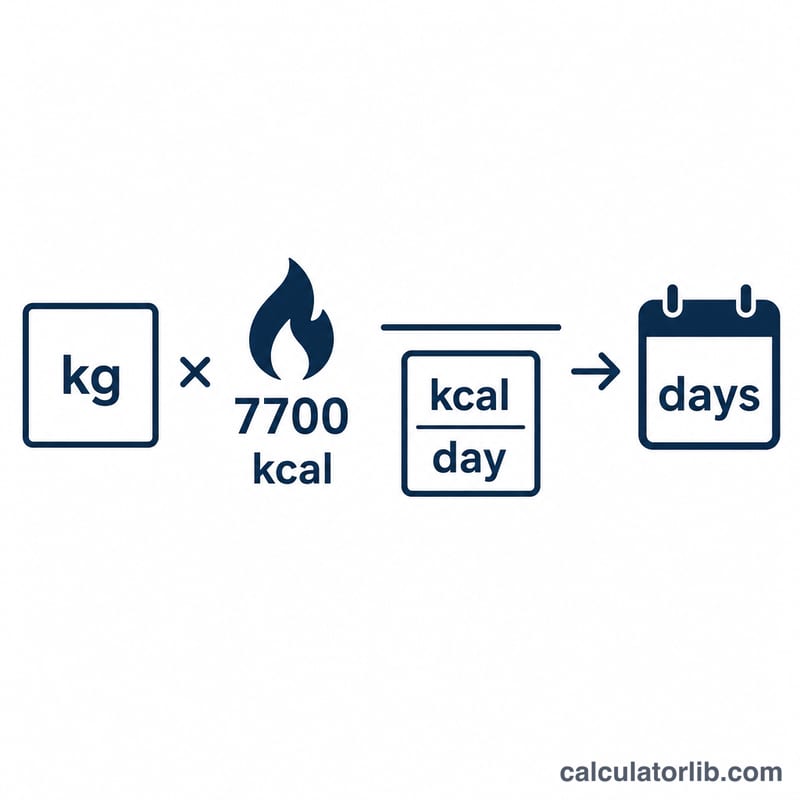
The core equation is $$\text{Days} = \frac{\text{Weight (kg)} \times 7700}{\text{Daily Deficit (kcal)}}$$ First the total energy gap is found by multiplying your goal weight by 7,700 kcal per kg. Dividing that by your daily deficit gives the number of days needed. Weeks are simply days \(\div\) 7.
Worked example
Suppose you want to lose 5 kg with a 500 kcal daily deficit. Total energy deficit $$= 5 \times 7700 = 38{,}500 \text{ kcal}.$$ Days $$= 38{,}500 \div 500 = 77 \text{ days},$$ which is 11 weeks, or about 0.45 kg per week — a safe, steady pace.
FAQ
Is 7,700 kcal per kg exact? No, it's an estimate. Real fat loss varies with metabolism, muscle changes and water weight, so treat results as a guide.
What's a healthy deficit? Many guidelines suggest 500–750 kcal/day for around 0.5–0.7 kg loss per week. Very aggressive deficits can be unsustainable or unhealthy.
Why does my actual loss differ? Weight loss is rarely linear — water retention, hormones and metabolic adaptation cause week-to-week swings even with a steady deficit.