What Is the Weight Loss Timeline Calculator?
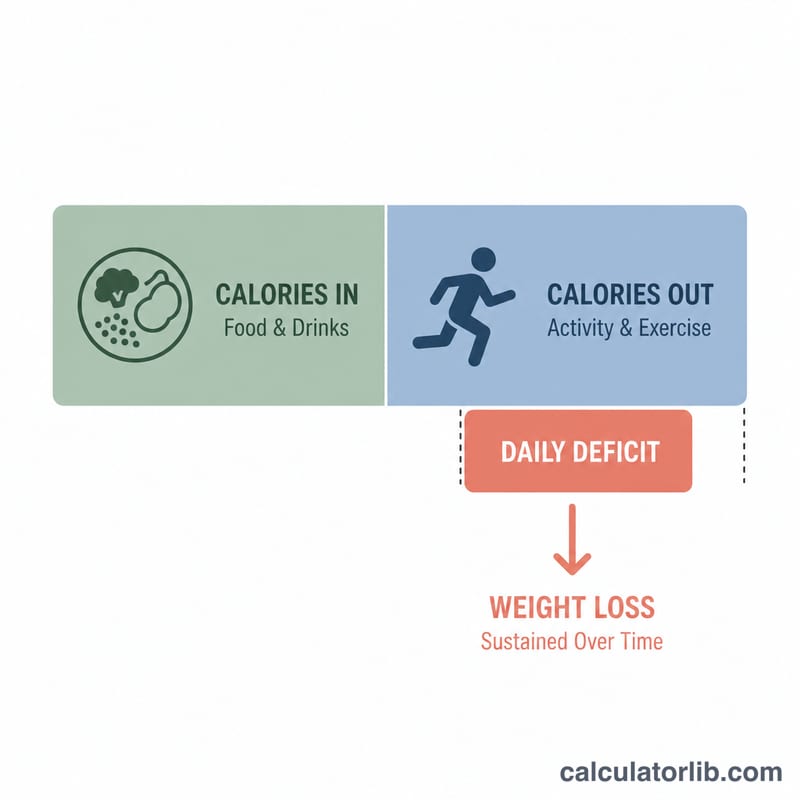
This calculator estimates how long it will take to reach a target weight given a consistent daily calorie deficit. It is based on the widely used approximation that roughly 7,700 kcal equals one kilogram of body fat. By dividing the total energy gap between your current and goal weight by your daily (and weekly) calorie shortfall, it returns the time in weeks, days, and months.
How to Use It
Enter your current weight and your goal weight in kilograms, then enter the daily calorie deficit you plan to maintain (the difference between calories eaten and calories burned). A deficit of 500 kcal/day is a common, sustainable target. The calculator then shows your estimated timeline plus how much weight you should lose each week.
The Formula Explained
$$\text{Weeks} = \frac{\left(\text{Current (kg)} - \text{Goal (kg)}\right) \times 7700}{\text{Deficit (kcal/day)} \times 7}$$ The numerator is the total calories your body must burn from fat stores; the denominator is the calories you cut each week. Weekly weight loss is simply the weekly deficit divided by 7700.
Worked Example
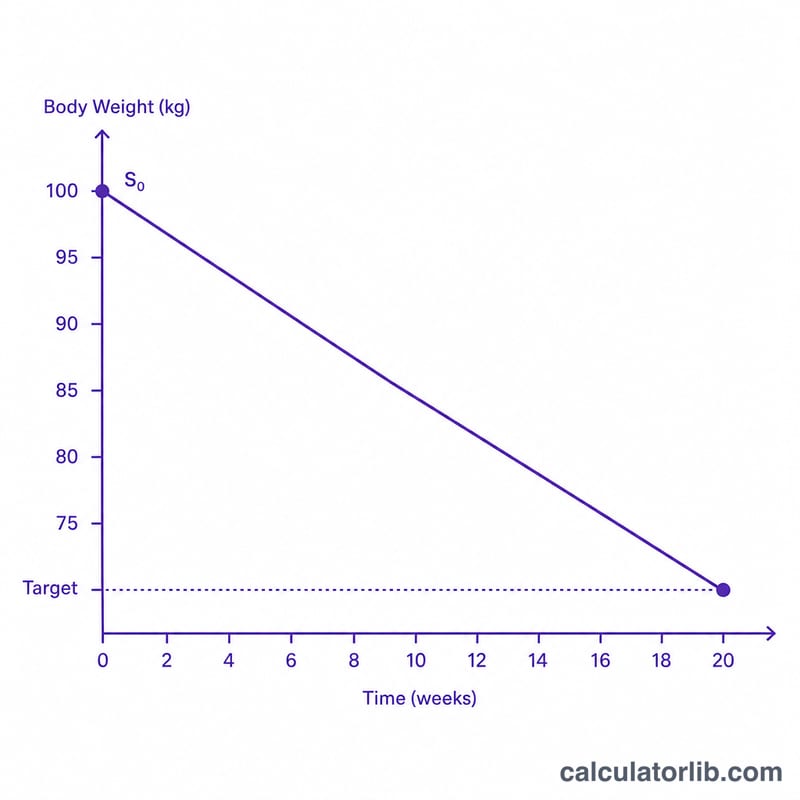
Suppose you weigh 85 kg, want to reach 75 kg, and maintain a 500 kcal/day deficit. You need to lose 10 kg, which is \(10 \times 7700 = 77{,}000\) kcal. Your weekly deficit is \(500 \times 7 = 3{,}500\) kcal, so $$\text{Weeks} = \frac{77{,}000}{3{,}500} = 22 \text{ weeks}$$ (about 5.1 months), losing roughly 0.45 kg per week.
Timeline Comparison for Different Deficits and Goals
The table below shows how long a 10 kg loss takes at different constant daily deficits, using the common approximation of 7,700 kcal per kg of body weight. The total energy to remove is \(10 \times 7700 = 77{,}000\) kcal. Weeks are calculated as \(\text{Weeks} = \frac{77000}{\text{deficit} \times 7}\), and months as weeks ÷ 4.345.
| Daily deficit (kcal) | Weekly loss (kg) | Weeks | Months |
|---|---|---|---|
| 250 | 0.23 | 44 (308 days) | 10.13 |
| 500 | 0.45 | 22 | 5.06 |
| 750 | 0.68 | 14.7 | 3.38 |
| 1,000 | 0.91 | 11 | 2.53 |
Worked check for the 500 kcal/day row: weekly deficit = \(500 \times 7 = 3500\) kcal, so weekly loss = \(3500 \div 7700 \approx 0.45\) kg, and weeks = \(77000 \div 3500 = 22\). Months = \(22 \div 4.345 \approx 5.06\).
Note that the 250 kcal/day row takes 308 days, which equals 44 weeks. Halving the deficit roughly doubles the time, because the timeline is inversely proportional to the deficit.
Interpreting Your Timeline
The result is an estimate, not a prediction. It assumes that your deficit stays constant for the whole period and that every kilogram lost represents about 7,700 kcal. That figure is a rough average of the energy in body fat and other tissue, and it varies between people.
In practice, loss tends to slow over time for several reasons:
- Lower maintenance energy needs: a lighter body burns fewer calories, so a deficit that started at 500 kcal/day shrinks unless intake or activity is adjusted.
- Water fluctuations: day-to-day changes in fluid, sodium, and glycogen can mask or exaggerate changes on the scale for days or weeks.
- Adaptive thermogenesis: the body may reduce energy expenditure somewhat more than weight change alone would explain.
Commonly cited public-health guidance, such as that from the US Centers for Disease Control and Prevention (CDC), describes about 0.5–1 kg (1–2 lb) per week as a gradual rate of loss. In the comparison table, deficits of 500–1,000 kcal/day fall roughly within that range.
If your timeline is very long (for example, many months or years from a small deficit), the deficit may be too small to be noticeable against everyday variation in intake and activity. If it is very short, the deficit may be unrealistically large or hard to sustain. Treat the result as a planning guide and re-check it periodically using your updated weight.
This is general information, not medical advice. For personal guidance on calorie targets or rate of weight loss, consult a doctor or registered dietitian.
FAQ
Is 7,700 kcal per kg accurate? It is a useful estimate. Real-world loss varies with metabolism, water weight, and adaptive changes, so treat the timeline as a guide.
What is a safe deficit? Many guidelines suggest 500–750 kcal/day for steady loss of about 0.5–0.7 kg per week. Very large deficits can be hard to sustain.
Will my rate slow over time? Often yes — as you lose weight, your maintenance calories drop, so you may need to adjust your deficit to keep progressing.