
What Is the Weight Loss Percentage Calculator?
This tool tells you what percentage of your original body weight you have lost. Tracking weight loss as a percentage is often more meaningful than tracking raw pounds or kilograms, because the same number of pounds represents a bigger achievement for a lighter person than for a heavier one. It's the same metric used in many weight-loss challenges and clinical guidelines (for example, a 5% loss is a common health milestone).
How to Use It
Enter your starting weight (your weight when you began) and your current weight. Use the same unit for both — pounds or kilograms, it doesn't matter since the result is a percentage. The calculator instantly shows the percentage of your starting weight you've lost, along with the absolute amount lost.
The Formula Explained
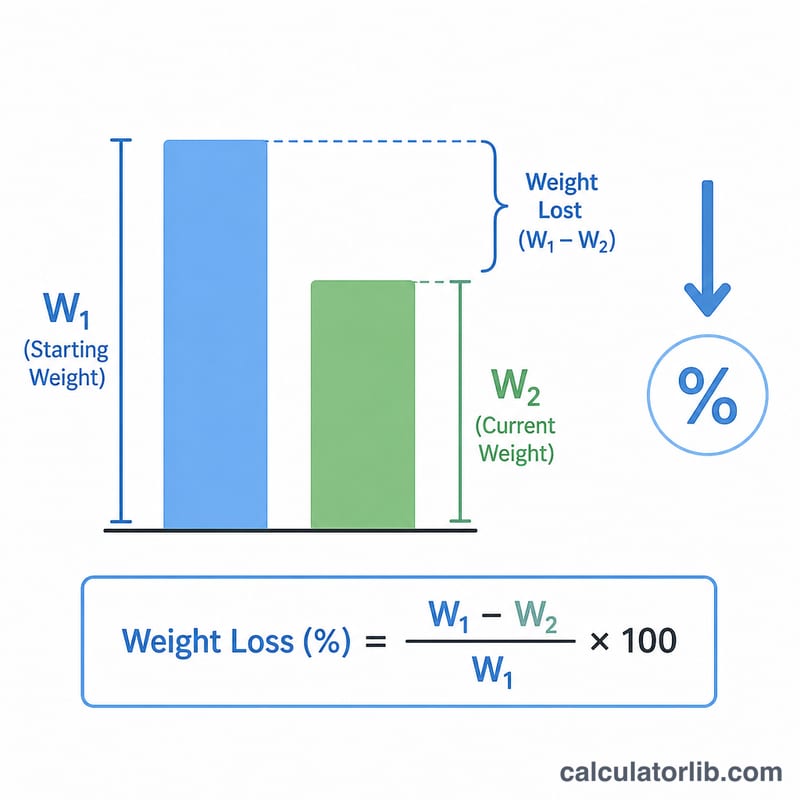
The calculation is simple:
$$\text{Weight Loss \%} = \frac{\text{Starting Weight} - \text{Current Weight}}{\text{Starting Weight}} \times 100$$
First it finds how much weight you lost (starting minus current), then divides by your starting weight to get the fraction, and multiplies by 100 to turn it into a percentage. If your current weight is higher than your starting weight, the result will be negative, indicating a gain.
Worked Example
Suppose you started at 200 lb and now weigh 170 lb. You lost 30 lb. Divide 30 by 200 to get 0.15, then multiply by 100: that's a 15% weight loss. Even though 30 lb sounds modest, losing 15% of body weight is a substantial, health-improving result.
$$\text{Weight Loss \%} = \frac{200 - 170}{200} \times 100 = 15\%$$
FAQ
Does the unit matter? No. As long as starting and current weight use the same unit, the percentage is identical whether you enter pounds, kilograms, or stones.
What is a healthy weight loss percentage? Many health authorities consider losing 5–10% of body weight a clinically significant improvement for blood pressure, blood sugar, and cholesterol. A safe pace is about 1–2 lb (0.5–1 kg) per week.
Can the result be negative? Yes. A negative percentage means your current weight is higher than your starting weight — you've gained rather than lost.