
What Is Weight Loss Percentage?
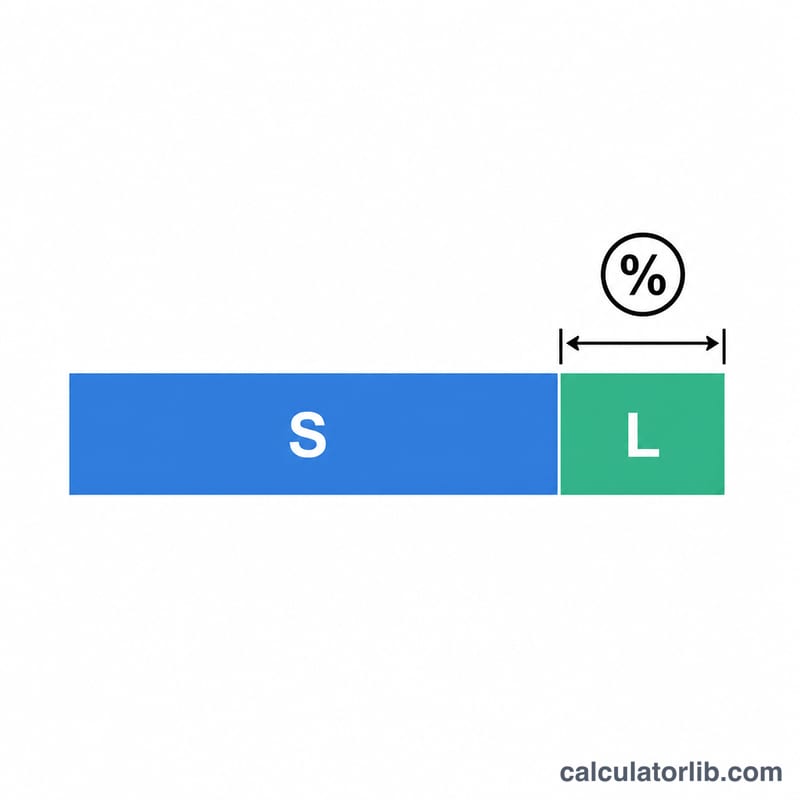
Weight loss percentage expresses how much weight you've lost relative to where you started, rather than as a raw number. Losing 10 pounds means something very different for a 150-pound person than for a 300-pound person. Expressing the change as a percentage gives a fair, comparable measure of progress that is widely used in weight-loss challenges, fitness programs, and clinical settings.
How to Use This Calculator
Enter your starting weight (your weight when you began) and your current weight in the same unit — pounds or kilograms, it doesn't matter as long as both match. The calculator returns the percentage of your starting body weight you have lost, along with the absolute amount lost.
The Formula Explained
The calculation is simple: subtract your current weight from your starting weight to get the amount lost, divide by your starting weight, and multiply by 100 to get a percentage:
$$\text{Loss \%} = \frac{\text{Starting Weight} - \text{Current Weight}}{\text{Starting Weight}} \times 100$$
A positive result means you've lost weight; a negative result means you've gained.
Worked Example
Suppose you started at 180 pounds and now weigh 162 pounds. The weight lost is \(180 - 162 = 18\) pounds. Divide by the starting weight: \(18 \div 180 = 0.1\). Multiply by 100 to get 10%. You have lost 10% of your starting body weight.
$$\frac{180 - 162}{180} \times 100 = 10\%$$
FAQ
Does it matter if I use pounds or kilograms? No. As long as both weights are in the same unit, the percentage is identical.
What is considered a healthy rate of weight loss? Most health authorities suggest 0.5–1% of body weight per week as a sustainable rate, though individual goals vary — consult a healthcare professional.
Can the result be negative? Yes. If your current weight is higher than your starting weight, the result is negative, indicating weight gain rather than loss.