
What is the Pythagorean Identity?
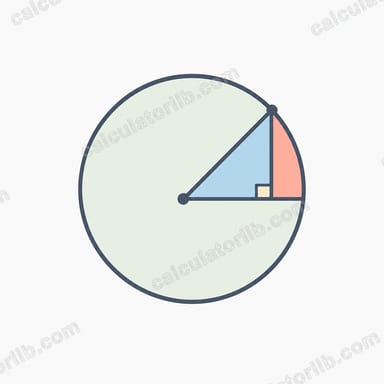
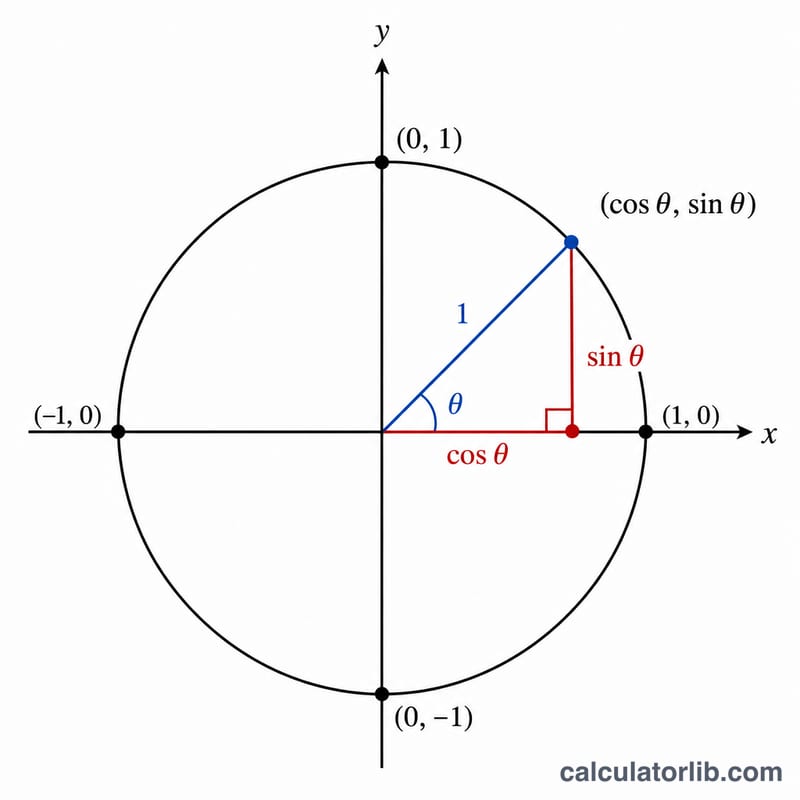
The Pythagorean identity, \(\sin^2\theta + \cos^2\theta = 1\), is the most fundamental relationship in trigonometry. It comes directly from the unit circle: a point at angle θ has coordinates (cos θ, sin θ), and because that point lies on a circle of radius 1, the Pythagorean theorem gives \(\cos^2\theta + \sin^2\theta = 1\). This calculator lets you enter sin θ, choose the quadrant, and instantly recover cos θ while confirming the identity holds.
How to use this calculator
Enter a value for sin θ between −1 and 1. Then select whether cos θ is positive (angles in Quadrant I or IV) or negative (Quadrant II or III). The calculator computes $$\cos\theta = \pm\sqrt{1 - \sin^2\theta}$$ reports sin²θ and cos²θ, and verifies that they sum to exactly 1.
The formula explained
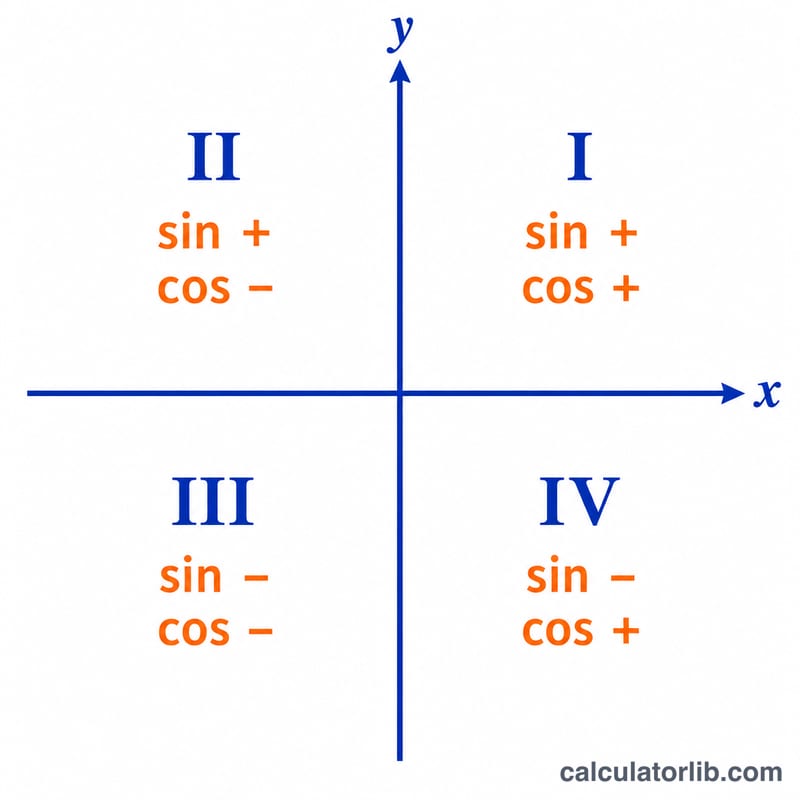
Rearranging the identity gives \(\cos^2\theta = 1 - \sin^2\theta\), so $$\cos\theta = \pm\sqrt{1 - \sin^2\theta}$$ The square root alone only gives the magnitude — the sign depends on which quadrant the angle lives in, since cosine is positive on the right half of the unit circle and negative on the left half. That is why selecting the quadrant matters.
Worked example
Suppose sin θ = 0.6 and θ is in Quadrant I. Then \(\sin^2\theta = 0.36\), so \(\cos^2\theta = 1 - 0.36 = 0.64\), and \(\cos\theta = +\sqrt{0.64} = 0.8\). Checking: \(0.36 + 0.64 = 1\) ✓. This is the classic 3-4-5 style right-triangle ratio (0.6, 0.8, 1).
FAQ
Why are there two possible answers for cos θ? Because squaring loses sign information. For any sin θ value (except ±1), there are two angles — one with positive cosine and one with negative cosine — that share the same sine.
What if I enter sin θ = 1? Then \(\cos^2\theta = 0\), so \(\cos\theta = 0\), regardless of sign choice. This corresponds to θ = 90°.
Does this work for any unit? Yes — the identity is independent of degrees or radians since it only involves sin θ and cos θ values.