
What is the Sin Cos Tan Calculator?
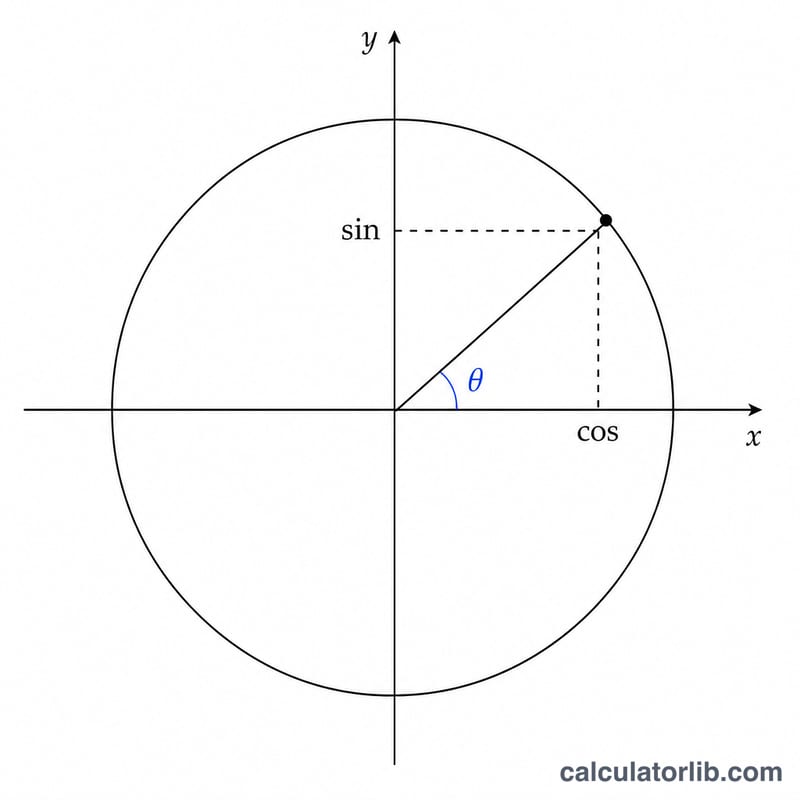
This calculator evaluates the three core trigonometric functions — sine, cosine and tangent — for any angle you enter, whether measured in degrees or radians. It is a universal math tool useful for students, engineers, surveyors and anyone working with triangles, waves or circular motion.
How to use it
Enter your angle, choose whether it is in degrees or radians, and submit. The calculator returns sin θ, cos θ and tan θ, and also shows the angle converted to radians so you can cross-check your work. If you enter degrees, the value is first converted to radians because the underlying math functions operate on radians.
The formula explained
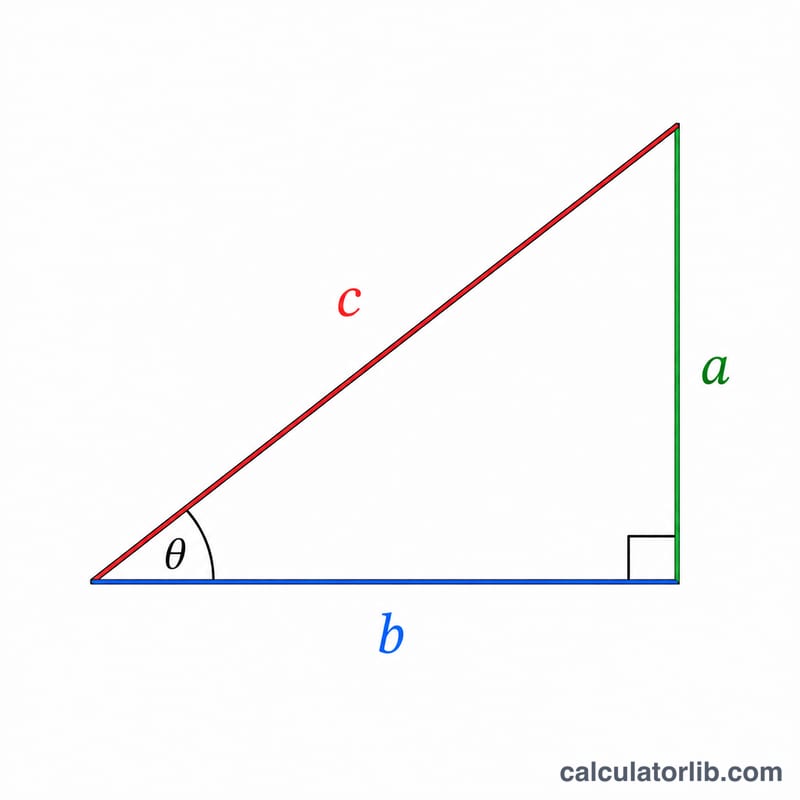
Degrees are converted with \( \theta_{\text{rad}} = \theta_{\text{deg}} \times \frac{\pi}{180} \). Sine and cosine are then computed directly. Tangent is defined as \( \tan\theta = \frac{\sin\theta}{\cos\theta} \). Where \( \cos\theta = 0 \) (for example at 90° or 270°), tangent is undefined, and the calculator reports it as such instead of returning a misleading huge number.
Worked example
For \( \theta = 30° \): convert to radians, $$30 \times \frac{\pi}{180} \approx 0.523599$$ Then \( \sin 30° = 0.5 \), \( \cos 30° \approx 0.866025 \), and \( \tan 30° \approx 0.577350 \). These match the well-known exact values \( \frac{1}{2} \), \( \frac{\sqrt{3}}{2} \) and \( \frac{1}{\sqrt{3}} \).
FAQ
Why is tan sometimes "undefined"? Because tangent equals sin/cos, and dividing by zero is undefined. This happens at 90°, 270°, and so on.
Can I use negative or large angles? Yes. Angles like -45° or 720° work fine; the functions are periodic.
Does it use radians internally? Yes. Degree inputs are converted to radians before computing, matching standard math libraries.