
What is the Arctangent (Tan-1) Calculator?
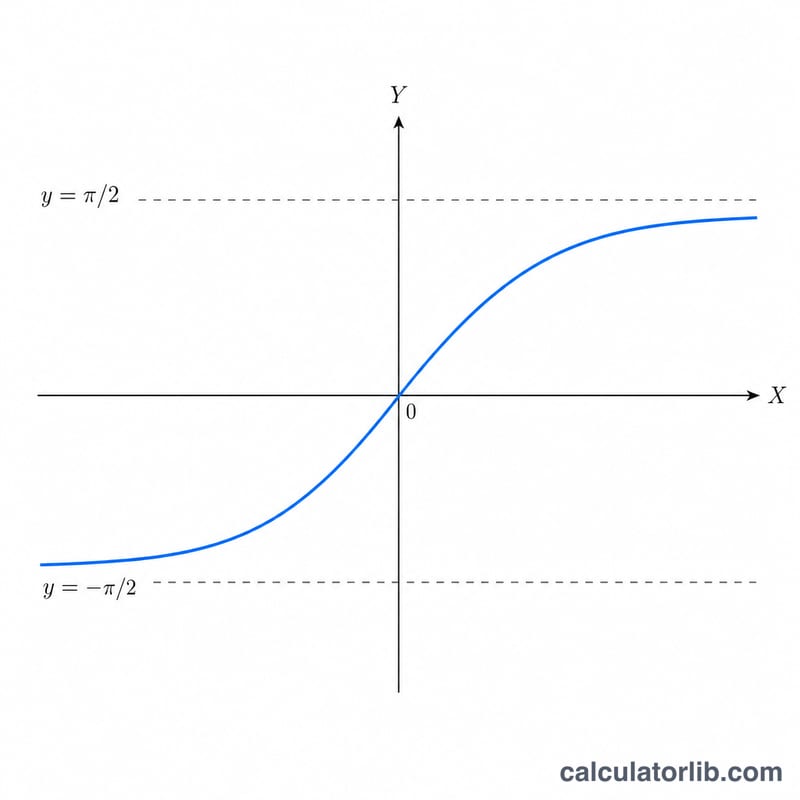
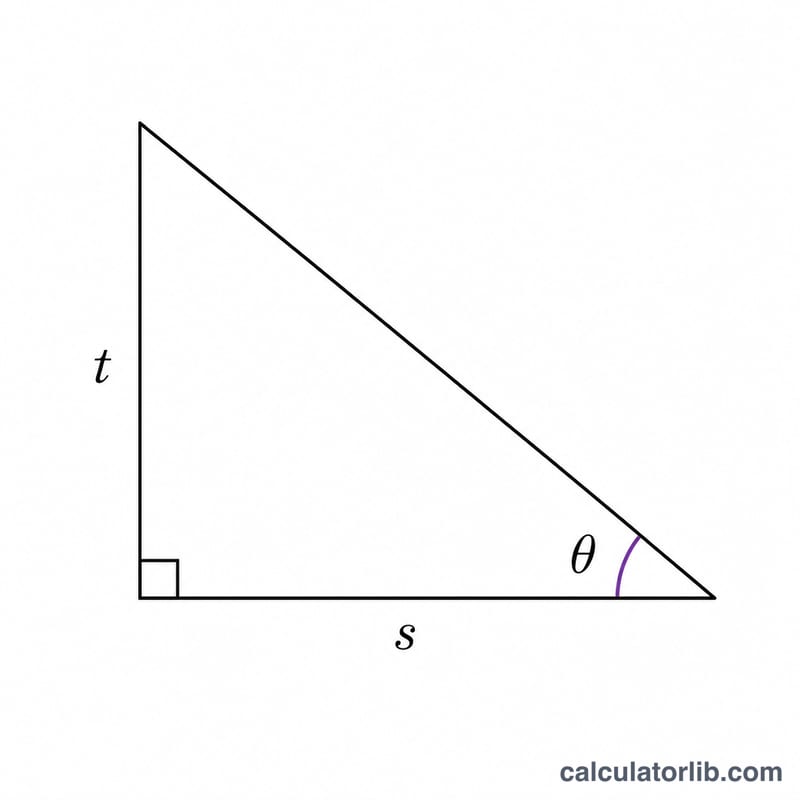
The arctangent, written as tan-1(x) or arctan(x), is the inverse of the tangent function. Given a ratio x, it returns the angle θ whose tangent equals x. This calculator instantly evaluates arctan(x) for any real number and shows the result in both degrees and radians. The principal value range is (-90°, 90°) or \((-\pi/2, \pi/2)\) in radians, which is what this tool returns.
How to Use It
Type any real number into the value box — it can be positive, negative, a decimal, or zero. Click calculate and the tool returns the angle in degrees (the headline figure) and radians (in the table below). Because the tangent function is unbounded, arctan accepts any real input from negative infinity to positive infinity, so there are no range restrictions on x.
The Formula Explained
The calculator computes \(\theta = \arctan(x)\), which gives an angle in radians. To convert to degrees it multiplies by \(180/\pi\):
$$\theta_{\deg} = \arctan(x) \times \frac{180}{\pi}$$
As x grows large the angle approaches 90°; as x grows very negative it approaches -90°. When x = 0, \(\arctan(0) = 0°\).
Worked Example
Suppose x = 1. The tangent of 45° equals 1, so $$\arctan(1) = 45° = 0.785398 \text{ radians} \left(\frac{\pi}{4}\right).$$ For \(x = \sqrt{3} \approx 1.732\), \(\arctan(1.732) = 60°\). For a negative value such as x = -1, \(\arctan(-1) = -45° = -0.785398\) radians.
FAQ
What is the range of arctan? The principal value of arctan always lies strictly between -90° and 90° (\(-\pi/2\) and \(\pi/2\) radians).
Is arctan(x) the same as 1/tan(x)? No. Arctan is the inverse function, not the reciprocal. The reciprocal of tan is cot (cotangent).
Can I enter very large numbers? Yes. As x increases, the result simply gets closer and closer to 90° without ever reaching it.