
What is the tangent ratio?
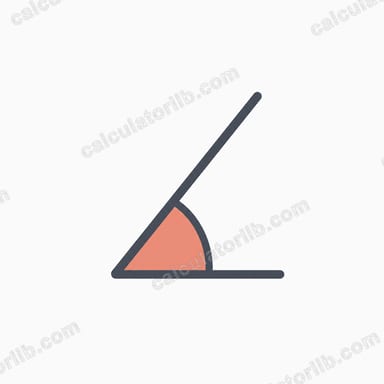
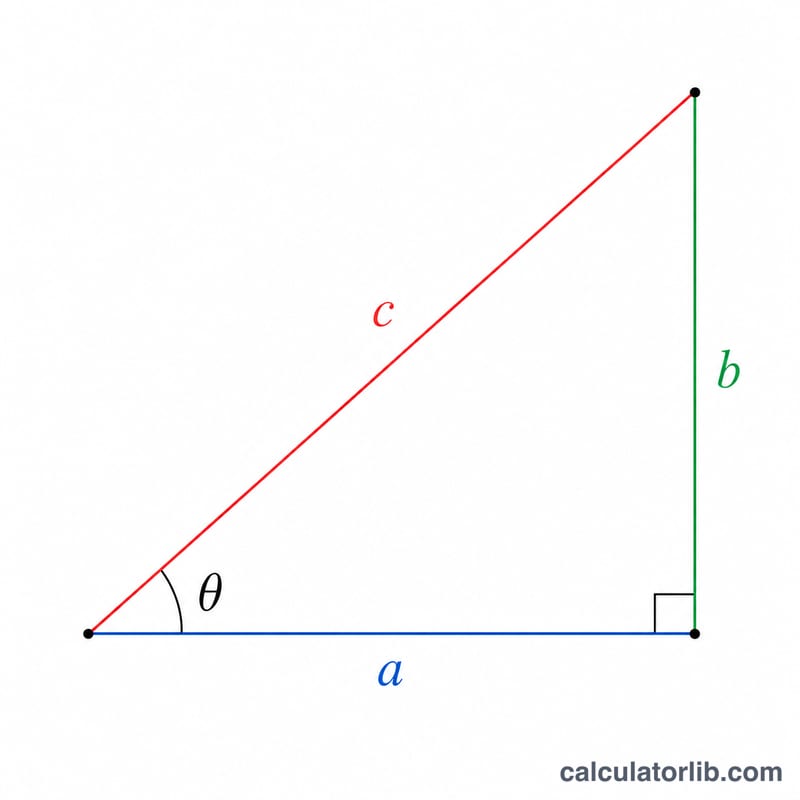
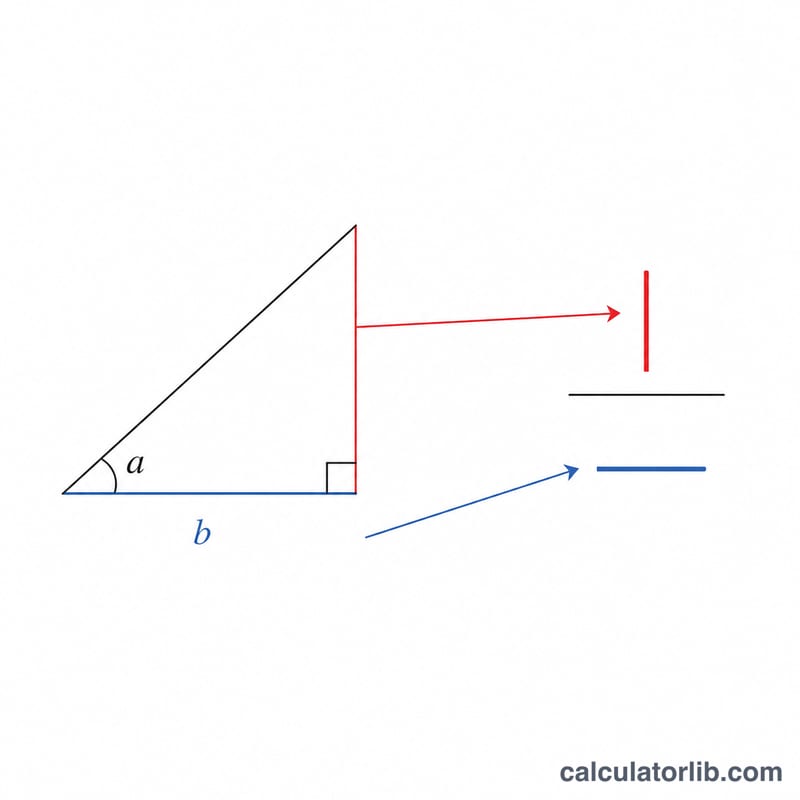
In a right triangle, the tangent of an acute angle θ is the ratio of the length of the side opposite the angle to the length of the side adjacent to it. Written as a formula, \(\tan(\theta) = \text{opposite} \div \text{adjacent}\). The tangent is one of the three core trigonometric ratios alongside sine and cosine, and it is widely used in geometry, surveying, navigation, engineering, and physics to relate angles and distances.
How to use this calculator
Enter the length of the opposite side (the side facing the angle) and the adjacent side (the side next to the angle, not the hypotenuse). The calculator instantly returns the tangent ratio and the corresponding angle θ in degrees. Lengths can be in any consistent unit because the ratio is dimensionless.
The formula explained
The tangent is simply a division: $$\tan(\theta) = \frac{\text{Opposite}}{\text{Adjacent}}$$ Because it is a pure ratio, scaling both sides by the same factor leaves the value unchanged. To find the angle itself, take the inverse tangent: $$\theta = \arctan\!\left(\frac{\text{Opposite}}{\text{Adjacent}}\right)$$ which this tool reports in degrees.
Worked example
Suppose the opposite side is 3 and the adjacent side is 4. Then $$\tan(\theta) = 3 \div 4 = 0.75$$ Taking the arctangent gives $$\theta = \arctan(0.75) \approx 36.87°$$ This is the well-known 3-4-5 right triangle.
FAQ
What if the adjacent side is zero? The tangent is undefined (the angle approaches 90°); the calculator reports the ratio as 0 to avoid division by zero, but treat that case as undefined.
Does the unit matter? No. The tangent is a ratio, so it is unitless as long as both sides use the same unit.
Can the tangent be negative? In a basic right triangle the sides are positive, so \(\tan(\theta)\) is positive. Negative values arise only when using signed coordinates.