
What Is the Surface Area of a Rectangular Pyramid?
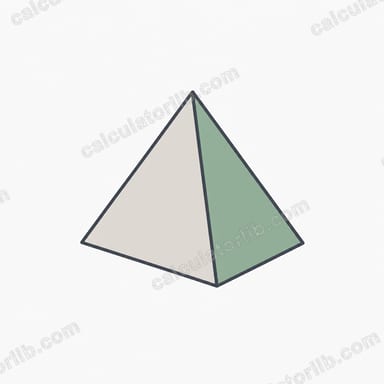
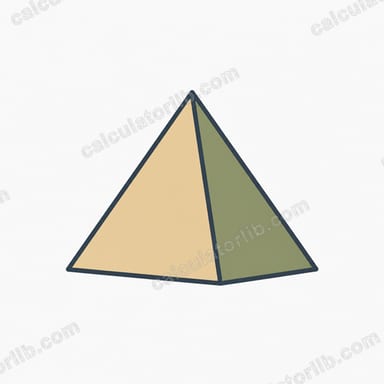
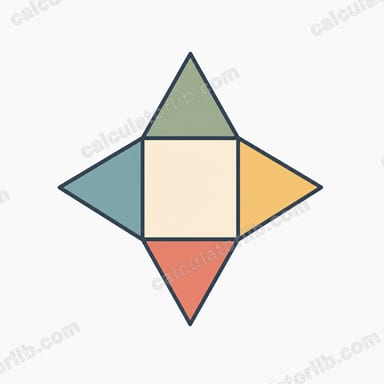
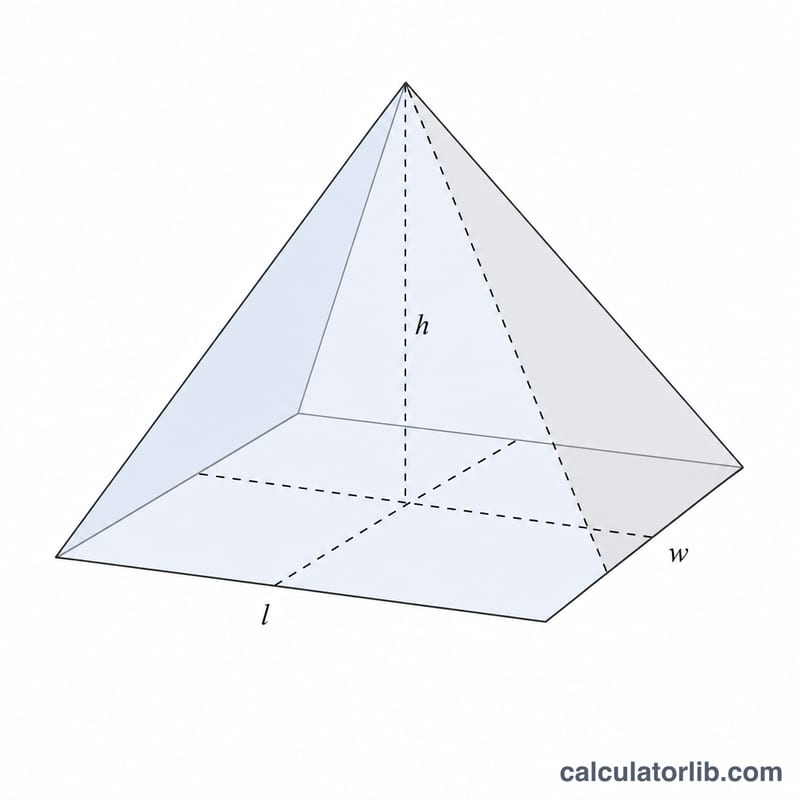
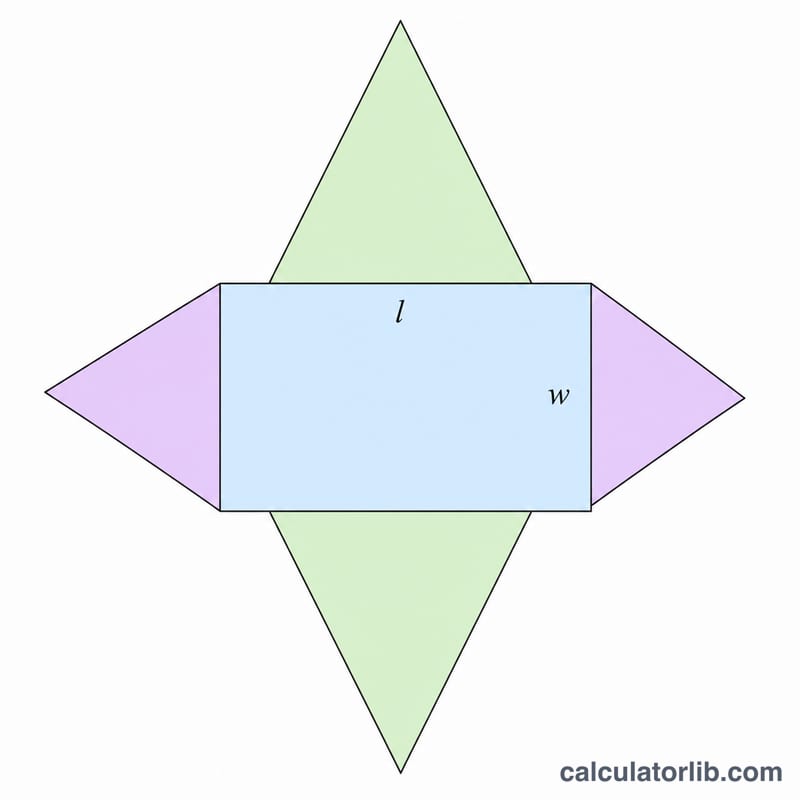
A rectangular pyramid has a rectangular base and four triangular faces that meet at a single apex directly above the center of the base. Its total surface area is the sum of the rectangular base and the four triangles. This calculator computes that area instantly from the base length (\(l\)), base width (\(w\)), and vertical height (\(h\)). The result is given in square units — if your measurements are in centimeters, the area is in square centimeters, and so on.
How to Use the Calculator
Enter the base length, base width, and the perpendicular height of the pyramid (the straight-up distance from the base to the apex). Click calculate to see the total surface area, broken down into the base area and the lateral (triangular) area, along with the two slant heights used in the computation.
The Formula Explained
The formula is $$A = lw + l\sqrt{\left(\tfrac{w}{2}\right)^2 + h^2} + w\sqrt{\left(\tfrac{l}{2}\right)^2 + h^2}$$ The term \(lw\) is the rectangular base. Each pair of opposite triangular faces shares a slant height. The slant height for the faces along the length is \(\sqrt{\left(\tfrac{w}{2}\right)^2 + h^2}\), and the slant height for the faces along the width is \(\sqrt{\left(\tfrac{l}{2}\right)^2 + h^2}\). Multiplying each slant height by its base edge and summing gives the lateral surface area.
Worked Example
For \(l = 6\), \(w = 4\), \(h = 10\): base area = \(6 \times 4 = 24\). Slant height $$s_1 = \sqrt{\left(\tfrac{4}{2}\right)^2 + 10^2} = \sqrt{4 + 100} = \sqrt{104} \approx 10.198$$ and $$s_2 = \sqrt{\left(\tfrac{6}{2}\right)^2 + 10^2} = \sqrt{9 + 100} = \sqrt{109} \approx 10.440$$ Lateral area = \(6 \times 10.198 + 4 \times 10.440 \approx 61.188 + 41.761 = 102.949\). Total \(\approx 24 + 102.949 =\) 126.95 square units.
FAQ
Is the height the same as the slant height? No. The height is the vertical distance from the base to the apex. The slant height runs along a triangular face and is always longer.
Why are there two different slant heights? Because the base is a rectangle, the faces along the length and the faces along the width have different slant heights unless the base is a square.
What if I only want the lateral area? Use the "Lateral Area" row in the results — it excludes the base.