
What Is the Surface Area of a Square Pyramid?
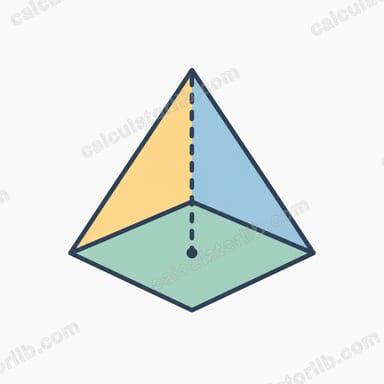
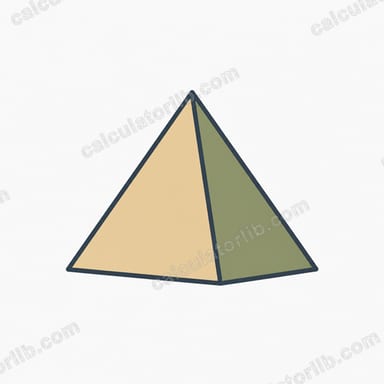
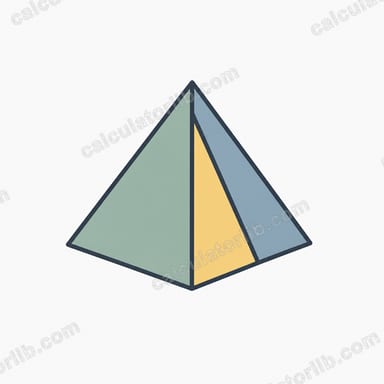
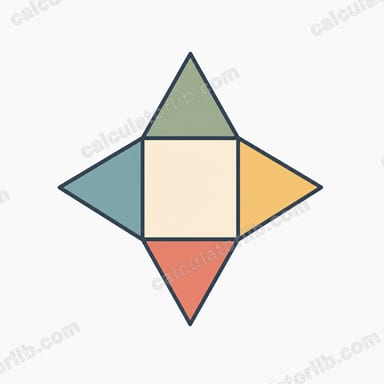
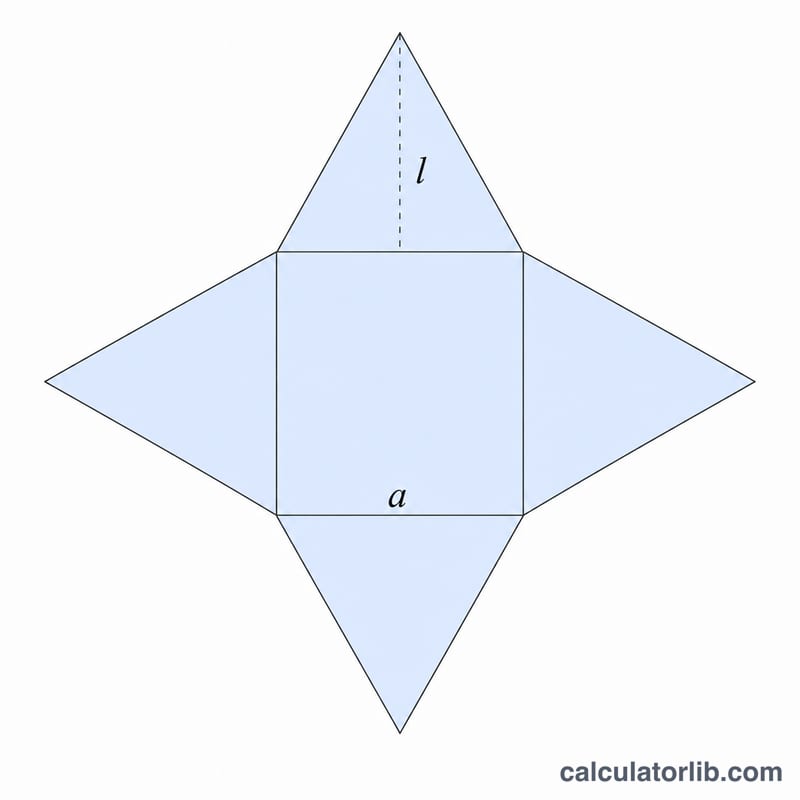
A square pyramid is a solid with a square base and four identical triangular faces that meet at a single apex above the center of the base. Its total surface area is the sum of the square base area and the combined area of the four triangular faces (the lateral surface area). This calculator works for any right square pyramid where the apex sits directly above the center of the base.
How to Use This Calculator
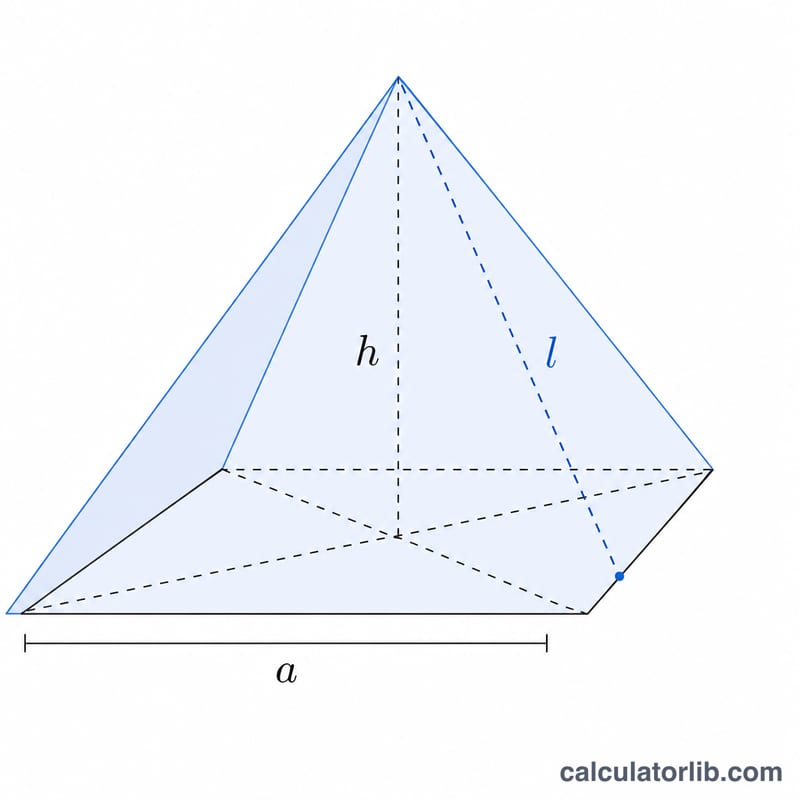
Enter the base edge length (a) — the side of the square base — and the vertical height (h) measured from the center of the base straight up to the apex. Use any consistent unit (cm, m, in, ft); the result is given in those units squared. The tool returns the total surface area along with the base area, lateral area, and slant height.
The Formula Explained
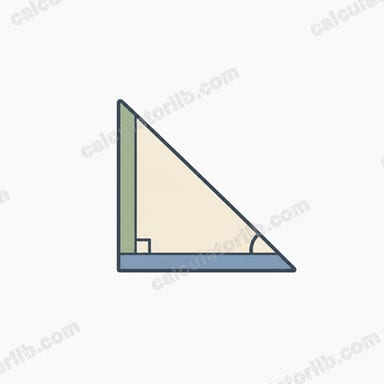
First the slant height is found with the Pythagorean theorem, combining half the base edge and the vertical height:
$$l = \sqrt{\left(\frac{a}{2}\right)^{2} + h^{2}}$$
The base contributes \(a^{2}\), and each of the four triangles has area \(\frac{1}{2}\cdot a\cdot l\), so all four together give \(2\cdot a\cdot l\). Adding them:
$$A = a^{2} + 2a\cdot\sqrt{\left(\frac{a}{2}\right)^{2} + h^{2}}$$
Worked Example
Suppose \(a = 6\) and \(h = 4\). Then \(a/2 = 3\), so the slant height is $$\sqrt{3^{2} + 4^{2}} = \sqrt{25} = 5.$$ The base area is \(6^{2} = 36\). The lateral area is \(2 \times 6 \times 5 = 60\). Total surface area $$= 36 + 60 = \textbf{96 square units}.$$
FAQ
Is height the same as slant height? No. Height (h) is the vertical distance from base center to apex. Slant height (l) runs along a triangular face from the apex to the midpoint of a base edge and is always longer than h.
What if I only know the slant height? If you know l instead of h, the lateral area is simply \(2\cdot a\cdot l\), so the total area is \(a^{2} + 2\cdot a\cdot l\) — no Pythagorean step needed.
Does this work for non-square pyramids? No, this calculator assumes a square base with four equal triangular faces. Rectangular or oblique pyramids require different formulas.