
What this calculator does
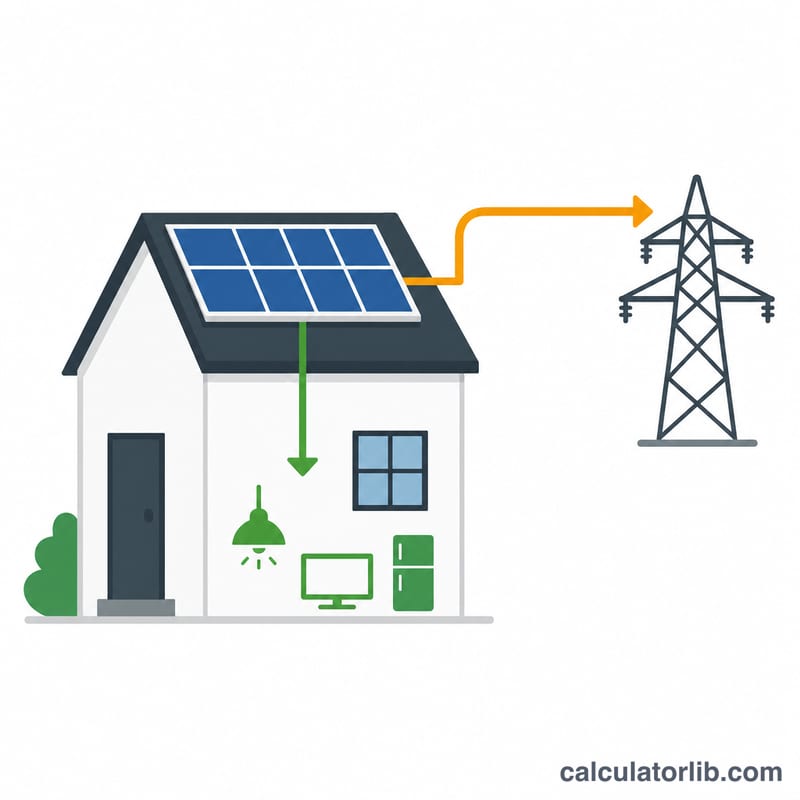
This tool applies to Japan and models a residential solar photovoltaic (PV) system under Japanese Feed-in Tariff (FIT)-style assumptions. Monetary inputs are entered in man (one man = 10,000 yen). It estimates the payback period: how many years it takes for the cumulative cash benefit of your solar system to cover its net upfront cost. The model assumes that once the buyback (FIT) period ends, all generated electricity is self-consumed (no further export sales). Figures are illustrative; tariff rules and prices change over time.
How to use it
Enter your purchase price and any subsidy (both in man), the annual generation in kWh, and how much of that is exported versus self-consumed. Set the sell unit price (FIT rate), the self-consumption value (the retail rate you avoid paying), the FIT period length, the total simulation horizon, the yearly generation degradation, and optional periodic repair settings. The calculator simulates each year's revenue and subtracts repairs, accumulating profit until it first reaches zero.
The formula explained
Generation degrades each year: \( \text{gen}(t) = \text{annualGeneration} \times (1 - d)^{t-1} \), where \( d = \text{degradation\%} / 100 \). During the FIT period, exported kWh earn the sell unit price and self-consumed kWh save the self-consumption unit price. After the FIT period, all generation is valued at the self-consumption price. Cumulative profit starts at minus the net cost (purchase minus subsidy, converted to yen) and adds each year's profit. Payback is the first year cumulative profit becomes non-negative, interpolated within that year for a fractional result.
$$\text{Annual Profit}_t = G_t \left( s\cdot p_{sell} + (1-s)\cdot p_{self} \right) - R_t$$$$\text{Payback Year} = \min\Big\{\, T : \textstyle\sum_{t=1}^{T}\text{Profit}_t \ge \text{Net Cost} \,\Big\}$$$$\text{where}\quad \left\{ \begin{aligned} \text{Net Cost} &= \left(\text{Price} - \text{Subsidy}\right)\times 10000 \\ G_t &= \text{Annual Gen}\left(1-\tfrac{\text{Degr.}}{100}\right)^{\text{age}} \\ s &= \dfrac{\text{Sell kWh}}{\text{Annual Gen}} \end{aligned} \right.$$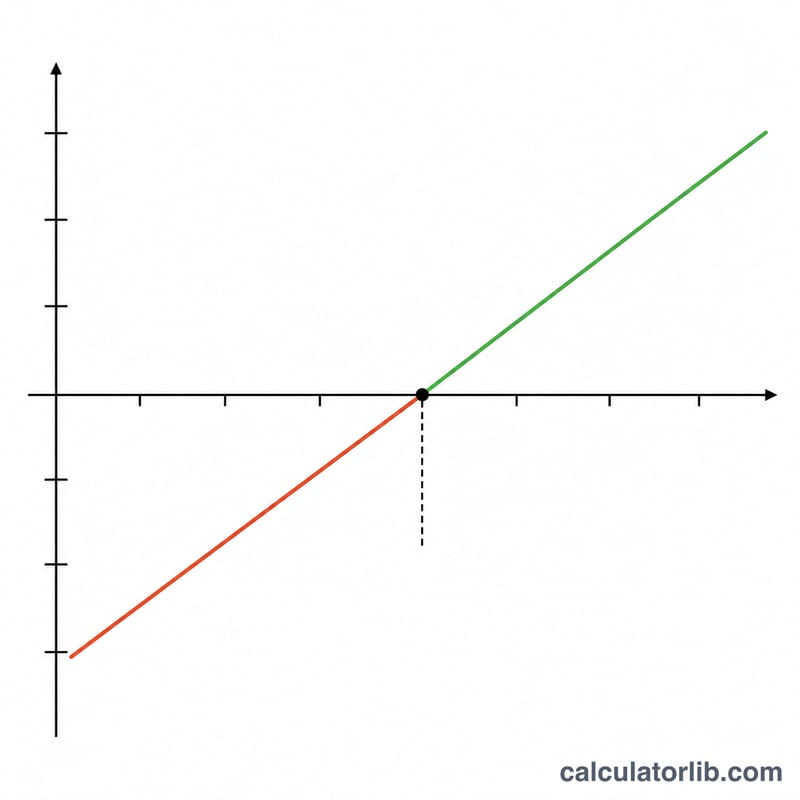
Worked example
With defaults (200 man cost, 5,000 kWh/year, 3,000 kWh sold at 26 yen, self-use 24 yen, 10-year FIT, 20-year horizon, 1% degradation, no repairs): net cost is \( 2{,}000{,}000 \) yen. FIT years 1-10 yield about \( 1{,}204{,}787 \) yen, leaving the system about \( 795{,}213 \) yen short. Self-consumption years 11+ then close the gap, with cumulative profit crossing zero partway through year 18 - roughly a 17.6-year payback - ending at about \( +242{,}492 \) yen after year 20.
FAQ
What if it never pays back? If cumulative profit stays negative through the simulation horizon, the result shows "Not recovered within the simulation period."
Why two unit prices? Exported power earns the FIT sell price, while self-consumed power is worth the retail price you avoid paying - usually different values.
How do repairs work? If you pick an interval, a repair cost is charged each interval year and the degradation recovery restores some panel performance going forward.