
What this calculator does
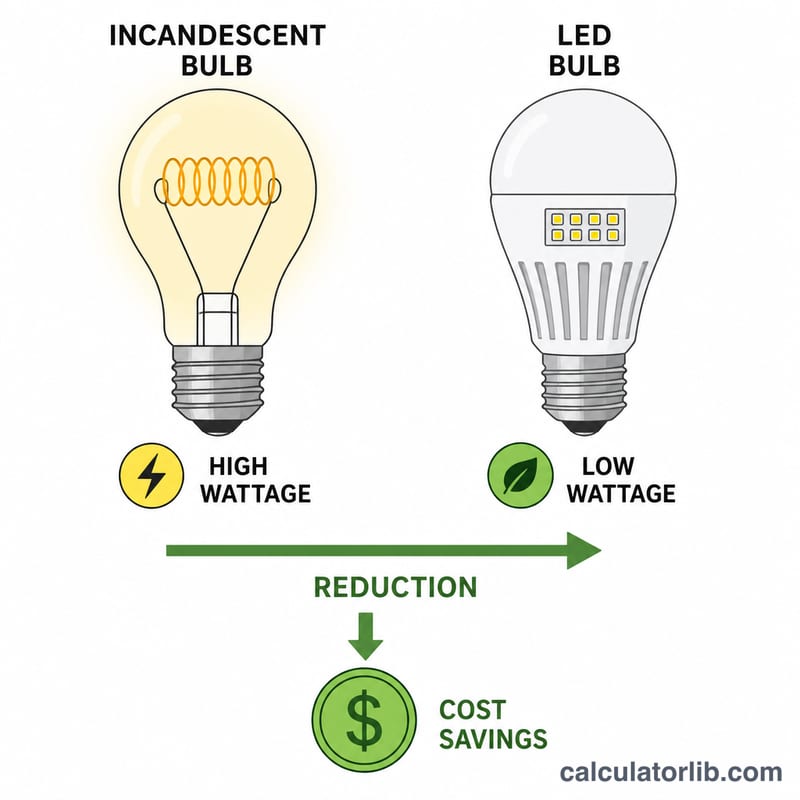
Switching from incandescent or halogen bulbs to LEDs cuts electricity use dramatically, but LEDs cost more upfront. This calculator tells you how many years it takes for the energy savings to repay that extra cost — the payback period — plus the annual energy and dollar savings and your net savings over ten years.
How to use it
Enter the wattage of your old bulb, the wattage of the replacement LED, how many hours per day the light runs, your electricity rate in dollars per kilowatt-hour, and the extra amount the LED costs compared with the bulb it replaces. Press calculate to see the payback period instantly.
The formula explained
The power saved is the wattage difference divided by 1000 to convert watts to kilowatts. Multiply by daily hours and 365 to get annual kilowatt-hours saved, then multiply by your rate for annual dollar savings:
$$\text{Annual savings} = \frac{W_{\text{old}} - W_{\text{new}}}{1000} \times \text{hrs/day} \times 365 \times \text{rate}$$
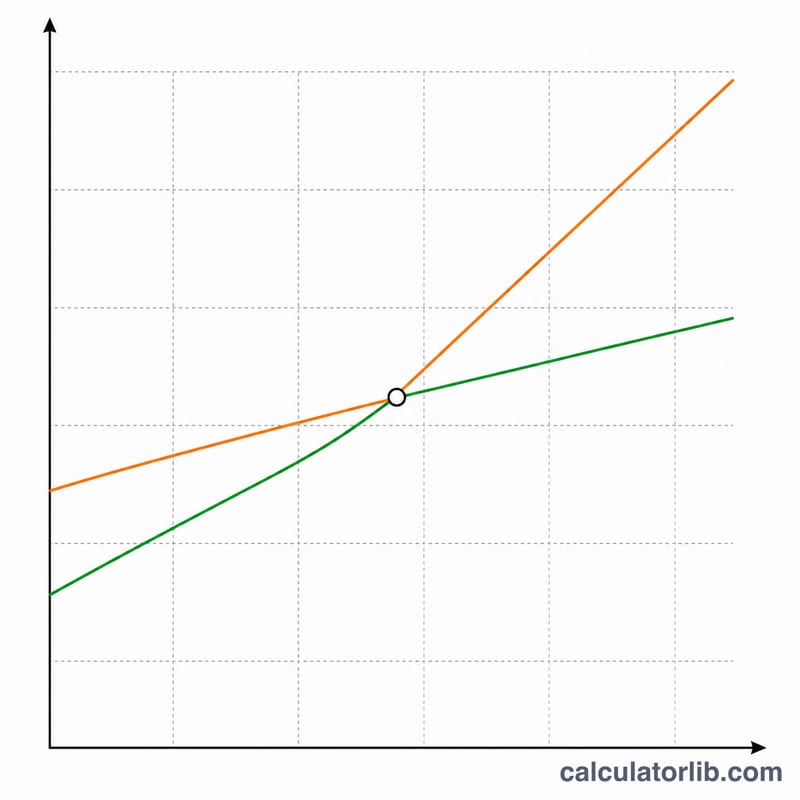
Payback simply divides the extra cost by those annual savings: $$\text{Payback} = \frac{\text{Extra cost}}{\text{Annual savings}}$$.
Worked example
Replace a 60 W incandescent with a 9 W LED, used 5 hours a day at $0.15/kWh, with the LED costing $2 more. Power saved = \(\frac{60-9}{1000} = 0.051 \text{ kW}\). Annual kWh = \(0.051 \times 5 \times 365 = 93.075 \text{ kWh}\). Annual savings = \(93.075 \times \$0.15 = \$13.96\). Payback = \(\frac{\$2}{\$13.96} \approx 0.14\) years — about 7 weeks.
FAQ
Does this include bulb lifespan? No — it focuses on energy payback. LEDs typically last far longer, adding extra savings on replacements not counted here.
What rate should I use? Use your utility bill's price per kWh. Many US homes pay $0.12–$0.20/kWh.
What if savings are zero? If the new bulb uses the same or more power, there are no energy savings and payback is not meaningful.