
What This Calculator Does
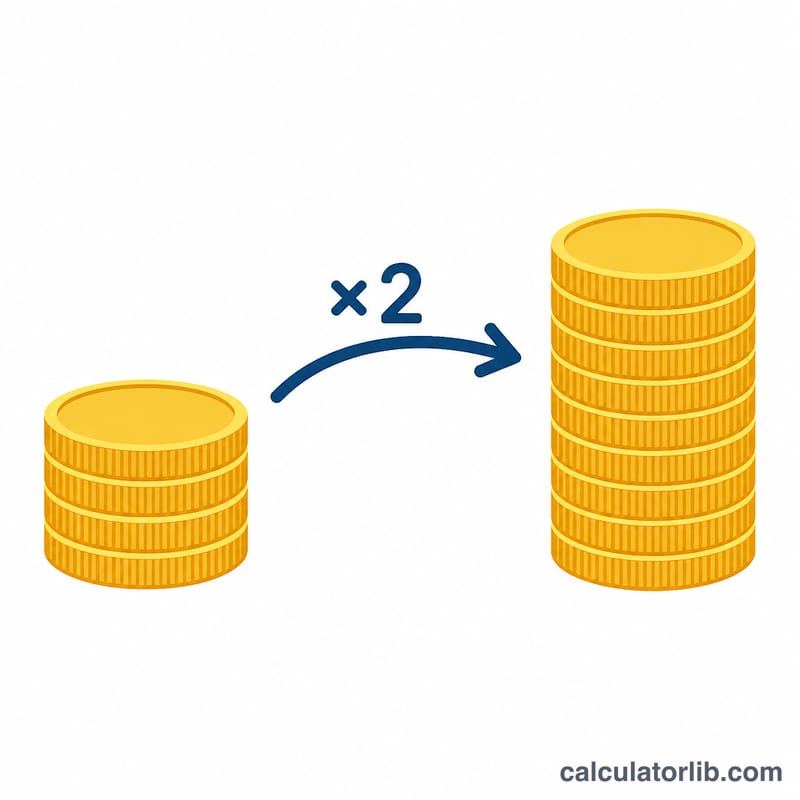
The Time to Double Your Deposit Calculator tells you exactly how many years it takes for a sum of money to grow to twice its original value, given a fixed annual interest rate and a compounding frequency. Unlike the popular "Rule of 72" shortcut, this tool uses the exact compound-interest equation, so the answer is precise for any rate and any compounding schedule.
How to Use It
Enter the annual interest rate as a percentage (for example, 5 for 5%), then choose how often interest is compounded — annually, semi-annually, quarterly, monthly, or daily. The calculator returns the doubling time in both years and months. The starting deposit amount is irrelevant: doubling time depends only on the rate and compounding frequency.
The Formula Explained
The exact doubling time is $$t = \dfrac{\ln 2}{n \cdot \ln\!\left(1 + \dfrac{r/n}{1}\right)}$$ where \(r\) is the annual rate as a decimal, \(n\) is the number of compounding periods per year, and \(\ln\) is the natural logarithm. The numerator \(\ln(2) \approx 0.6931\) reflects the goal of growing by a factor of two. The denominator measures the natural-log growth contributed by each year of compounding.
Worked Example
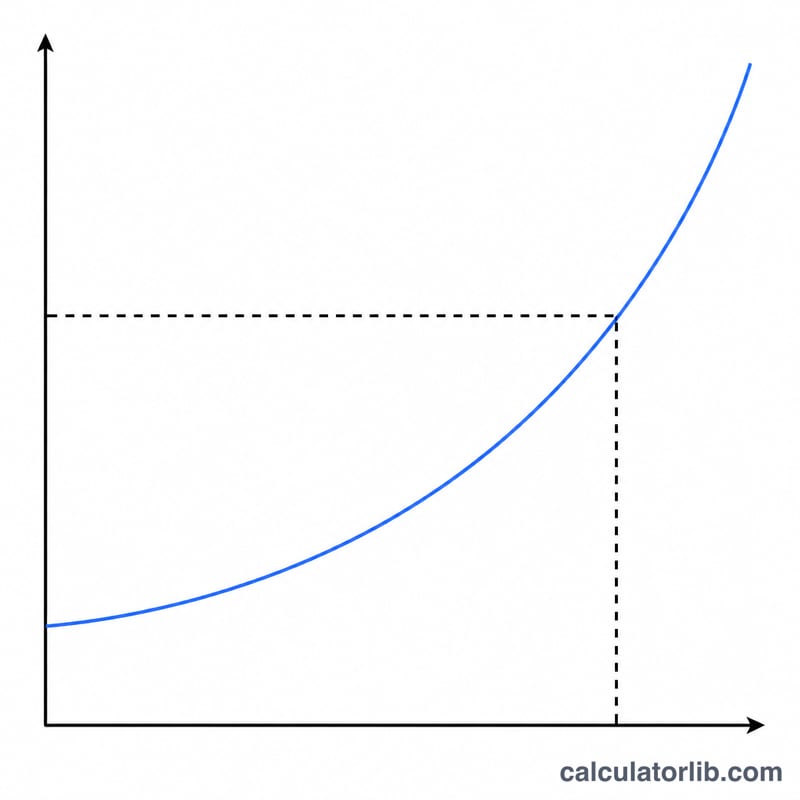
Suppose you deposit money at 6% annual interest compounded monthly. Here \(r = 0.06\) and \(n = 12\). Then \(1 + r/n = 1.005\), \(\ln(1.005) \approx 0.0049875\), and \(12 \times 0.0049875 \approx 0.059850\). Dividing \(\ln(2) \approx 0.693147\) by \(0.059850\) gives about \(11.58\) years — roughly 139 months for your deposit to double.
FAQ
Is this the same as the Rule of 72? No. The Rule of 72 is an approximation (\(72 \div \text{rate}\)). This calculator gives the mathematically exact figure.
Does the deposit size matter? No. Doubling time is independent of the principal — it depends only on the rate and compounding frequency.
What if the rate is 0%? Money never doubles at 0% interest, so the calculator returns zero. Enter a positive rate for a meaningful result.