What This Calculator Does
The Eating Out vs Cooking at Home Savings Calculator shows how much money you can keep in your pocket by preparing meals yourself instead of dining out or ordering takeout. It compares the average price of a restaurant meal with what the same meal costs to cook at home, then multiplies the difference by how often you eat that meal in a month.
How to Use It
Enter three numbers: the average cost of one meal when eating out, the average cost of cooking that meal at home (ingredients per serving), and how many such meals you have in a typical month. The calculator instantly returns your savings per meal, per month, and projected over a full year.
The Formula Explained
The math is simple: $$\text{Monthly Savings} = \left(\text{Restaurant Cost} - \text{Home Cost}\right) \times \text{Meals per Month}$$ The term in parentheses is your savings per meal. Multiply by the number of meals to get a monthly figure, then by 12 for an annual estimate. If the home cost is higher than the restaurant cost (rare, but possible for cheap fast food), the result will be negative — meaning eating out is actually cheaper.
Worked Example
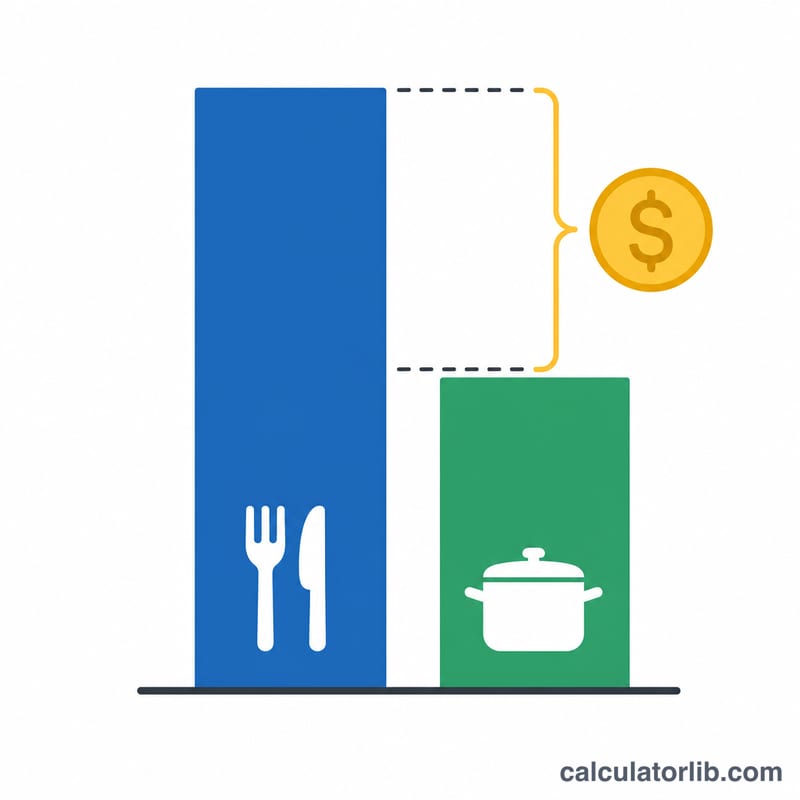
Suppose a restaurant lunch costs $15, while cooking the same lunch at home costs $5 per serving, and you eat 20 such meals a month. Savings per meal = \(\$15 - \$5 = \$10\). Monthly savings = $$\$10 \times 20 = \$200$$ Over a year that is $$\$200 \times 12 = \$2{,}400$$ — enough for a vacation just by changing where you eat.
Savings Scenarios at Different Meal Frequencies
Each row uses the same formula: \(\text{Savings per meal} = \text{Restaurant Cost} - \text{Home Cost}\), then \(\text{Monthly Savings} = \text{Savings per meal} \times \text{Meals}\) and \(\text{Annual Savings} = \text{Monthly Savings} \times 12\). Amounts are in US dollars and are illustrative only.
| Restaurant cost / meal | Home cost / meal | Savings / meal | Meals / month | Monthly savings | Annual savings |
|---|---|---|---|---|---|
| $12 | $6 | $6 | 4 | $24 | $288 |
| $12 | $6 | $6 | 12 | $72 | $864 |
| $12 | $6 | $6 | 20 | $120 | $1,440 |
| $12 | $6 | $6 | 30 | $180 | $2,160 |
| $15 | $5 | $10 | 4 | $40 | $480 |
| $15 | $5 | $10 | 12 | $120 | $1,440 |
| $15 | $5 | $10 | 20 | $200 | $2,400 |
| $15 | $5 | $10 | 30 | $300 | $3,600 |
| $20 | $4 | $16 | 4 | $64 | $768 |
| $20 | $4 | $16 | 12 | $192 | $2,304 |
| $20 | $4 | $16 | 20 | $320 | $3,840 |
| $20 | $4 | $16 | 30 | $480 | $5,760 |
Worked example: at $15 per restaurant meal and $5 per home meal, 12 meals a month gives \((15 - 5) \times 12 = 120\) dollars per month, and \(120 \times 12 = 1{,}440\) dollars per year.
Interpreting Your Savings Result
Positive result. If the restaurant cost per meal is higher than the home cost, the result is positive. This means that, on direct food costs alone, replacing those meals with home-cooked ones would leave you with that much more money. The gap grows in proportion to the number of meals you replace.
Near-zero result. If the two costs are almost equal, for example an inexpensive takeaway meal compared with a home meal built from premium ingredients, the savings are close to zero. In that case, cost is not a strong reason to choose one over the other, and factors such as nutrition, taste or schedule may matter more.
Negative result. If the home cost per meal is higher than the restaurant cost, the result is negative. This can happen when cooking for one person leads to ingredients going unused, when specialty ingredients are expensive, or when a restaurant offers a low-priced deal. A negative number means that eating out is cheaper for that meal on direct costs.
What the result leaves out. The calculation covers direct per-meal costs only. It does not include the value of your time for shopping, cooking and cleaning, food that is thrown away, kitchen equipment and energy, delivery fees, service charges and tips (unless you add them to the restaurant cost), or the convenience and social value of eating out. Including these figures in your inputs will give a more realistic comparison.
The result is an illustrative estimate based on the figures you enter. It is general information, not financial advice.
FAQ
Should I include drinks and tips? For the most accurate comparison, add tax, tip, and drinks into the restaurant cost figure, since those are real out-of-pocket expenses.
How do I estimate the home cost? Add up the price of ingredients for a recipe and divide by the number of servings it produces. Don't forget pantry staples used in small amounts.
Does this account for my time? No — it only compares direct money cost. Cooking takes time, so weigh the dollar savings against the hours spent shopping and preparing food.