
What Is the VinFast VF7 Range Calculator?
The VinFast VF7 is an electric compact SUV available in single- and dual-motor variants. This calculator estimates how far you can drive on the remaining charge by combining three values: usable battery capacity, current state of charge, and your real-world energy consumption per mile. It works for any EV, but the defaults reflect the VF7's roughly 75 kWh battery pack.
How to Use It
Enter the battery capacity in kWh (the VF7 Plus offers around 75.3 kWh usable), the current state of charge as a percentage, and your average consumption in kWh per mile. Highway driving, cold weather, and high speeds raise consumption; gentle city driving lowers it. The result is your estimated remaining range in miles.
The Formula Explained
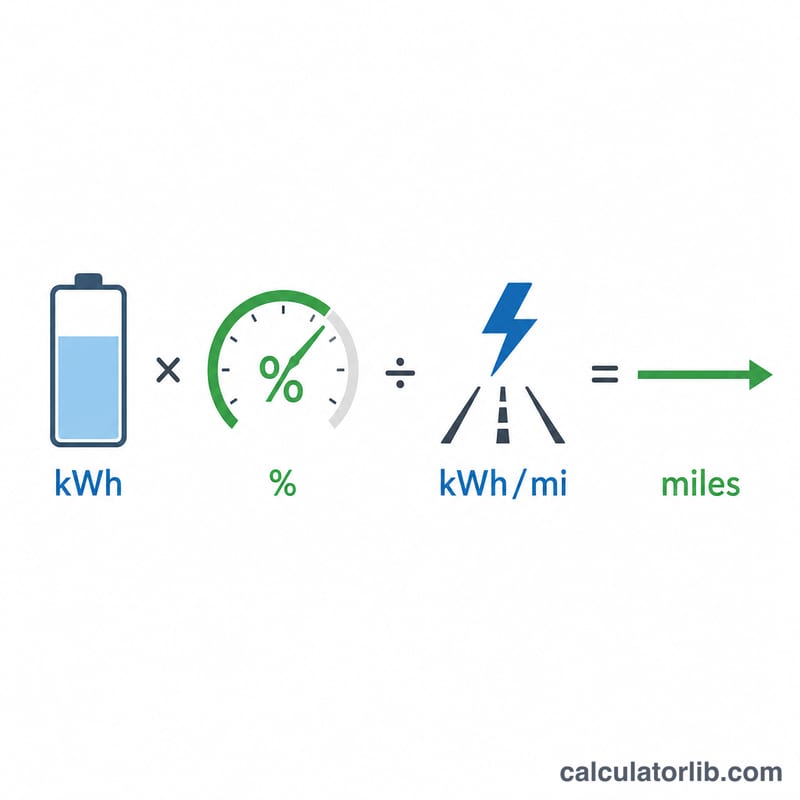
Range is simply the usable energy divided by how much energy each mile costs:
$$\text{Range} = \frac{\text{Battery (kWh)} \times \dfrac{\text{SoC (\%)}}{100}}{\text{Consumption (kWh/mi)}}$$
First we find the usable energy (battery × charge fraction), then divide by consumption. A lower kWh-per-mile figure means a more efficient drive and a longer range.
Worked Example
Suppose a VF7 has a 75.3 kWh battery at 100% charge, consuming 0.29 kWh per mile. Usable energy = \(75.3 \times 1.00 = 75.3\) kWh. Range $$= \frac{75.3}{0.29} \approx 259.7 \text{ miles}$$ At 50% charge the range would halve to about 130 miles.
FAQ
What consumption should I use? Most midsize EVs use 0.25–0.35 kWh/mile. Check your trip computer for an accurate figure.
Why is my real range lower? Cold temperatures, climate control, high speeds, and a full load all increase consumption and reduce range.
Does this use EPA or WLTP figures? Neither directly — it computes a physics-based estimate from your own inputs, so it adapts to real conditions.