What this calculator does
This tool estimates how much battery charge your VinFast EV needs before setting off on a trip. It converts your planned distance and your car's energy consumption into a percentage of the battery, then adds a safety reserve so you don't arrive on empty. It works for any electric vehicle — just plug in your own consumption and battery capacity — but the defaults are sized around typical VinFast figures.
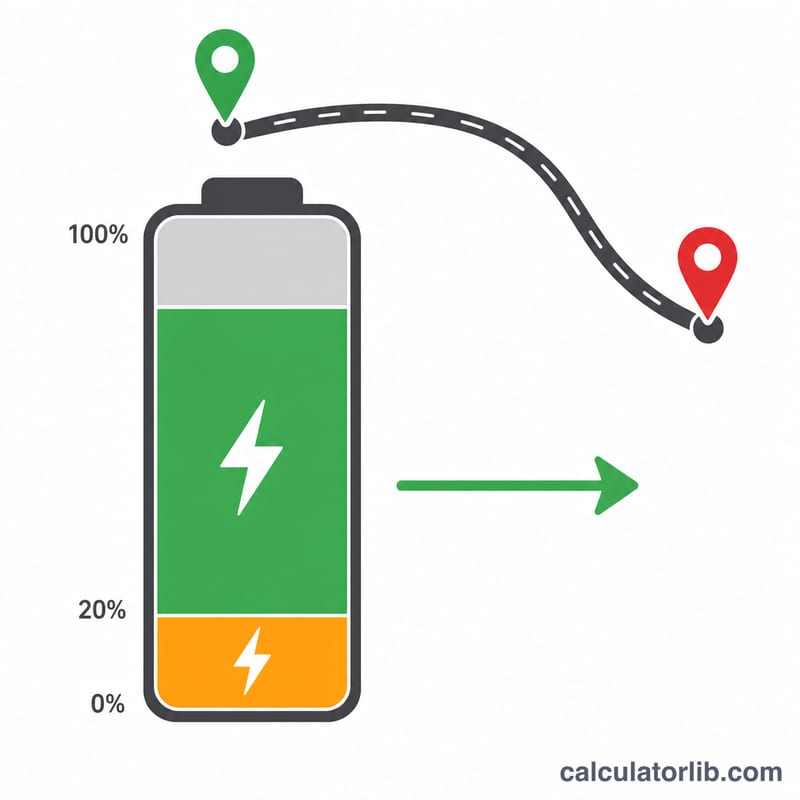
How to use it
Enter the trip distance in miles, your average consumption in kilowatt-hours per mile (commonly 0.25–0.35 kWh/mi for SUVs), your usable battery capacity in kWh, and a reserve buffer percent (10% is a sensible default). The result shows the total charge percentage you should have before departing, along with the raw energy required and whether the trip is feasible on a single charge.
The formula explained
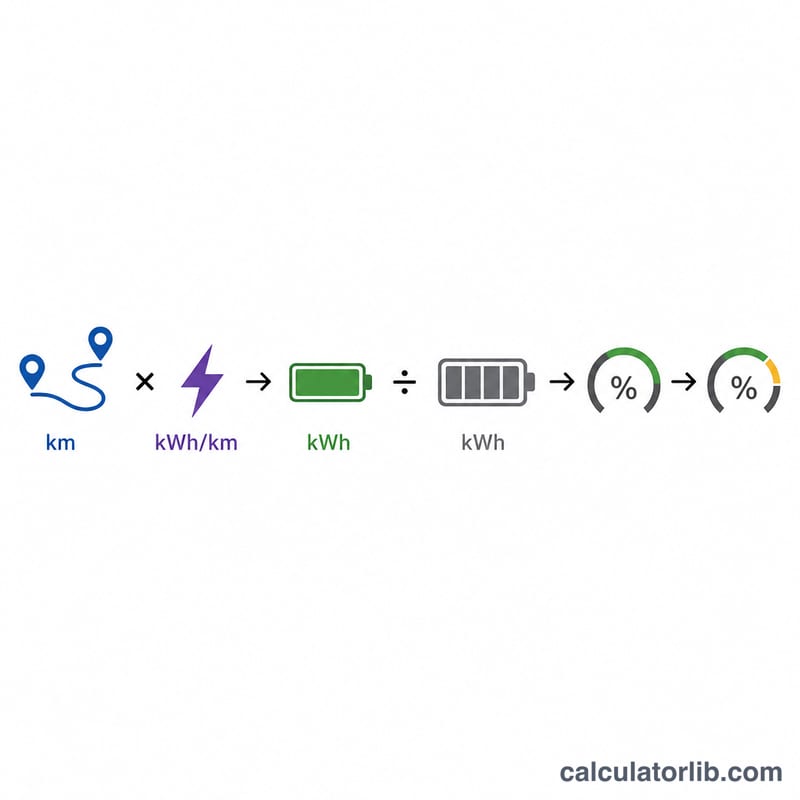
The energy a trip consumes is distance times consumption: \(E = d \times c\). Dividing that by battery capacity and multiplying by 100 gives the percentage of the pack the drive uses. Adding the reserve percent yields the charge level you should target: $$\text{Required\%} = \frac{d \times c}{B} \times 100 + r$$ If the result exceeds 100%, the trip cannot be completed without a charging stop and is capped at 100%.
Worked example
For a 150-mile trip at 0.28 kWh/mi with an 82 kWh battery and a 10% reserve: energy = \(150 \times 0.28 = 42\) kWh. Trip charge = \(42 / 82 \times 100 \approx 51.22\%\). Adding the 10% reserve gives about 61.22% — so charge to roughly 62% before leaving.
Typical Consumption and Reserve Ranges
The ranges below are general estimates for electric SUVs in the mid-size to large class. Actual consumption varies by model, tyre size, load, speed, terrain, temperature and driving style, so treat them as starting points and replace them with your own measured kWh/mi when you can.
| Driving condition | Typical consumption (kWh/mi) |
|---|---|
| City / low-speed stop-and-go | about 0.22–0.30 |
| Mixed driving | about 0.27–0.35 |
| Highway at high speed | about 0.33–0.45 |
| Cold weather with cabin heating | about 0.35–0.50 |
| Trip type | Commonly used reserve |
|---|---|
| Short, familiar urban trip with easy charging at the destination | about 10% |
| Mixed regional trip | about 10–15% |
| Long highway trip | about 15–20% |
| Cold weather, hilly terrain, or sparse charging network | about 20% or more |
A reserve covers headwinds, detours, traffic, battery degradation and the chance that a charger is out of order. Because consumption rises noticeably at higher speeds and in cold weather, use the upper end of the range when conditions are unfavourable.
Consumption Unit Conversions
Use 1 mile = 1.609344 km. To convert kWh/mi to kWh/100 km, divide by 1.609344 and multiply by 100. Efficiency expressed as distance per energy is the reciprocal of consumption: mi/kWh = 1 ÷ (kWh/mi), and km/kWh = 1.609344 ÷ (kWh/mi).
| kWh/mi | kWh/100 km | mi/kWh | km/kWh |
|---|---|---|---|
| 0.25 | 15.53 | 4.00 | 6.44 |
| 0.28 | 17.40 | 3.57 | 5.75 |
| 0.30 | 18.64 | 3.33 | 5.36 |
| 0.35 | 21.75 | 2.86 | 4.60 |
| 0.40 | 24.85 | 2.50 | 4.02 |
Worked conversion: \(\frac{0.28}{1.609344} \times 100 = 17.40\) kWh/100 km.
| Miles | Kilometres |
|---|---|
| 50 | 80.47 |
| 100 | 160.93 |
| 150 | 241.40 |
| 250 | 402.34 |
Going the other way, 100 km ≈ 62.14 mi, 200 km ≈ 124.27 mi and 300 km ≈ 186.41 mi. Keep units consistent: if you enter the trip in miles, the consumption must be in kWh per mile; if you enter kilometres, use kWh per km (kWh/100 km ÷ 100).
FAQ
What consumption value should I use? Check your trip computer's recent average. Highway driving, cold weather, and high speeds raise consumption.
Why add a reserve? A buffer accounts for detours, traffic, heating/AC, and battery uncertainty so you don't risk being stranded.
What if it says over 100%? The trip is too long for one charge at your settings — plan a charging stop along the route.