
What Is the VinFast Depreciation Calculator?
This tool estimates how much value a VinFast electric vehicle loses over time and what it might be worth when you sell it. Using the declining-balance method, it applies a fixed annual depreciation rate to the remaining value each year, giving a realistic projection of resale value. It works for any currency or vehicle, but is tuned for EV owners planning a future trade-in or private sale.
How to Use It
Enter three values: the purchase price you paid (or the MSRP), an annual depreciation rate as a percentage, and the number of years you plan to keep the car. EVs typically depreciate 10–20% per year, with newer brands sometimes higher in the first years. The calculator returns the estimated resale value, total depreciation, average yearly loss, and the percentage of value retained.
The Formula Explained
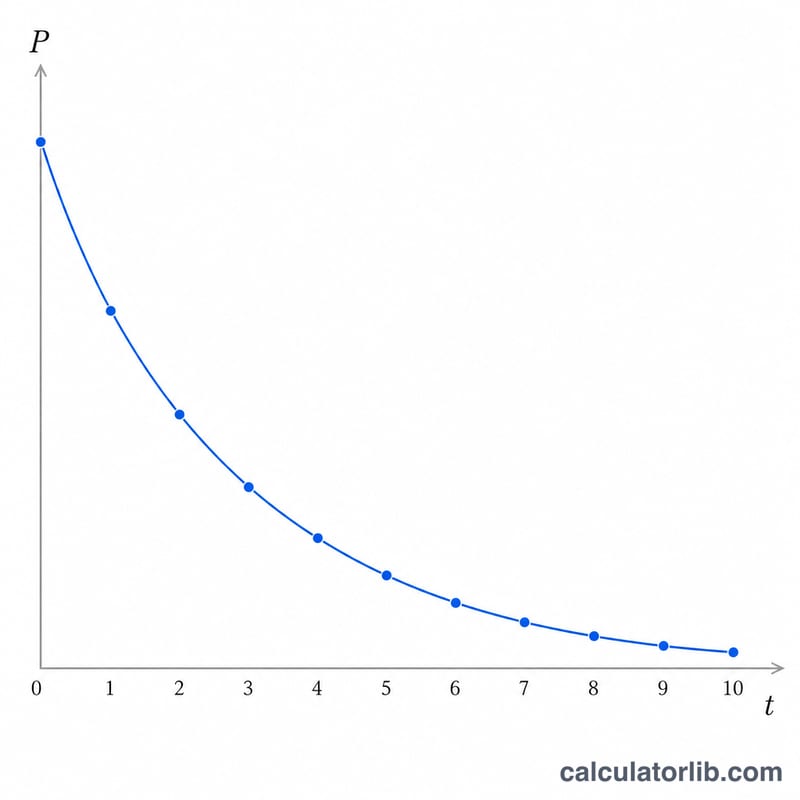
The core equation is $$\text{ResaleValue} = P \times (1 - r)^{t}$$ where \(P\) is the purchase price, \(r\) is the annual depreciation rate written as a decimal (e.g. 15% = 0.15), and \(t\) is the number of years. Because depreciation compounds on the shrinking value rather than the original price, the dollar loss is largest in the early years and tapers off later — exactly how used-car markets behave.
Worked Example
Suppose you buy a VinFast for $40,000 with an expected 15% annual depreciation, and you keep it 5 years. Then $$\text{ResaleValue} = 40{,}000 \times (1 - 0.15)^{5} = 40{,}000 \times 0.4437 \approx 17{,}748$$ Total depreciation is about $22,252, an average of roughly $4,450 lost per year, and you retain about 44.4% of the original price.
FAQ
What depreciation rate should I use? A common range for EVs is 12–20% per year; check recent resale listings for your model to refine it.
Does this include taxes or fees? No — it models the vehicle's market value only. Add registration, insurance, and charging costs separately for full ownership cost.
Is the first year worse? In reality, year-one depreciation is often steeper; this calculator assumes a constant rate for simplicity, so treat early-year figures as conservative.