
What Is Car Depreciation?
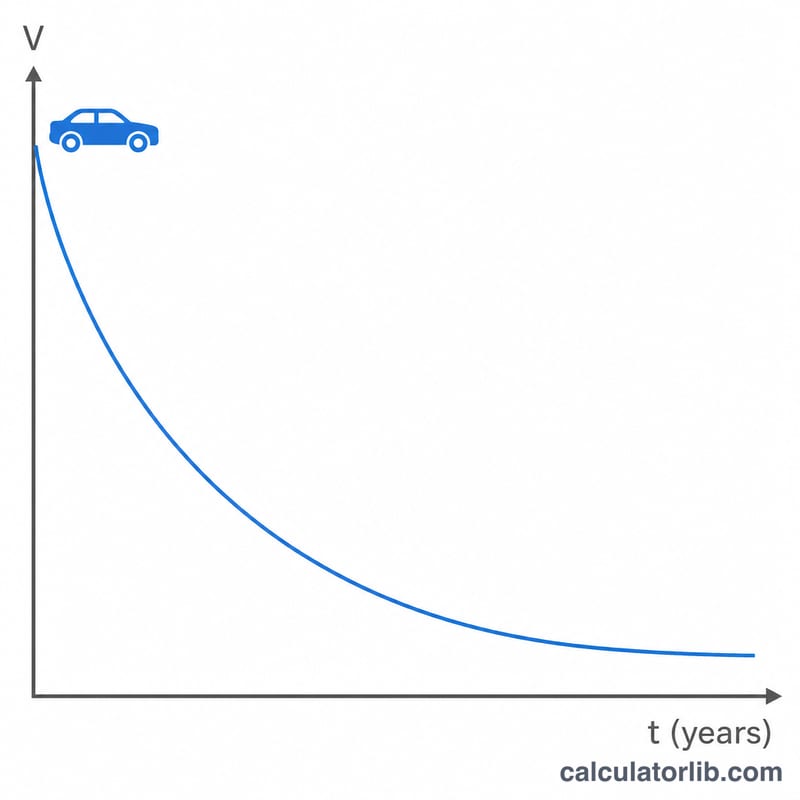
Car depreciation is the loss in a vehicle's value over time. As soon as a new car leaves the dealership it begins to lose worth, and most vehicles shed a significant portion of their value within the first several years of ownership. This calculator uses the declining-balance (reducing-balance) method, where the car loses a fixed percentage of its remaining value each year — a model that closely mirrors real-world resale curves.
How to Use This Calculator
Enter three values: the initial purchase price of the vehicle, the expected annual depreciation rate as a percentage, and the number of years you want to project. The calculator returns the estimated value at the end of the period, the total dollars lost, and the average loss per year. Typical annual depreciation rates range from 10% to 20%, with 15% being a common average for many mainstream cars.
The Formula Explained
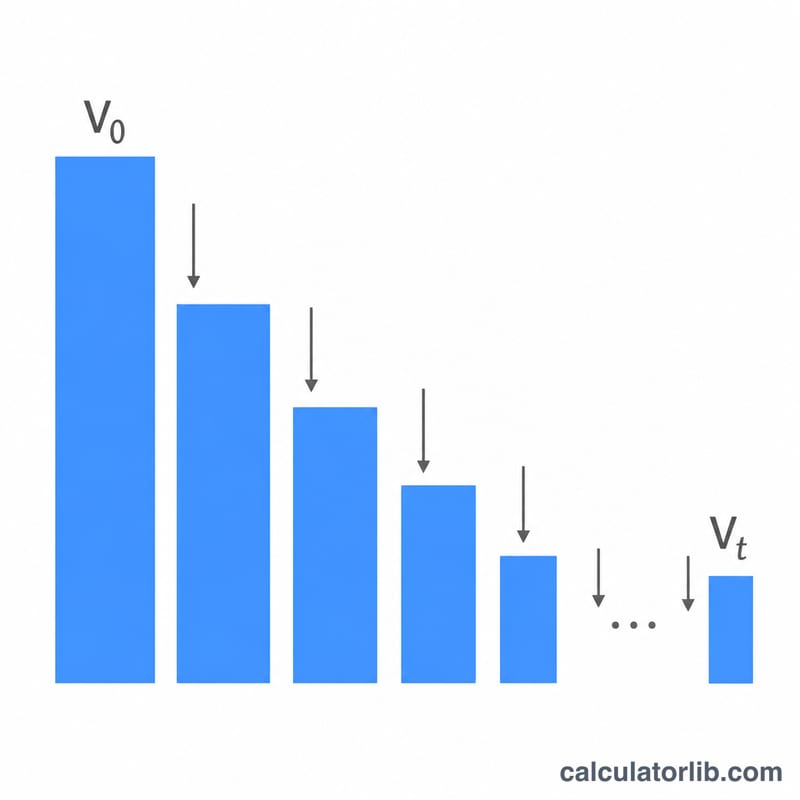
The core equation is $$V_t = V_0 \times (1 - r)^t$$ where \(V_0\) is the initial value, \(r\) is the annual depreciation rate expressed as a decimal, and \(t\) is the number of years. Because the same percentage is applied to a shrinking base each year, the dollar loss is largest early and tapers off over time.
Worked Example
Suppose you buy a car for $30,000 with a 15% annual depreciation rate and want its value after 5 years. Compute $$(1 - 0.15)^5 = 0.85^5 \approx 0.4437$$ Multiply by $30,000 to get about $13,311. That means total depreciation is roughly $16,689, or about $3,338 lost per year on average.
FAQ
Why does the loss slow down over time? Because the percentage is applied to the remaining value, not the original price, so later years subtract from a smaller base.
What rate should I use? If you don't know your model's history, 15% per year is a reasonable default; luxury and electric vehicles can depreciate faster, while some trucks and reliable models hold value better.
Is this an exact resale value? No. It's an estimate. Actual resale depends on mileage, condition, demand, and market conditions.