
What Is Appliance Depreciation?
Depreciation is the loss in value an appliance experiences as it ages and wears out. Whether you're valuing a used refrigerator for resale, settling an insurance claim, or tracking household assets, knowing the current worth of an appliance helps you make fair, informed decisions. This calculator supports the two most common methods: declining-balance (a fixed percentage each year) and straight-line (an equal dollar amount each year).
How to Use the Calculator
Pick a method. For declining balance, enter the original purchase price, how many years you've owned the item, and an annual depreciation rate (commonly 10–20% for household appliances). For straight-line, enter the price, years owned, and the appliance's useful life in years. The calculator returns the current estimated value, total value lost, the percentage of value remaining, and the first-year depreciation amount.
The Formula Explained
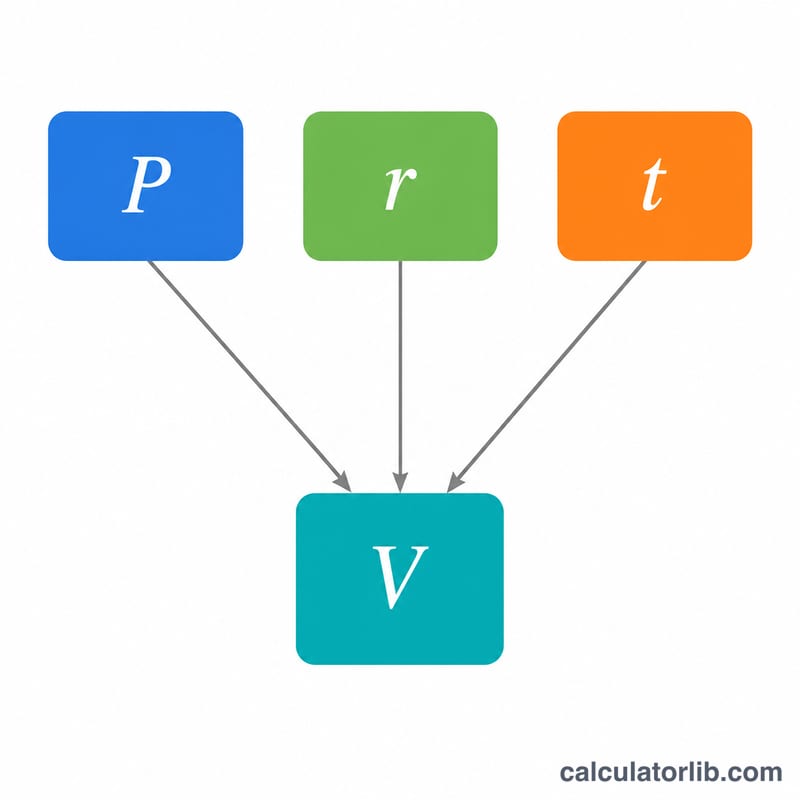
Declining balance applies the same rate to a shrinking base: $$V = P \times (1 - r)^{t}$$ where P is purchase price, r is the yearly rate (as a decimal), and t is years. Straight-line spreads the cost evenly: $$V = P - (P \div L) \times t$$ where L is the useful life. Both methods are floored at zero so value never goes negative.
Worked Example
A washing machine cost $1,200 and depreciates 15% per year using declining balance. After 3 years: $$V = 1200 \times (1 - 0.15)^{3} = 1200 \times 0.614125 = \$736.95$$ Total depreciation is $463.05, and about 61.4% of the value remains.
Typical Depreciation Rates and Useful Life by Appliance
The figures below reflect commonly published insurance, tax, and resale guidance for household appliances. The annual rate is a typical declining-balance figure (value lost each year as a percentage of the remaining value), while useful life is the average number of years the appliance is expected to remain serviceable. Actual values vary by brand, maintenance, and usage, so treat these as starting points.
| Appliance | Typical annual declining-balance rate | Typical useful life (years) |
|---|---|---|
| Refrigerator | 8%–10% | 10–14 |
| Clothes washer | 10%–12% | 8–12 |
| Clothes dryer | 10%–12% | 10–13 |
| Dishwasher | 10%–14% | 9–12 |
| Oven / range | 7%–10% | 13–15 |
| Microwave | 15%–20% | 7–10 |
| Water heater | 9%–11% | 8–12 |
| HVAC unit (central A/C) | 6%–8% | 15–20 |
As a quick check, a $1,200 refrigerator depreciated at 9% per year for 5 years retains roughly $748 of value under declining-balance.
Value Across Different Ages and Rates
The table uses a sample appliance with a purchase price of $1,000. The declining-balance columns apply \(V = 1000 \times (1 - \text{rate}/100)^{\text{years}}\). The final straight-line column assumes a 10-year useful life with zero salvage, losing $100 (10% of the original price) every year for contrast.
| Age (years) | Declining-balance 10% | Declining-balance 15% | Declining-balance 20% | Straight-line (10-yr life) |
|---|---|---|---|---|
| 1 | $900.00 | $850.00 | $800.00 | $900.00 |
| 3 | $729.00 | $614.13 | $512.00 | $700.00 |
| 5 | $590.49 | $443.71 | $327.68 | $500.00 |
| 8 | $430.47 | $272.49 | $167.77 | $200.00 |
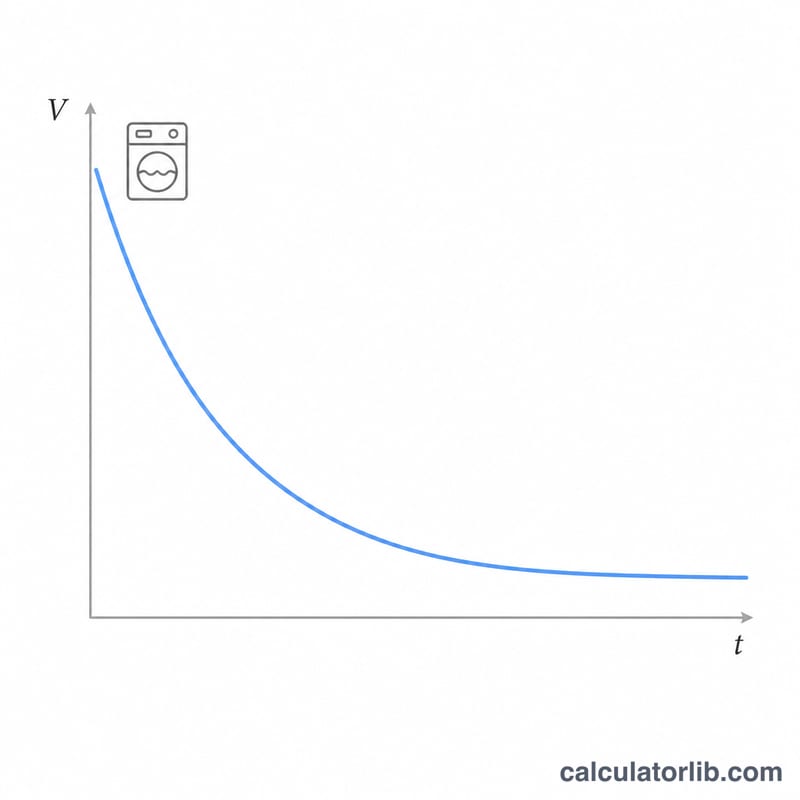
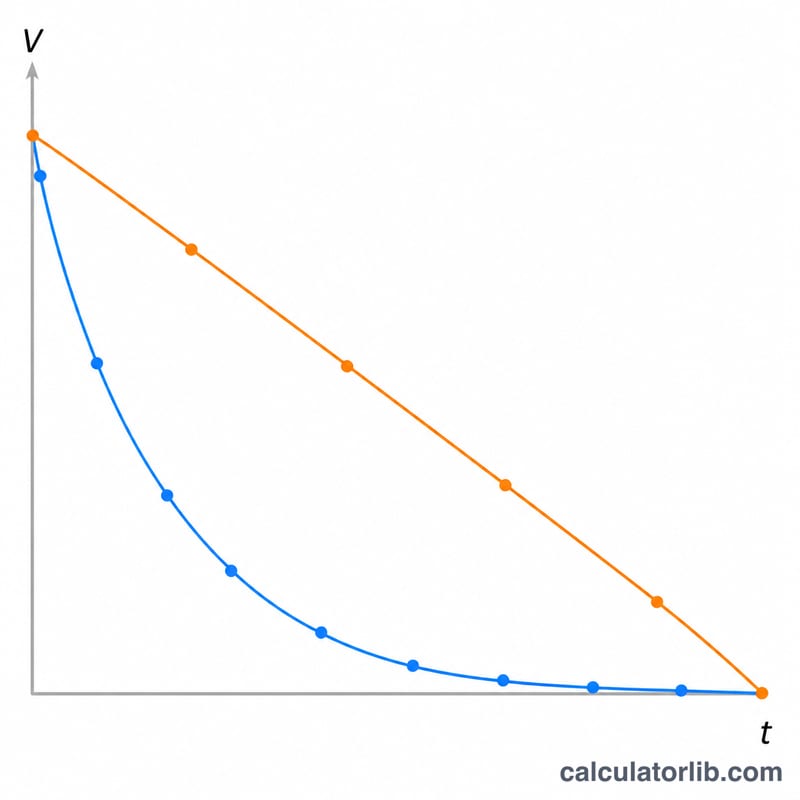
Notice that declining-balance drops fastest in the early years and then flattens, so it never quite reaches zero, while straight-line falls by a fixed amount each year and reaches zero at the end of the useful life.
Interpreting Your Estimated Value
Current value is what the calculator estimates the appliance is worth today after depreciation. Total value lost is the purchase price minus the current value — the cumulative depreciation. Percent remaining is current value divided by purchase price; for example, a current value of $590 on a $1,000 appliance means about 59% of the original value remains.
Declining-balance vs. straight-line. Declining-balance applies the rate to the shrinking remaining value, so it front-loads the loss — appliances lose the most value in their first few years, mirroring real-world resale behavior. Straight-line spreads the loss evenly across the useful life and is simpler and common for accounting or tax purposes. For the same appliance, declining-balance usually shows a lower value early on and a higher residual value late in life compared with straight-line.
This estimate is a modeling tool, not an actual market price or an insurance payout. Insurers often calculate actual cash value using their own depreciation schedules, and a buyer will pay whatever the market supports. Real value is shifted by:
- Condition — dents, wear, missing parts, and service history.
- Brand and model — premium or commercial brands hold value better than budget lines.
- Local demand — supply, season, and how quickly you need to sell.
- Energy efficiency — newer high-efficiency units command a premium; older inefficient ones discount faster.
- Remaining useful life — an appliance near the end of its expected lifespan sells for little regardless of the formula.
Use the result as a reasonable benchmark for budgeting, resale pricing, or replacement planning, then adjust up or down based on the specific item in front of you. This is general information, not professional appraisal, tax, or insurance advice.
FAQ
What rate should I use? Many appliances lose 10–20% per year; check resale listings for your specific model. Useful life for major appliances is often 8–15 years.
Which method is more accurate? Declining balance better reflects fast early-year value loss, while straight-line is simpler and common for accounting.
Does this include tax depreciation? No. This is a general value estimate, not a tax schedule like MACRS. Consult a tax professional for filings.