
What Is the Car Depreciation Calculator?
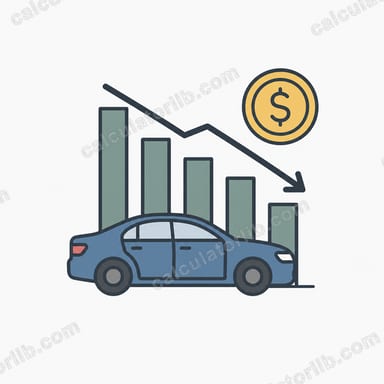
Depreciation is the loss in a vehicle's market value over time as it ages and accumulates mileage. This calculator uses the declining-balance method to estimate what your car will be worth after a number of years, how much total value it will lose, and what percentage of its original price remains. It is a universal tool that works for any currency or country — simply enter your local price.
How to Use It
Enter three values: the original purchase price, the annual depreciation rate as a percentage, and the number of years you have owned (or plan to own) the vehicle. The calculator instantly returns the estimated current value, the total depreciation, the average annual loss, and the share of the original price that remains.
The Formula Explained
The estimate uses compounding (declining-balance) depreciation:
$$\text{Value} = \text{Price} \times (1 - r)^{\text{years}}$$
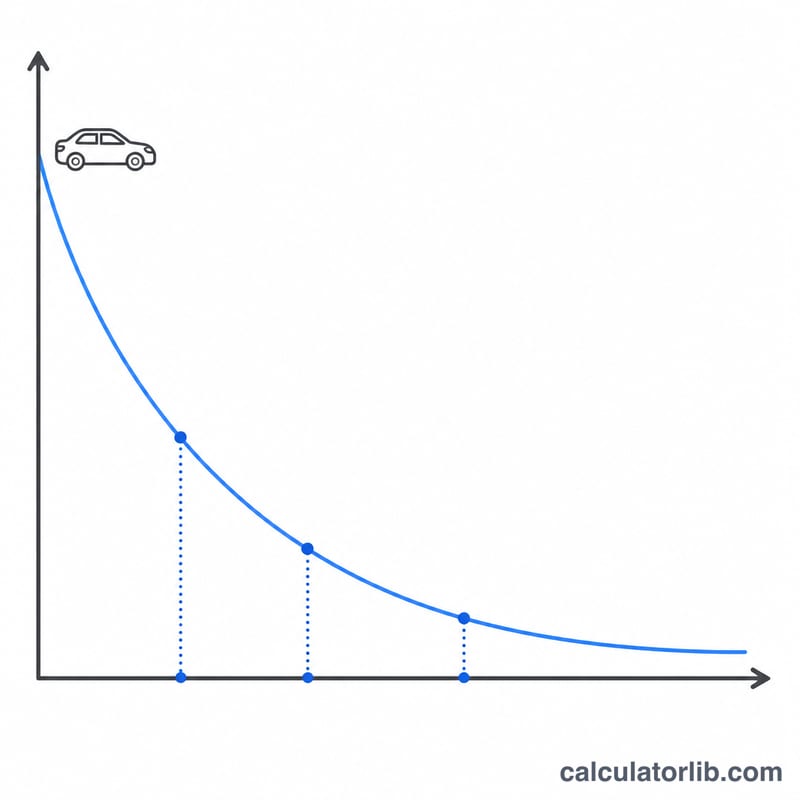
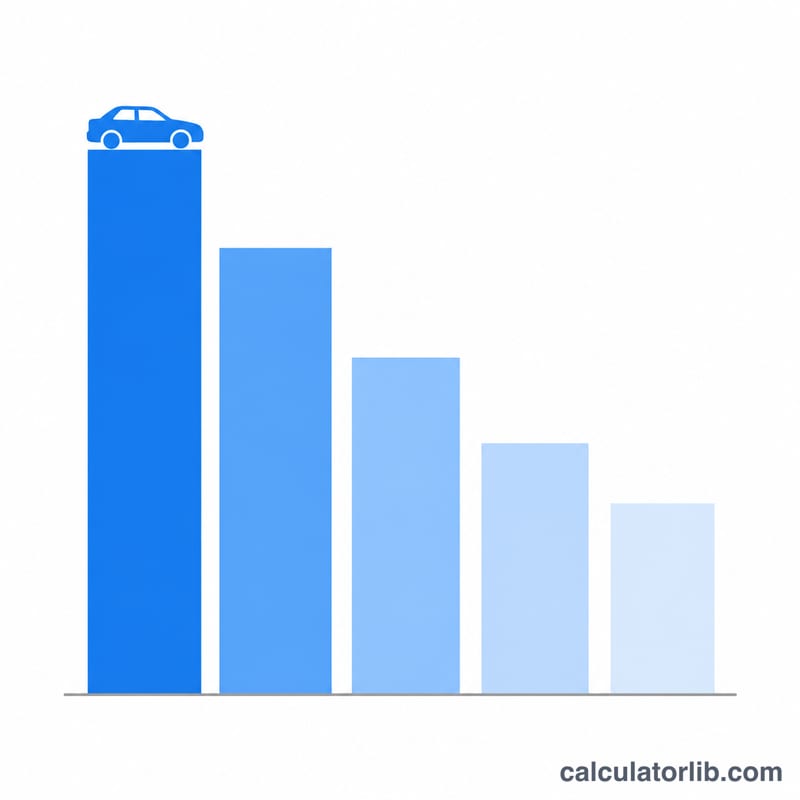
where r is the annual depreciation rate expressed as a decimal (e.g. 15% = 0.15). Each year the car loses a fixed percentage of its remaining value rather than a fixed dollar amount, which closely mirrors how real-world vehicle values fall fastest early on and flatten later.
Worked Example
Suppose you buy a car for $30,000 with a 15% annual depreciation rate and keep it for 5 years. Then $$\text{Value} = 30{,}000 \times (1 - 0.15)^{5} = 30{,}000 \times 0.4437 \approx \mathbf{\$13{,}311.16}.$$ The total depreciation is about $16,688.84, and roughly 44.4% of the original value remains.
FAQ
What depreciation rate should I use? Many cars lose 15–20% per year, with the steepest drop in the first year. Check your make and model's resale history for a more accurate figure.
Why use compounding instead of straight-line? Compounding (declining balance) better reflects actual used-car markets, where value falls quickly at first and then more slowly.
Is this an exact resale value? No. It is an estimate. Actual value depends on mileage, condition, demand, and market conditions.