What Is the Molarity to PPM Calculator?
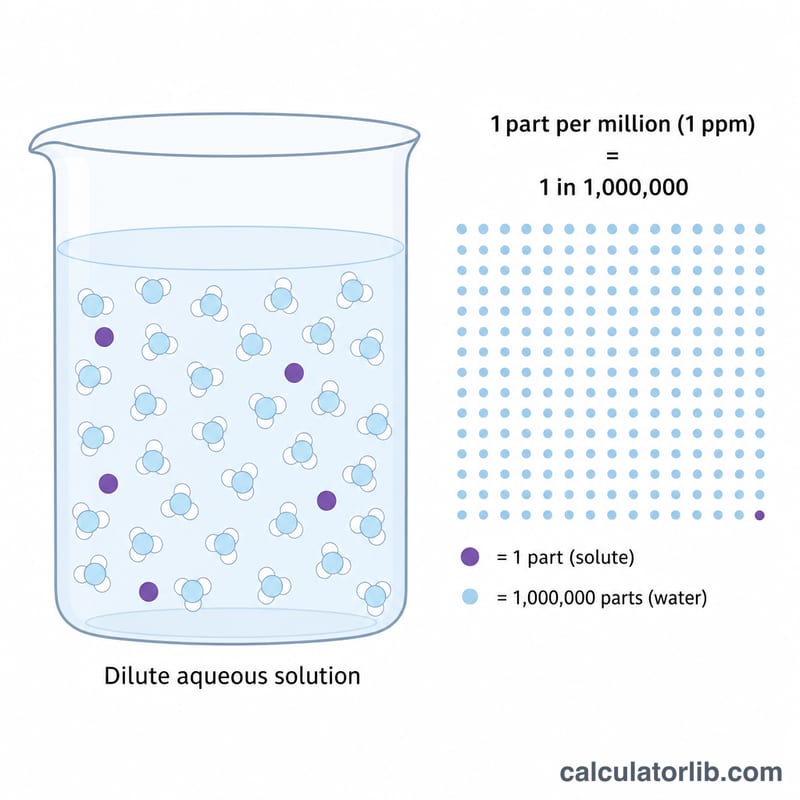
This tool converts a solution's molarity (moles per liter, mol/L) into parts per million (ppm). Molarity describes the number of moles of solute per liter, while ppm expresses concentration as milligrams of solute per liter of solution. Because chemists and lab technicians frequently switch between these units, a quick converter saves time and reduces errors.
How to Use It
Enter the molarity of your solution in mol/L and the molar mass (molecular weight) of the solute in g/mol. The calculator returns the equivalent concentration in ppm. For dilute aqueous solutions the density is essentially that of water (\(\approx 1\ \text{g/mL}\)), so 1 mg/L is treated as 1 ppm.
The Formula Explained
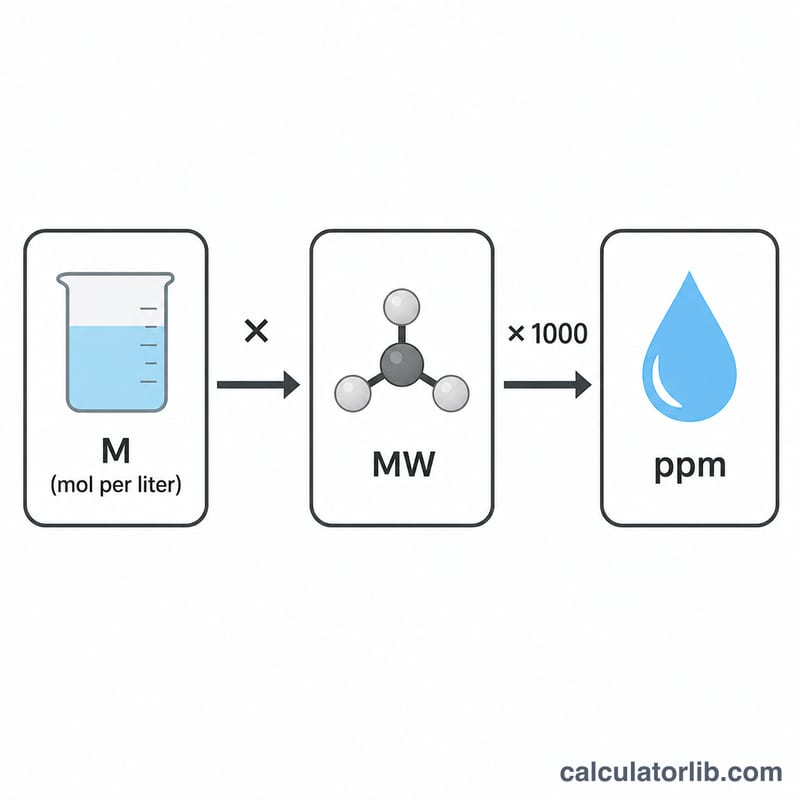
The conversion is $$\text{ppm} = M \times \text{MW} \times 1000$$ Multiplying molarity (mol/L) by molar mass (g/mol) gives grams per liter (g/L). Multiplying by 1000 converts grams to milligrams, yielding mg/L, which equals ppm for dilute aqueous solutions where density \(\approx 1\ \text{g/mL}\).
Worked Example
Consider a 0.1 mol/L solution of sodium chloride (NaCl), whose molar mass is 58.44 g/mol. Then $$\text{ppm} = 0.1 \times 58.44 \times 1000 = 5844\ \text{ppm}$$ So the solution contains about 5,844 mg of NaCl per liter.
Molar Masses of Common Solutes
Use these molar masses (rounded to two decimals) in the formula \(\text{ppm} = M \times MW \times 1000\), where ppm means mg/L for a dilute aqueous solution. Because 1 mmol/L × MW g/mol = MW mg/L, the ppm produced by 1 mM of a solute is numerically equal to its molar mass. To scale, multiply the last column by the millimolar concentration.
| Solute | Formula | Molar mass (g/mol) | ppm (mg/L) at 1 mmol/L |
|---|---|---|---|
| Sodium chloride | NaCl | 58.44 | 58.44 |
| Potassium chloride | KCl | 74.55 | 74.55 |
| Calcium chloride | CaCl2 | 110.98 | 110.98 |
| Sodium hydroxide | NaOH | 40.00 | 40.00 |
| Hydrogen chloride | HCl | 36.46 | 36.46 |
| Sulfuric acid | H2SO4 | 98.08 | 98.08 |
| Sodium bicarbonate | NaHCO3 | 84.01 | 84.01 |
| Calcium carbonate | CaCO3 | 100.09 | 100.09 |
| Glucose | C6H12O6 | 180.16 | 180.16 |
| Potassium nitrate | KNO3 | 101.10 | 101.10 |
| Magnesium sulfate (anhydrous) | MgSO4 | 120.37 | 120.37 |
| Ammonia | NH3 | 17.03 | 17.03 |
Example: 2.5 mM KCl is 2.5 × 74.55 = 186.4 ppm (rounded). Note that the ppm refers to the whole compound; if you want ppm of one ion (e.g. Cl− alone), use that ion's molar mass instead. Hydrated salts (such as MgSO4·7H2O) have a larger molar mass than the anhydrous values listed here.
Interpreting Your PPM Result and Limits of Validity
The calculator returns mg of solute per litre of solution. This equals ppm by mass (mg of solute per kg of solution) only when the solution density is about 1 g/mL, which is a good approximation for dilute aqueous solutions, roughly below 1,000–5,000 ppm. In that range the solution is effectively water, so 1 L weighs about 1 kg.
ppm vs mg/L vs ppm by mass
- mg/L is a mass-per-volume unit and is the value computed directly from molarity: \(\text{mg/L} = M \times MW \times 1000\).
- ppm by mass means mg of solute per kg of solution. Converting needs the solution density \(\rho\) in g/mL: \(\text{ppm}_{m} = \frac{ \text{mg/L}}{\rho}\).
- "ppm" with no qualifier in water chemistry usually means mg/L, but this is a convention, not a strict equivalence.
Example near the limit
A 0.1 mol/L NaCl solution gives 0.1 × 58.44 × 1000 = 5844 mg/L. Its density is only about 1.00 g/mL, so the ppm by mass is within a fraction of a percent of this value. As concentration rises, the density climbs: a roughly 10% by mass NaCl solution has a density of about 1.07 g/mL, and then mg/L and ppm by mass differ by about 7%. At those levels the density must be applied, and mass-based units such as % w/w or g/kg are usually clearer.
Factual context
- The US EPA secondary (non-enforceable, aesthetic) standard for total dissolved solids in drinking water is 500 mg/L. It relates to taste, hardness, and scaling, not to health effects.
- The WHO does not set a health-based guideline value for TDS; it notes that water below about 600 mg/L is generally considered to have good palatability.
- Typical open-ocean seawater has a salinity near 35 g/kg, or about 35,000 ppm by mass, with a density around 1.025 g/mL. At this level the dilute-solution assumption no longer holds.
Also remember that the calculation assumes a single, fully dissolved solute. For mixtures, strong ion interactions or very concentrated solutions, measured density data give more reliable conversions. This is general information, not professional advice.
FAQ
Does this work for non-aqueous solvents? Not directly. The 1 mg/L = 1 ppm shortcut assumes a solution density near 1 g/mL. For denser or lighter solvents you must divide mg/L by the actual density (in g/mL) to get true ppm by mass.
What is molar mass? It is the mass of one mole of a substance in grams, found by summing the atomic masses of all atoms in its chemical formula.
How do I convert ppm back to molarity? Rearrange the formula: $$M = \frac{\text{ppm}}{\text{MW} \times 1000}$$