
What is the Rideshare Fare Estimate Calculator?
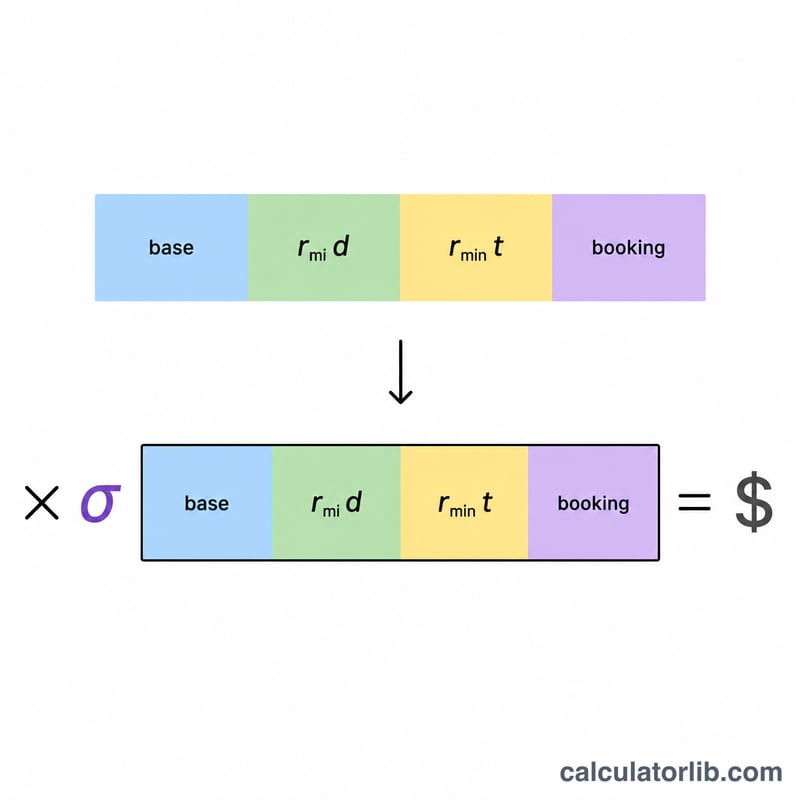
This calculator gives you a quick, transparent estimate of what an Uber, Lyft or other rideshare trip is likely to cost. Most rideshare apps build a fare from the same building blocks: a fixed base fare, a charge for every mile travelled, a charge for every minute the trip takes, a flat booking (or service) fee, and finally a surge multiplier that scales the whole thing up during busy periods. Plug in the rates for your city and the details of your trip to see a fare you can sanity-check against the app.
How to use it
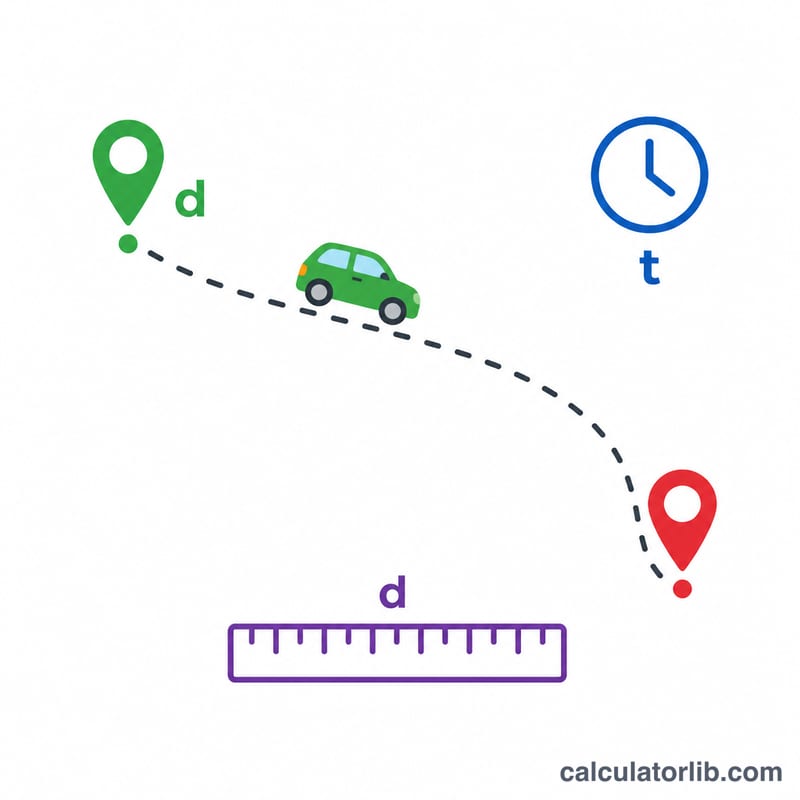
Enter the base fare and booking fee shown for your ride type, the per-mile and per-minute rates, then the expected distance and duration of your trip. Set the surge multiplier to 1.0 for normal pricing, or higher (e.g. 1.5 or 2.0) when demand is high. The result shows the total estimated fare plus a breakdown of each component.
The formula explained
The calculator computes a subtotal: Base + (per-mile × miles) + (per-minute × minutes) + booking fee. That subtotal is then multiplied by the surge factor to get the final fare. Note that the surge typically multiplies the whole metered subtotal, which is why a 2× surge roughly doubles your cost.
$$\text{Fare} = \left(\text{Base} + \text{Booking} + \text{Per Mile} \times \text{Miles} + \text{Per Min} \times \text{Minutes}\right) \times \text{Surge}$$
Worked example
Suppose the base fare is $2.55, per-mile is $1.75, per-minute is $0.35, and the booking fee is $2.30. For an 8-mile, 18-minute trip with no surge (1.0×): distance cost = \(1.75 \times 8 = \$14.00\), time cost = \(0.35 \times 18 = \$6.30\). Subtotal = \(2.55 + 14.00 + 6.30 + 2.30 = \$25.15\). With a 1.0× surge the fare stays $25.15. At 1.5× surge it becomes \(25.15 \times 1.5 = \$37.73\).
Fare Across Common Trip Scenarios
The table below runs one consistent rate set through six typical trips so you can see how distance, time and surge each move the total. The rate set used is a base fare of $2.55, a booking/service fee of $2.30, $1.75 per mile and $0.35 per minute — plausible US-market figures, but illustrative only. They are not published Uber or Lyft rates: real rates vary by city, vehicle class, time of day and currency, and the companies change them without notice. Enter your own market's rates in the calculator for a meaningful number.
Each row is computed as:
$$\text{Total} = \left(\text{Base} + \text{Booking} + \text{Per Mile} \times \text{Miles} + \text{Per Min} \times \text{Minutes}\right) \times \text{Surge}$$| Scenario | Distance (mi) | Duration (min) | Surge | Distance charge | Time charge | Subtotal (before surge) | Total fare |
|---|---|---|---|---|---|---|---|
| Short city hop | 2 | 8 | 1.0× | $3.50 | $2.80 | $11.15 | $11.15 |
| Standard cross-town trip | 8 | 18 | 1.0× | $14.00 | $6.30 | $25.15 | $25.15 |
| Same trip in heavy traffic | 8 | 30 | 1.0× | $14.00 | $10.50 | $29.35 | $29.35 |
| Airport run | 15 | 25 | 1.0× | $26.25 | $8.75 | $39.85 | $39.85 |
| Cross-town trip at moderate surge | 8 | 18 | 1.5× | $14.00 | $6.30 | $25.15 | $37.73 |
| Cross-town trip at high surge | 8 | 18 | 2.0× | $14.00 | $6.30 | $25.15 | $50.30 |
Worked check on the heavy-traffic row, with every term substituted:
$$\left(2.55 + 2.30 + 1.75 \times 8 + 0.35 \times 30\right) \times 1.0 = \left(2.55 + 2.30 + 14.00 + 10.50\right) = 29.35$$Two readings stand out. First, adding 12 minutes of congestion to the same 8-mile route adds $4.20 — about 17% — while the distance charge does not move at all. Second, surge multiplies the entire subtotal, fees included, so the 2.0× row costs $25.15 more than the identical unsurged trip. None of these totals include tolls, airport surcharges, local taxes or a tip.
Key Rideshare Fare Terms Defined
Rideshare pricing vocabulary differs between apps and countries. The list below gives the common meaning of each term and states plainly whether this calculator takes it as an input or leaves it out.
| Term | What it means | In this calculator? |
|---|---|---|
| Base fare | A fixed amount charged for starting the trip, independent of how far or how long you travel. | Input — the base field. |
| Per-mile (or per-kilometre) rate | The distance component, charged for each unit of the route actually driven — not straight-line distance. | Input — permile × miles. Enter a per-km rate and kilometres instead if that is how your market quotes it. |
| Per-minute rate | The time component, accruing for every minute the trip is in progress, including time stopped in traffic or at lights. | Input — permin × minutes. |
| Booking fee / service fee | A flat per-trip platform charge, sometimes itemised separately from the fare on the receipt. Names vary by region and regulator. | Input — the booking field. |
| Surge multiplier / "Prime Time" | A dynamic uplift applied when requests outnumber available drivers. "Prime Time" is Lyft's term; Uber has used both a multiplier and a flat added amount depending on market and era. | Input — the surge field, applied as a multiplier to the whole subtotal. Enter 1 for no surge. |
| Minimum fare | A floor: if the metered calculation falls below it, you are charged the floor instead. It mainly affects very short trips. | Not modelled. Compare the result against your market's minimum yourself. |
| Upfront (fixed) pricing | A price shown and locked before you book, derived from the predicted route and duration rather than from the meter as it runs. | Not modelled. This tool computes the metered form; see the interpretation section. |
| Metered fare | A fare assembled after the trip from actual distance and time — the model this calculator reproduces. | This is the model used. |
| Long-pickup fee | Compensation when the driver must travel an unusually long distance or time to reach you. | Not modelled. |
| Wait-time fee | A per-minute charge that starts after a short free window once the driver arrives at the pickup point. | Not modelled. |
| Airport surcharge | A fee airports levy on commercial pickups and drop-offs, passed through to the rider. Amount and rules are set by each individual airport. | Not modelled. Add it to the result manually. |
| Tolls, congestion charges and local taxes | Road tolls, city congestion or cordon charges, and sales/VAT-type taxes on the ride, all governed by local law. | Not modelled. These are jurisdiction-specific and vary widely. |
| Driver tip | A voluntary payment to the driver, added in-app or in cash. Customary amounts differ sharply by country. | Not modelled. Budget for it separately where tipping is the norm. |
| Cancellation fee | Charged if you cancel after a grace period, or if the driver waits past a set limit. | Not modelled. |
Interpreting Your Estimated Fare
The number is an estimate from a metered model, not a quote. It tells you what a trip should cost if the platform assembled the price from a base fare, a booking fee, a per-mile rate, a per-minute rate and a surge multiplier. In most markets Uber and Lyft instead show upfront pricing: a fixed price computed before you book from the predicted route, predicted duration and current demand. Because the prediction is made in advance and the platform absorbs the difference, the price you are shown can sit above or below a clean metered calculation for the same trip.
What the estimate leaves out
The total covers only the five rate components you entered. It does not include tolls or congestion charges, airport surcharges, local taxes, driver tips, wait-time fees, long-pickup fees or cancellation fees. On an airport run those extras can add a meaningful amount on top — so treat the result as a floor for that kind of trip, not a ceiling.
Two further mismatches are worth knowing. A minimum fare can override a low result: if your market's minimum is, say, $9 and the calculator returns $7.40 for a very short hop, you will be charged the minimum. And in some markets surge is applied as a flat added amount ("+$4.50") rather than as a multiplier — where that is the case, leave surge at 1 and add the flat amount to the result yourself instead of multiplying.
Reading the component breakdown
The split between the distance charge and the time charge tells you how fragile the estimate is:
- Distance-dominant fares are stable. A highway trip where the per-mile charge is most of the fare will land close to the estimate, because the route length is known in advance and barely varies.
- Time-dominant fares carry traffic risk. When the per-minute charge is a large share of the subtotal, your fare is effectively a bet on traffic. In the scenario table, the same 8-mile route costs $25.15 at 18 minutes and $29.35 at 30 minutes — the entire difference is time. On dense-city trips at rush hour, build in a buffer by entering a pessimistic minute count.
- Surge scales everything. Because the multiplier applies to the full subtotal, a 2.0× reading doubles the fees as well as the fare. Waiting 10–15 minutes for a multiplier to fall is often the single largest saving available.
How close should you expect it to be?
For an uncongested, non-surge trip in a market whose published per-mile and per-minute rates you have entered accurately, a metered estimate typically lands within a few dollars of the app's price. Accuracy degrades quickly when surge is active, when the route is congestion-prone, when airport or toll charges apply, or when you are guessing at the rate card rather than reading it from a recent receipt. The most reliable way to calibrate this tool is to take an old receipt, work backwards to the rates your city actually charges, and use those figures from then on.
These figures and examples are general information for budgeting purposes only, not a price quote or financial advice. Rates, fees and taxes are set by the platforms and by local authorities and change frequently; always confirm the price in the app before you ride.
FAQ
Is this exact? No — it's an estimate. Real apps may round, apply minimum fares, tolls, taxes, airport fees or promotions that this tool doesn't model.
Where do I find the rates? Rates vary by city and ride type. Some are published locally; otherwise compare a few real quotes to back-calculate them.
Does surge apply to the booking fee? In this model the surge multiplies the full subtotal including the booking fee, which matches how many markets price it. Adjust inputs if your market differs.