
What is the PPM to Percent Calculator?
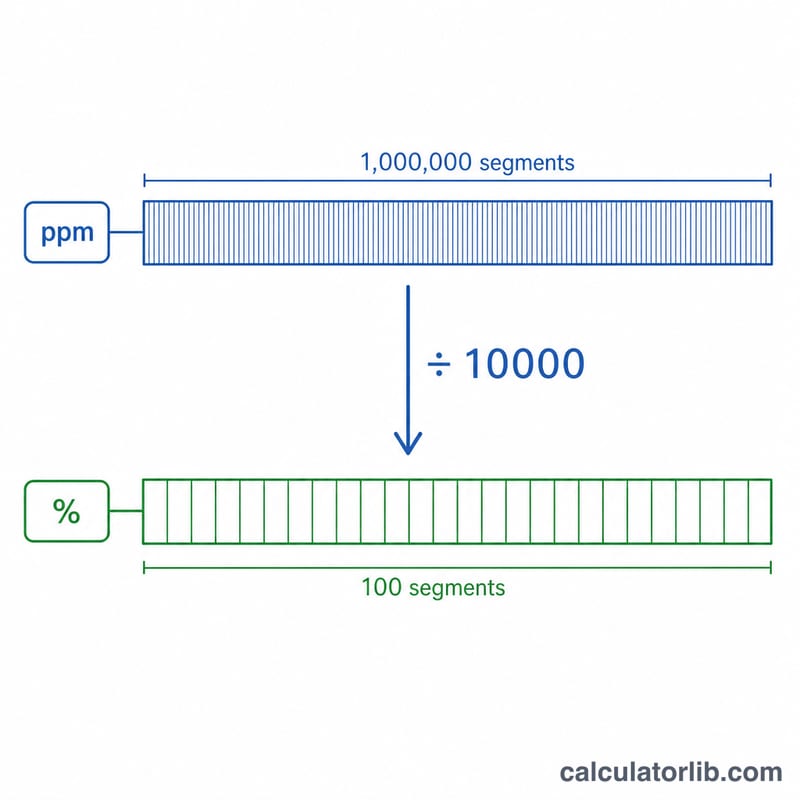
This calculator converts a concentration expressed in parts per million (ppm) into the equivalent percentage (%). Both are dimensionless ratios describing how much of a substance exists within a whole. Since 1% means "1 part per 100" and 1 ppm means "1 part per 1,000,000," there are exactly 10,000 ppm in every 1%. This tool is universal and applies to any field — chemistry, water treatment, air quality, agriculture, and manufacturing.
How to use it
Type the concentration in ppm into the input box and the calculator immediately returns the matching percentage. For example, drinking water hardness, CO₂ levels, or trace impurity specifications are often quoted in ppm and may need to be reported as a percent.
The formula explained
The conversion is a simple scaling:
$$\text{Percent (\%)} = \frac{\text{Concentration (ppm)}}{10000}$$
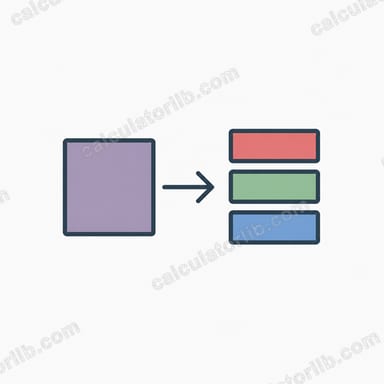
This works because a percent is parts per hundred and ppm is parts per million. To go from a denominator of 1,000,000 to 100 you divide by 10,000 (\(1{,}000{,}000 \div 100 = 10{,}000\)).
Worked example
Suppose a lab report lists a chloride concentration of 5,000 ppm. Dividing by 10,000 gives $$5{,}000 \div 10{,}000 = 0.5\%$$ Similarly, 25,000 ppm equals 2.5%, and 100 ppm equals 0.01%.
FAQ
How many ppm are in 1 percent? Exactly 10,000 ppm equal 1%.
Is this valid for mass and volume? Yes — ppm and percent are both pure ratios, so the conversion holds whether the basis is mass/mass, volume/volume, or mass/volume, as long as both values use the same basis.
How do I convert percent back to ppm? Multiply the percent by 10,000. For instance, \(0.3\% \times 10{,}000 = 3{,}000\) ppm.