
What is the mmol to mg Calculator?
This calculator converts an amount of substance measured in millimoles (mmol) into a mass in milligrams (mg). Because a mole is a count of particles, you need the molar mass of the substance — its grams per mole (g/mol) — to translate that count into a weight. The conversion is widely used in chemistry, pharmacology, and clinical lab work.
How to use it
Enter the amount in millimoles and the molar mass of the compound in grams per mole. The molar mass equals the numeric milligrams-per-millimole value, so the calculator multiplies the two directly. Click calculate and the result is your mass in milligrams.
The formula explained
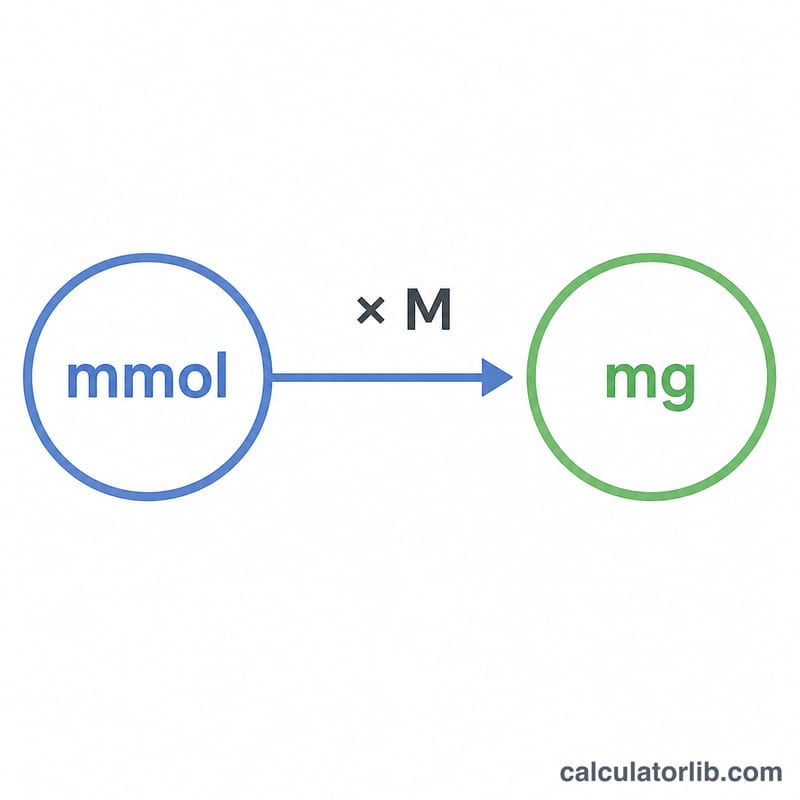
The core equation is $$\text{mg} = \text{mmol} \times M$$ where M is the molar mass in g/mol. This works because 1 mmol of a substance weighs exactly M milligrams (\(1\ \text{mmol} = 0.001\ \text{mol}\), and \(0.001\ \text{mol} \times M\ \text{g/mol} = M\ \text{mg}\)). So multiplying the number of millimoles by the molar mass gives milligrams directly, with no extra factor needed.
Worked example
Suppose you have 5 mmol of glucose, which has a molar mass of about 180.16 g/mol. $$\text{Mass} = 5 \times 180.16 = 900.8\ \text{mg}$$ So 5 mmol of glucose weighs roughly 900.8 milligrams.
FAQ
Where do I find the molar mass? Add up the atomic masses of every atom in the compound formula, or look it up on a periodic table or chemical database.
Why is molar mass in g/mol the same as mg/mmol? The ratio is identical because both numerator and denominator are scaled by 1000, so the value carries over unchanged.
Can I convert mg back to mmol? Yes — divide the mass in mg by the molar mass: \(\text{mmol} = \text{mg} \div M\).