
What is the Cholesterol Unit Converter?
Lipid (cholesterol and triglyceride) results are reported in different units around the world. The United States and a few other countries use milligrams per deciliter (mg/dL), while most of the world uses millimoles per liter (mmol/L). This tool converts total cholesterol, LDL, HDL and triglycerides between the two units so you can compare results no matter where your lab report comes from.
How to use it
Pick whether you are converting a cholesterol value (total, LDL or HDL all use the same factor) or a triglyceride value. Choose the direction — from mg/dL to mmol/L or the reverse — then enter your number and read the converted result.
The formula explained
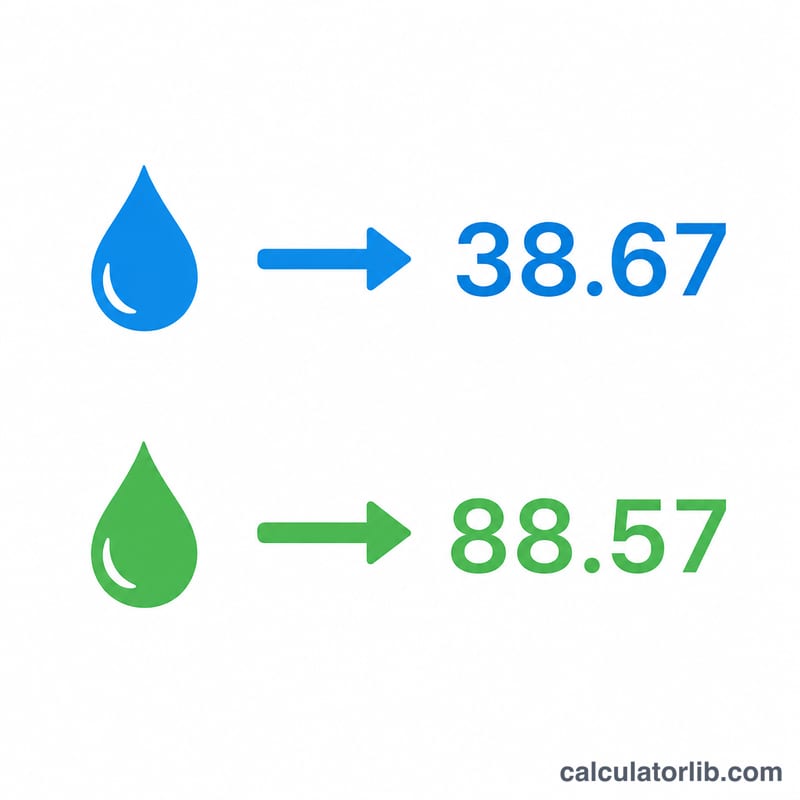
The conversion depends on molecular weight. For cholesterol, divide the mg/dL value by 38.67 to get mmol/L (or multiply mmol/L by 38.67 to go back). Triglyceride molecules are heavier, so they use a factor of 88.57 instead.
So:
$$\text{mmol/L} = \frac{\text{mg/dL}}{38.67} \text{ (cholesterol)}$$ $$\text{mmol/L} = \frac{\text{mg/dL}}{88.57} \text{ (triglycerides)}$$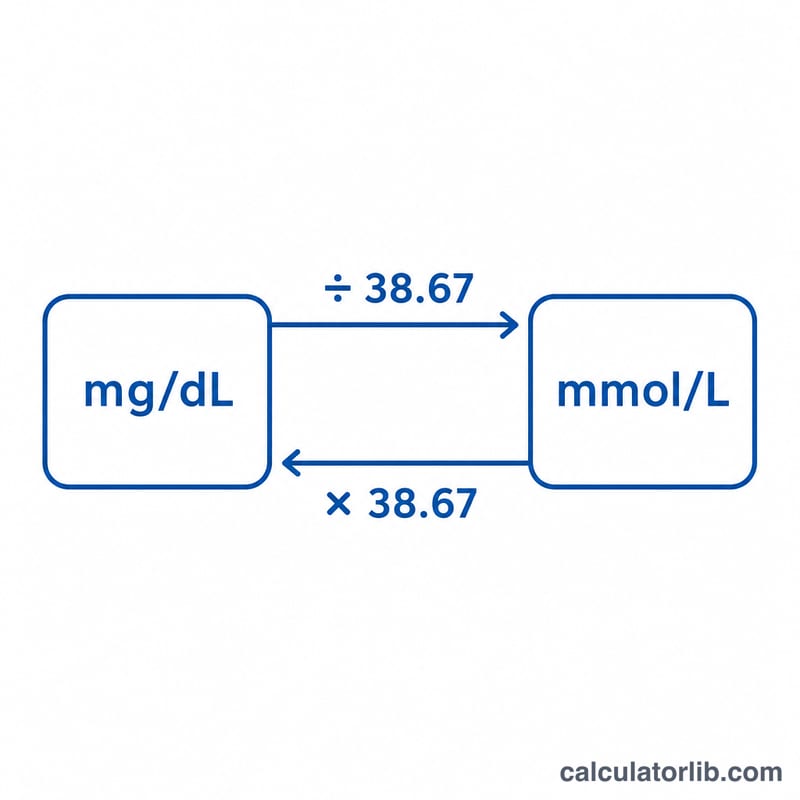
Worked example
A total cholesterol of 200 mg/dL converts to $$200 \div 38.67 \approx 5.17 \text{ mmol/L}.$$ A triglyceride reading of 150 mg/dL converts to $$150 \div 88.57 \approx 1.69 \text{ mmol/L}.$$ To reverse: 5 mmol/L of cholesterol equals $$5 \times 38.67 \approx 193.4 \text{ mg/dL}.$$
FAQ
Why do triglycerides use a different factor? Conversion factors are derived from molecular weight. Triglycerides are larger molecules than cholesterol, so the factor (88.57) is larger.
Do LDL and HDL use the same factor as total cholesterol? Yes. All cholesterol fractions — total, LDL and HDL — use 38.67.
Is this medical advice? No. This is a unit converter only. Discuss your actual lipid results and treatment with a qualified healthcare professional.