
What the Fertile Window Calculator does
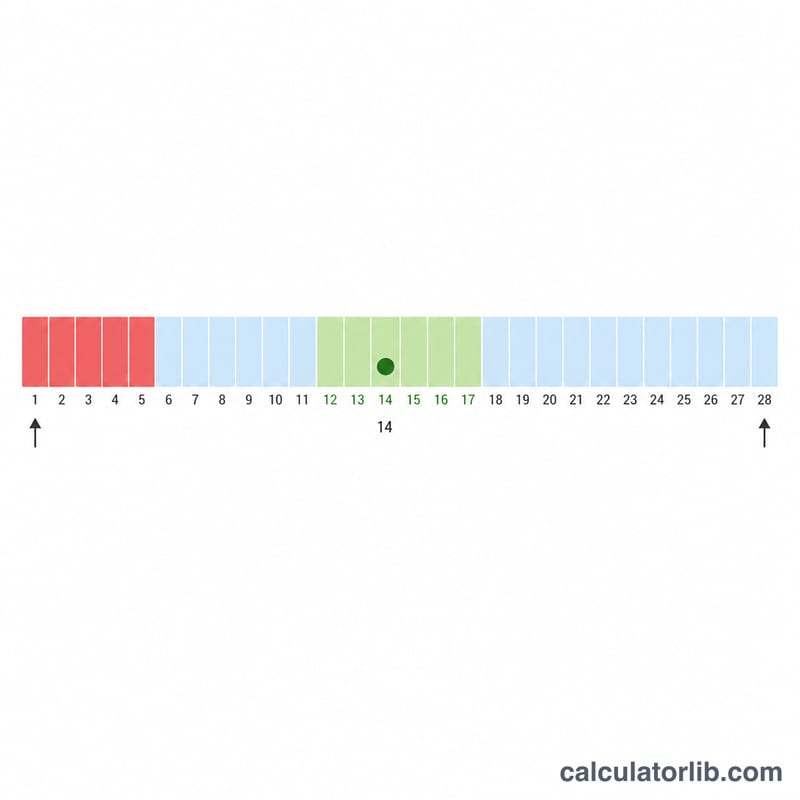
This calculator estimates the days each cycle when conception is most likely. Using the first day of your last menstrual period (LMP) and your average cycle length, it pinpoints your estimated ovulation day and the surrounding "fertile window" — the six days that offer the best chance of pregnancy. The results are expressed as cycle days counted from day 1 (the first day of your period).
How to use it
Enter the day of the month your last period started and your typical cycle length in days (the time from the first day of one period to the first day of the next — commonly 28 days, but anything from about 21 to 35 is normal). The tool returns your estimated ovulation cycle day and the fertile window range.
The formula explained
Ovulation usually happens about 14 days before your next period begins, regardless of total cycle length. So ovulation day = LMP day + (cycle length − 14). Because sperm can live up to 5 days and an egg about 24 hours, the fertile window runs from 5 days before ovulation to 1 day after, giving a 7-day span of cycle days.
$$\begin{gathered} \text{Ovulation Day} = \text{LMP Day} + \left(\text{Cycle Length} - 14\right) \\[1.5em] \text{where}\quad \left\{ \begin{aligned} \text{Fertile Start} &= \text{Ovulation Day} - 5 \\ \text{Fertile End} &= \text{Ovulation Day} + 1 \end{aligned} \right. \end{gathered}$$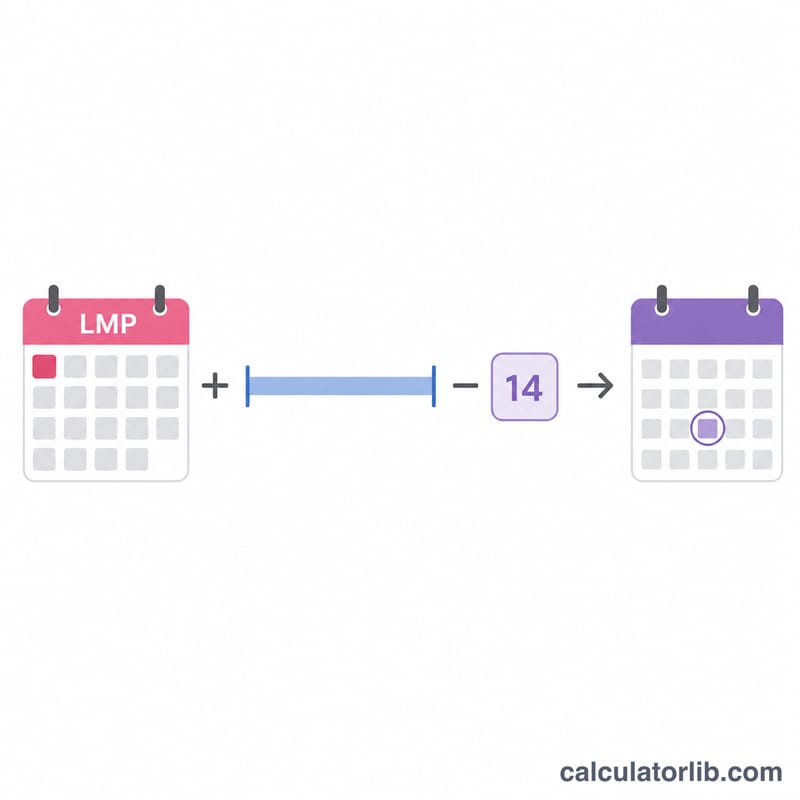
Worked example
Suppose your last period started on day 1 and your cycle is 28 days long. Ovulation = $$1 + (28 - 14) = 15$$ cycle day 15. The fertile window is day \(15 - 5 = 10\) through day \(15 + 1 = 16\). Your most fertile days are therefore cycle days 10 to 16.
FAQ
Is this method accurate? It is an estimate based on average cycles. Ovulation timing varies, especially with irregular cycles. Ovulation tests and basal body temperature tracking add precision.
Which days are most fertile? The two days before ovulation and ovulation day itself typically give the highest chance of conception.
Can I use this for birth control? No. This tool is for conception planning, not contraception — fertility-awareness contraception requires more rigorous tracking and guidance from a professional.