
What is the Due Date from Ovulation Calculator?
This calculator estimates your baby's due date (EDD, or Estimated Date of Delivery) based on the day you ovulated or conceived. Unlike the common Naegele's rule that counts from the last menstrual period (LMP), this method works directly from conception, which is especially helpful if you tracked ovulation, used fertility awareness, or conceived via IUI/IVF.
How to use it
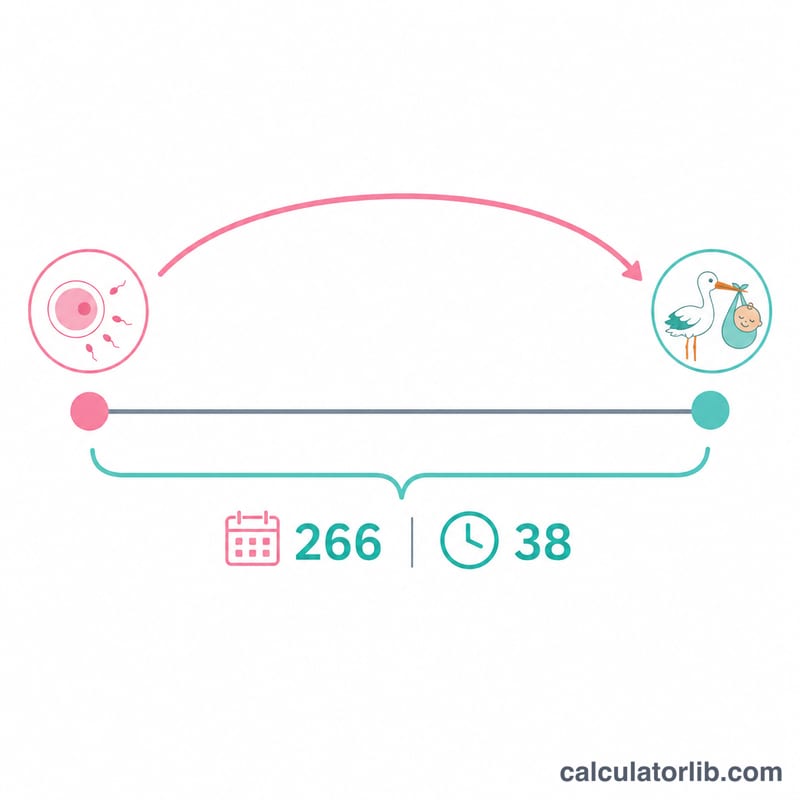
Enter the year, month, and day of your known or estimated ovulation/conception date. The calculator adds 266 days and returns the estimated due date. Because conception occurs roughly two weeks after the first day of the last period, 266 days from conception is equivalent to the standard 280 days (40 weeks) from LMP.
The formula explained
The full-term pregnancy is conventionally measured as 280 days from the last menstrual period. Ovulation and conception happen about 14 days after that, so counting from conception we subtract those 14 days: \(280 - 14 = 266\) days. Hence:
$$\text{EDD} = \text{Ovulation Date} + 266\ \text{days}\ (38\ \text{weeks})$$
Worked example
Suppose you ovulated on January 1, 2024. Adding 266 days lands on September 23, 2024 (2024 is a leap year, so February has 29 days). That September date is your estimated due date.
$$\text{EDD} = \text{Date}(2024,\ 1,\ 1) + 266\ \text{days} = \text{September } 23,\ 2024$$
FAQ
Is the due date exact? No. Only about 4% of babies arrive on the exact due date; most births occur within a window of roughly two weeks before or after.
Why 266 days instead of 280? 280 days is counted from the last period; 266 is counted from conception, which happens about 14 days later.
Should I rely on this instead of my doctor? Use this as a helpful estimate. An early ultrasound performed by your healthcare provider is the most accurate way to date a pregnancy.