
What this calculator does
The Pregnancy Conception Date Calculator estimates the day a pregnancy likely began. You can work either from the first day of your last menstrual period (LMP) or backward from an estimated due date. Because conception cannot be observed directly, these are well-established clinical estimates, not exact dates.
How to use it
Choose your method, enter a date as year, month and day, and—if calculating from LMP—your average cycle length. Click calculate to see the estimated conception date plus a corresponding estimated due date (40 weeks from LMP).
The formula explained
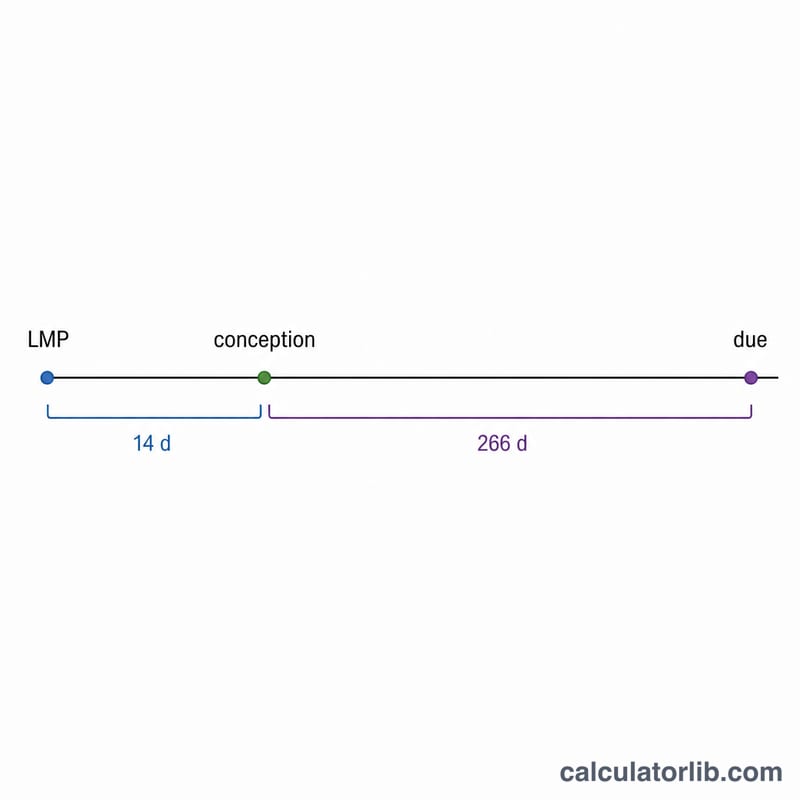
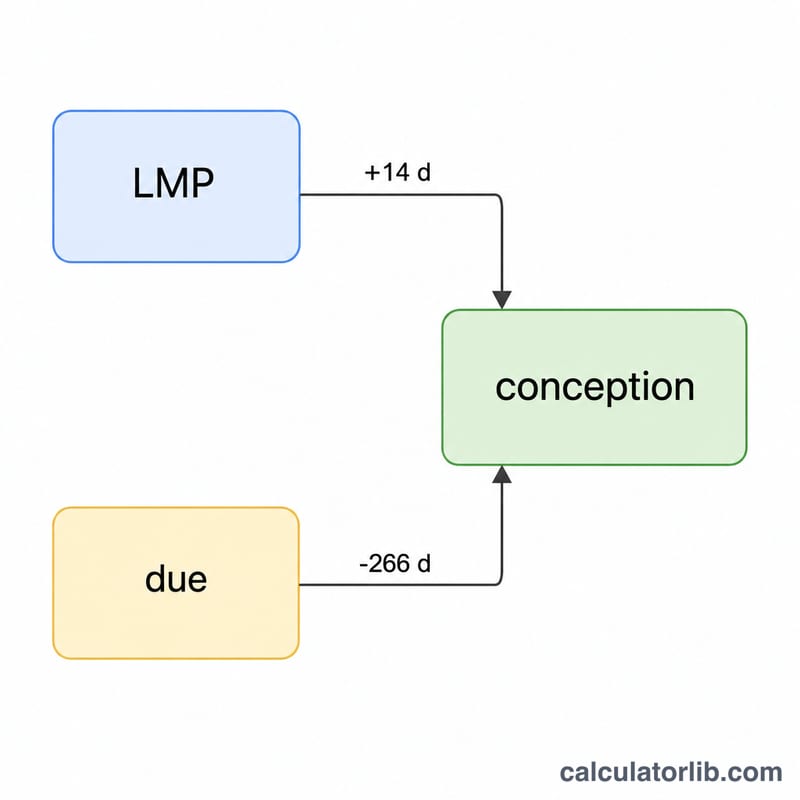
In a typical 28-day cycle, ovulation (and therefore conception) happens about 14 days after the first day of the LMP. For other cycle lengths the luteal phase stays near 14 days, so conception \(\approx \text{LMP} + (\text{cycle} - 14)\) days. Working from a due date, conception is roughly 266 days (38 weeks) earlier, since the standard 40-week pregnancy is measured from the LMP, which is about 2 weeks before conception.
$$\text{Conception} = \text{LMP} + 14\ \text{days} = \text{Due Date} - 266\ \text{days}$$
Worked example
Suppose your LMP began on 1 January 2024 with a 28-day cycle. Ovulation offset = \(28 - 14 = 14\) days, so estimated conception = 1 January + 14 days = 15 January 2024. The estimated due date is conception + 266 days ≈ 7 October 2024.
$$\text{Conception} = \text{LMP} + (28 - 14)\ \text{days} = \text{LMP} + 14\ \text{days}$$
FAQ
Is the conception date exact? No. Sperm can survive several days and ovulation timing varies, so treat it as a best estimate within a window of a few days.
Why use cycle length? Longer cycles usually mean later ovulation, which shifts the conception estimate; the calculator adjusts using \((\text{cycle} - 14)\).
Should I rely on this medically? Use it for general planning only. An ultrasound dating scan gives the most accurate gestational age—always confirm with your healthcare provider.