What is a Conception Date Calculator?
A conception date calculator estimates the day you most likely conceived a pregnancy. Conception (fertilization) usually happens around the time of ovulation, about 14 days after the first day of your last menstrual period (LMP) in a typical 28-day cycle. This tool works backward or forward from one of four known reference points: a due date, an ultrasound, your last period, or a baby's date of birth. It is a universal clinical date tool based on Naegele's rule and applies to any region.
How to use it
Choose what you want to calculate from, then enter the matching date. If you pick "Ultrasound," also enter the gestational age (weeks and days) that the scan reported. If you pick "Last Period," you can refine the result with your cycle length. The calculator returns your estimated conception date, a fertility window, the trimester and gestational age, and the due date.
The formula explained
Obstetric convention treats full term as 280 days (40 weeks) measured from the first day of the LMP, with conception occurring about 14 days later. That makes conception-to-birth about 266 days (38 weeks). So from a due date, \(\text{Conception} = \text{Due Date} - 266\text{ days}\); from an LMP, conception = LMP + 14 days (or + cycle length - 14 for non-28-day cycles). The fertility window is the 6 days ending on the conception (ovulation) day, from conception - 5 days to conception (Wilcox 1995), because sperm can survive about 5 days.
$$\text{Conception Date} = \text{Due Date} - 266 \text{ days}$$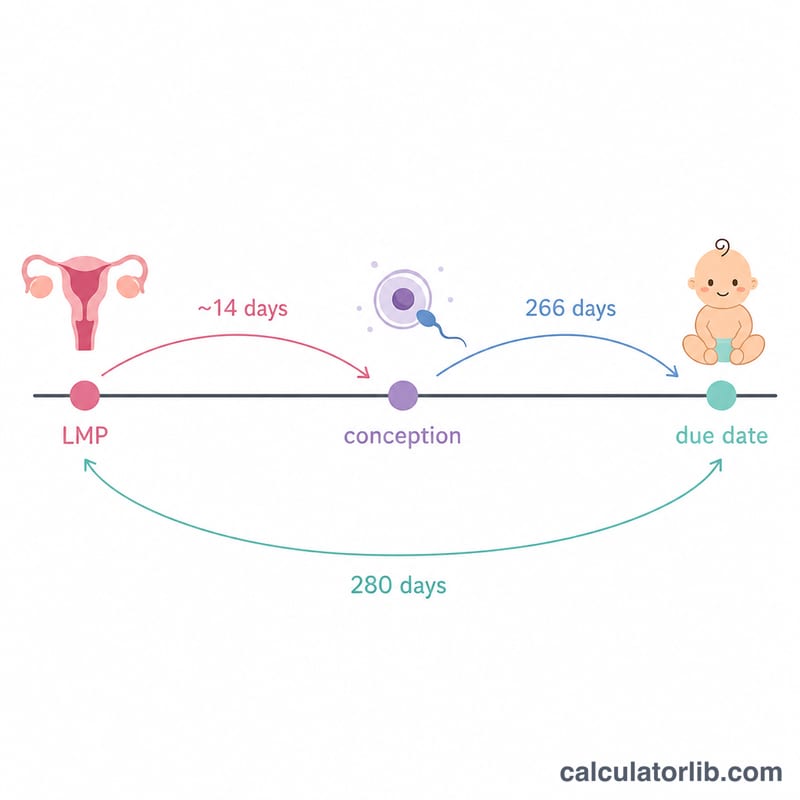
Worked example
If your due date is 15 Jun 2026: conception = 15 Jun 2026 - 266 days = Mon, 22 Sep 2025. The fertility window is 17 Sep 2025 to 22 Sep 2025, and at full term the pregnancy is "40 weeks and 0 days, Third Trimester."
$$\text{Conception} = 15\text{ Jun }2026 - 266 \text{ days} = \text{Mon, } 22\text{ Sep }2025$$Gestational Age, Trimester and Conception Timeline Reference
Obstetric dating (gestational age) counts from the first day of the last menstrual period (LMP), not from conception. Conception normally happens about 14 days after the LMP in a 28-day cycle, so gestational age is about 2 weeks ahead of fetal age (time since conception). The table uses the standard 280-day / 266-day convention.
| Milestone | Gestational age (from LMP) | Days from LMP | Days since conception |
|---|---|---|---|
| LMP (first day of last period) | 0w0d | 0 | −14 |
| Ovulation / conception (28-day cycle) | 2w0d | 14 | 0 |
| End of first trimester | 13w6d | 97 | 83 |
| Start of second trimester | 14w0d | 98 | 84 |
| End of second trimester | 27w6d | 195 | 181 |
| Start of third trimester | 28w0d | 196 | 182 |
| Start of full term (37 weeks) | 37w0d | 259 | 245 |
| Due date (estimated) | 40w0d | 280 | 266 |
| End of the typical term range (42 weeks) | 42w0d | 294 | 280 |
In formula form: \(\text{Due date} = \text{LMP} + 280\ \text{days} = \text{Conception} + 266\ \text{days}\). Trimester boundaries are a convention and some sources place them one or two days differently. The 14-day offset assumes ovulation on day 14 of a 28-day cycle; see the next section for other cycle lengths.
How Cycle Length Changes the Estimated Conception Date
Ovulation typically occurs about 14 days before the next period, so ovulation falls about cycle length − 14 days after the LMP. The estimated conception date is therefore \(\text{LMP} + (\text{cycle length} - 14)\) days, and the fertile window is the 6 days ending on that date (from 5 days before up to the date itself). The due date is Naegele's rule (LMP + 280 days) adjusted by \((\text{cycle length} - 28)\) days. Example below: LMP = 1 January 2026.
| Cycle length | Ovulation (days after LMP) | Estimated conception | Fertile window | Adjusted due date (shift vs. 28-day) |
|---|---|---|---|---|
| 21 days | 7 | 8 Jan 2026 | 3 Jan – 8 Jan | 1 Oct 2026 (−7 days) |
| 24 days | 10 | 11 Jan 2026 | 6 Jan – 11 Jan | 4 Oct 2026 (−4 days) |
| 28 days | 14 | 15 Jan 2026 | 10 Jan – 15 Jan | 8 Oct 2026 (no shift) |
| 32 days | 18 | 19 Jan 2026 | 14 Jan – 19 Jan | 12 Oct 2026 (+4 days) |
| 35 days | 21 | 22 Jan 2026 | 17 Jan – 22 Jan | 15 Oct 2026 (+7 days) |
Check for the 28-day row: 15 Jan 2026 + 266 days = 8 Oct 2026, which equals 1 Jan 2026 + 280 days. A longer cycle pushes ovulation, conception and the due date later by the same number of days; a shorter cycle moves them earlier. Cycles that vary from month to month make the estimate less reliable, and the real ovulation day may differ from the formula.
Interpreting Your Conception Date Result
- It is a statistical estimate. The result comes from a standard average (266 days from conception, 280 days from LMP), not from a measurement of when fertilization actually happened.
- Due dates are rarely exact. Only about 4% of babies are born on their estimated due date. Birth from about 3 weeks before to 2 weeks after the due date is considered normal.
- Ultrasound dating. A first-trimester ultrasound measuring crown-rump length is accurate to roughly ±5–7 days, and it is often used to confirm or revise LMP-based dates, especially when cycles are irregular or the LMP is uncertain.
- The fertile window. It spans about 6 days because sperm can survive in the reproductive tract for up to about 5 days, while the egg is viable for only about 12–24 hours after ovulation. Intercourse in this window, not only on one day, could have led to conception.
- Working back from a birth date is approximate. If you enter a birth date, the tool assumes a 40-week pregnancy. Babies born early or late will have a conception date that differs from the estimate by days or even weeks.
- Implantation comes later. The embryo usually implants about 6–12 days after conception, so a positive pregnancy test generally cannot happen right at conception.
- Cycle length matters. The calculator's default assumes ovulation about 14 days before the next period; a different cycle length shifts the estimated date as shown in the table above.
This is general information, not medical advice. Your healthcare provider can confirm your dating using your history and ultrasound findings.
FAQ
How accurate is the conception date? It is an estimate. Ovulation timing and cycle length vary, so the result can be off by several days, which is why a fertility window and a due-date range (about 3 weeks before to 2 weeks after) are shown.
Can I use my baby's birth date? Yes, but it assumes birth happened exactly at 40 weeks, so the conception estimate is only approximate for early or late births.
What if my cycle is not 28 days? In Last Period mode, enter your cycle length. Ovulation is assumed at cycle length minus 14 days, so a longer cycle pushes conception later.