What this period calculator does
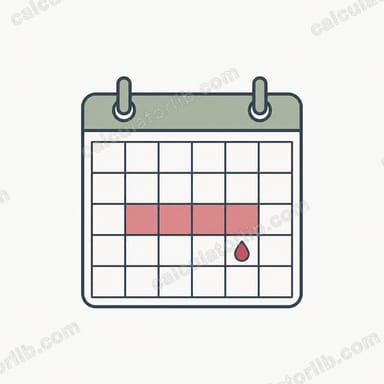
This menstrual cycle calculator predicts the start date of your next period, tells you which cycle day you are currently on, and draws a calendar that highlights the days you are likely to be menstruating over the coming months. All you need is the first day of your last period, how long your period usually lasts, and your average cycle length.

How to use it
Enter the first day of your last period (treated as cycle day 1), your average period length in days (how long bleeding lasts, often 3-7 days), and your average cycle length in days (the gap from one period start to the next, typically 21-35 days, with 28 being a common average). Use the Previous / Next buttons to scroll the calendar three months at a time.
The formula explained
Let \(L\) be your last period start, \(C\) your cycle length, \(P\) your period length and \(T\) today. The number of whole cycles since \(L\) is \(\left\lfloor \frac{T-L}{C}\right\rfloor\). Your current cycle day is
$$\text{cycleDay} = \big((T-L)\bmod C\big) + 1$$The next period start is \(L\) plus one extra full cycle beyond the cycle you are in, and the days until then is simply that date minus today.
$$\text{nextPeriodStart} = L + \left(\left\lfloor \frac{T-L}{C}\right\rfloor + 1\right)\cdot C \text{ days}$$Each predicted period spans \(P\) consecutive days starting on every \(L + k\cdot C\).

Worked example
Suppose your last period started on 14 Jun 2026, your period lasts 5 days, and your cycle is 28 days, and today is also 14 Jun 2026. Then days since last period \(= 0\), so you are on cycle day 1. The next period start is \(14 \text{ Jun} + 28 \text{ days} = \text{Sun, 12 Jul 2026}\), which is 28 days away. The calendar marks Jun 14-18 and Jul 12-16 as predicted period days.
Typical Menstrual Cycle and Period Length Ranges
Cycle length is counted from the first day of one period to the day before the next period begins. Period length is the number of days of bleeding. The ranges below are general reference values from the American College of Obstetricians and Gynecologists (ACOG, United States) and the National Health Service (NHS, United Kingdom).
| Measure | Typical range | Notes |
|---|---|---|
| Cycle length (adults) | About 21–35 days | The average is often quoted as about 28 days, but many healthy cycles are shorter or longer. |
| Period (bleeding) length | About 2–7 days | Flow is usually heaviest in the first days. |
| Cycle length (adolescents) | About 21–45 days | Cycles in the first years after the first period commonly run longer and are less regular. |
Individual variation is normal. A cycle or period outside these ranges is simply atypical. It is not a diagnosis on its own, and this tool cannot tell you whether anything is wrong. If you have concerns about your cycle, speak with a doctor or other qualified healthcare professional.
Menstrual Cycle Terms Explained
- Cycle day 1
- The first day of menstrual bleeding. It starts a new cycle and is the date you enter as the last period start.
- Cycle length
- The number of days from the first day of one period to the day before the first day of the next period.
- Period length
- The number of days of bleeding in a period. This tool marks that many days on the calendar, starting with the predicted start date.
- Follicular phase
- The first part of the cycle, from day 1 until ovulation, when follicles in the ovary develop. Its length varies the most between people and between cycles.
- Ovulation
- The release of an egg from an ovary, which happens partway through the cycle.
- Luteal phase
- The part of the cycle from ovulation until the next period begins. It is often described as fairly consistent, at roughly 12–14 days for many people.
- Predicted vs. actual period
- A predicted period is a calendar estimate from your inputs. An actual period is what really happens. The two can differ by several days.
Important: this tool only projects period dates from your last period start and cycle length. It does not predict ovulation, fertile days, or pregnancy chances, and it should not be used for contraception or conception planning.
Interpreting Your Predicted Dates
- Estimates, not certainties: the calculator assumes your cycle length stays the same every month. It repeats the same interval from your last period start to generate each predicted date.
- Expect some variation: cycle-to-cycle differences of a few days are common, so treat each predicted date as approximate and allow a window of several days either side.
- Cycle day: the cycle day shows where today falls within the current cycle only, counting your last period start as day 1. It does not indicate hormone levels or fertility.
- Further ahead means less reliable: because the cycle is projected forward, small differences between your assumed and actual cycle length add up. Months far ahead on the calendar are less reliable than the next one.
- Keep inputs current: after each new period, enter its actual start date to refresh the predictions. Tracking several cycles can help you choose a more representative cycle length.
This is general information, not medical advice. If your periods are very irregular, unusually heavy or painful, absent, or you have other concerns, consult a healthcare professional.
FAQ
Is this medical advice? No. It is a statistical estimate that assumes a regular, constant-length cycle. It does not diagnose anything or predict ovulation and fertility windows.
Why are my real dates different? Cycles naturally vary in length. Accuracy improves when your average cycle length is stable; logging several cycles gives a better average.
What if my cycle isn't 28 days? Just enter your own average. Anything from about 21 to 35 days is generally considered normal, and the calculator adapts the predictions accordingly.