
What this calculator does
This tool adds and subtracts a chain of 2 to 10 simple fractions and shows the complete worked solution. Choose how many fractions you want, type each numerator and denominator, and pick whether each fraction after the first is added or subtracted. The calculator finds the least common denominator (LCD), rewrites every fraction over it, combines the numerators, and reduces the result to lowest terms, also giving a mixed number and a decimal.
How to use it
Select the number of fractions from the dropdown. Enter each numerator (which may be negative or zero) and each nonzero denominator. For every fraction after the first, choose the add or subtract operator. Press calculate to see the answer and the step-by-step breakdown. Denominators of zero are flagged because division by zero is undefined.
The formula explained
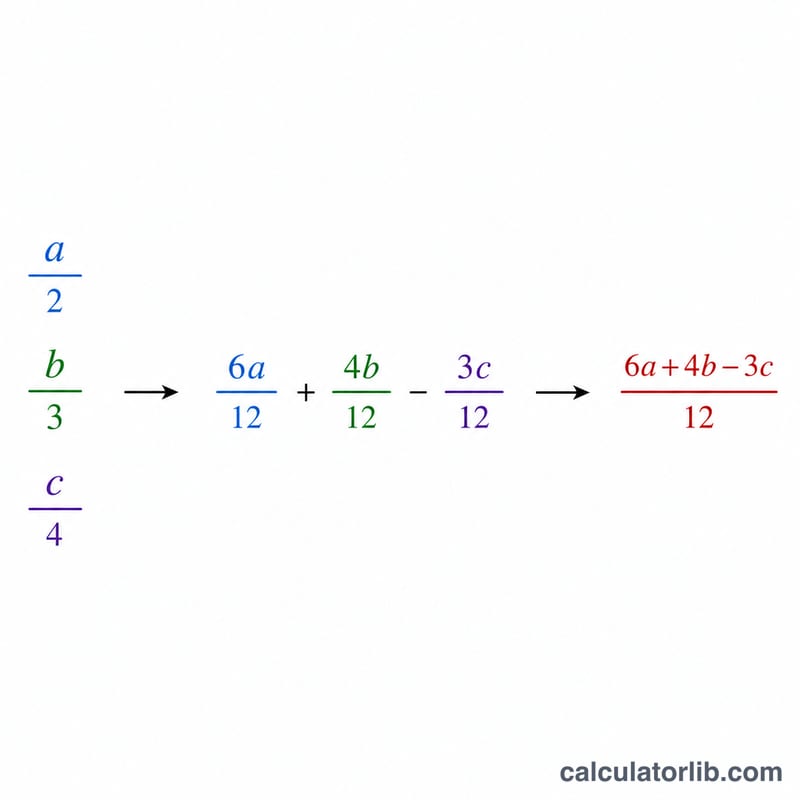
Each subtract operator is turned into a sign on the following fraction, so the whole expression becomes a sum: $$\text{value} = \sum_{i=1}^{k} s_i \cdot \frac{n_i}{d_i} = \frac{\sum_i s_i\, n_i\, (\text{LCD}/d_i)}{\text{LCD}}$$ The LCD is the least common multiple of all denominators, computed with \(\text{lcm}(a,b)=|a\cdot b|/\gcd(a,b)\). Multiply each fraction's top and bottom by \(\text{LCD}/d\) to put them over the common denominator, add the resulting numerators, then divide numerator and denominator by their greatest common divisor (Euclid's algorithm) to reduce: $$\frac{N}{D}=\frac{N/g}{D/g},\quad g=\gcd(|N|,D)$$
Worked example
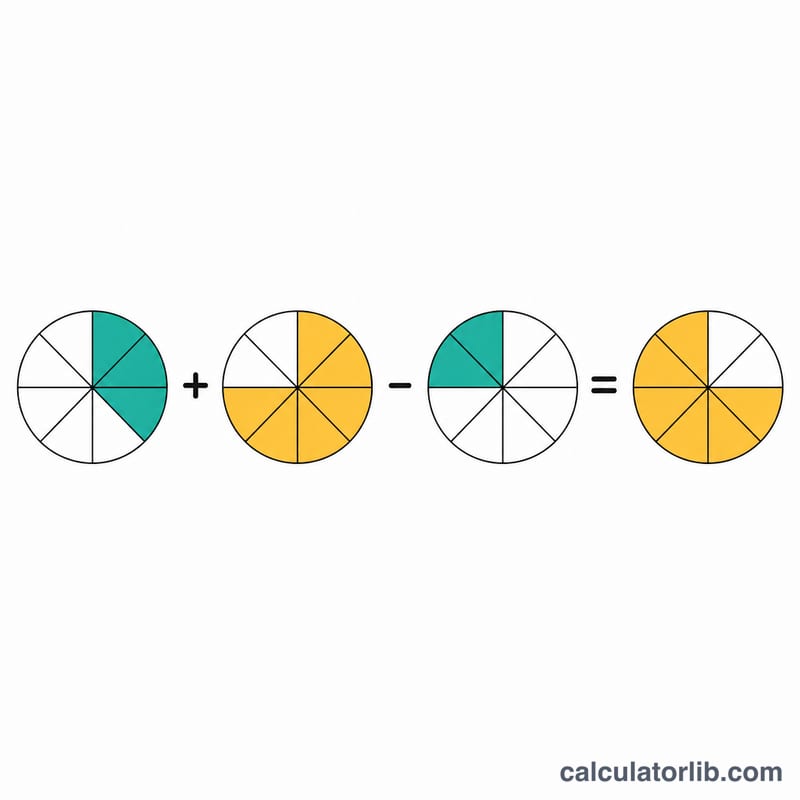
Compute \(-\frac{1}{8} - \frac{1}{16} - \frac{3}{8} + \frac{5}{8}\). Signed numerators are \(-1, -1, -3, +5\) over denominators \(8, 16, 8, 8\). The LCD is \(16\), with multipliers \(2, 1, 2, 2\). Equivalent fractions are \(-\frac{2}{16}, -\frac{1}{16}, -\frac{6}{16}, +\frac{10}{16}\). Summing the numerators: $$-2 - 1 - 6 + 10 = 1$$ so the result is \(\frac{1}{16}\) (already in lowest terms), or \(0.0625\) as a decimal.
Definitions & Glossary
- Numerator
- The top number of a fraction; it counts how many equal parts are taken. In \( \tfrac{3}{8} \) the numerator is 3.
- Denominator
- The bottom number of a fraction; it tells how many equal parts make one whole. In \( \tfrac{3}{8} \) the denominator is 8. It can never be 0.
- Least common denominator (LCD)
- The smallest positive number that is a common multiple of all the denominators in a set of fractions. It equals the least common multiple (LCM) of those denominators and is the denominator you convert every fraction to before adding or subtracting.
- Least common multiple (LCM)
- The smallest positive integer that is divisible by each of two or more given integers. For example, \( \operatorname{lcm}(4,6)=12 \). The LCD of fractions is the LCM of their denominators.
- Greatest common divisor (GCD)
- The largest positive integer that divides two or more integers without a remainder, also called the greatest common factor (GCF). For example, \( \gcd(12,8)=4 \). Dividing a fraction's numerator and denominator by their GCD reduces it to lowest terms.
- Equivalent fraction
- A fraction that represents the same value as another, obtained by multiplying or dividing the numerator and denominator by the same nonzero number. For example, \( \tfrac{1}{2}=\tfrac{15}{30} \).
- Lowest terms
- A fraction in which the numerator and denominator share no common factor greater than 1, i.e. \( \gcd(\text{numerator},\text{denominator})=1 \). Also called simplest form.
- Improper fraction
- A fraction whose numerator is greater than or equal to its denominator, so its value is 1 or more, such as \( \tfrac{53}{30} \).
- Mixed number
- A number written as a whole part plus a proper fraction, such as \( 1\tfrac{23}{30} \); it is an alternative way to express an improper fraction.
FAQ
Can I enter negative fractions? Yes. The first fraction's sign comes from its numerator, and later fractions combine the chosen operator with their numerator's sign.
What if my answer is improper? Improper results such as \(\frac{7}{4}\) are shown as a mixed number (\(1\frac{3}{4}\)) alongside the fraction and decimal.
Why does my result show as a whole number? When the reduced denominator becomes 1, the value is an integer and is displayed without a denominator.