
What is the Simplifying Fractions Calculator?
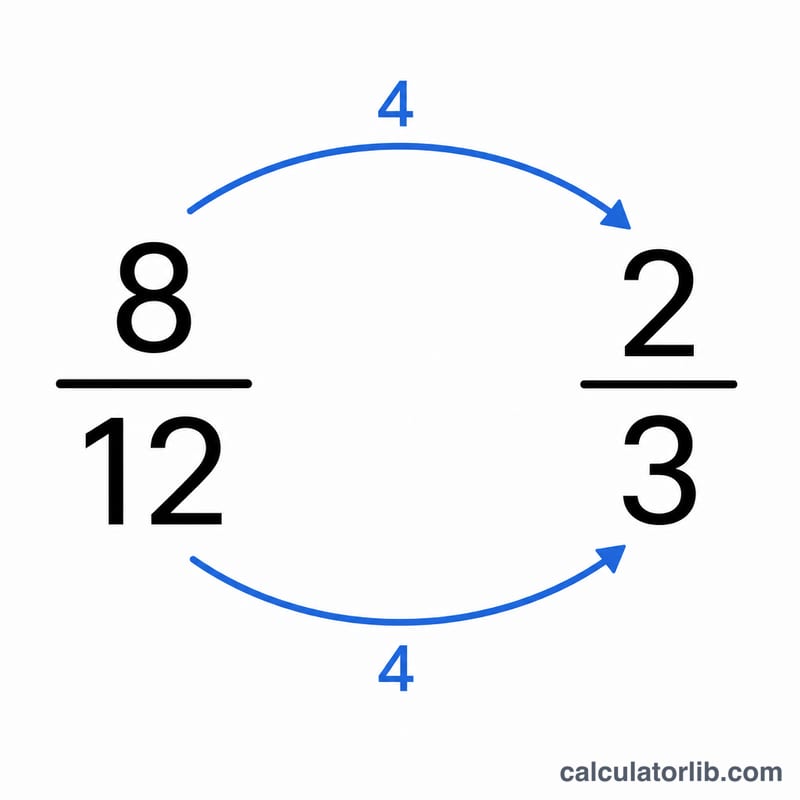
This tool reduces any fraction to its simplest form (lowest terms). A fraction is fully simplified when the numerator and denominator share no common factor other than 1. The calculator finds the greatest common divisor (GCD) of the two numbers and divides both by it, returning the reduced fraction along with the GCD used and the equivalent mixed number.
How to use it
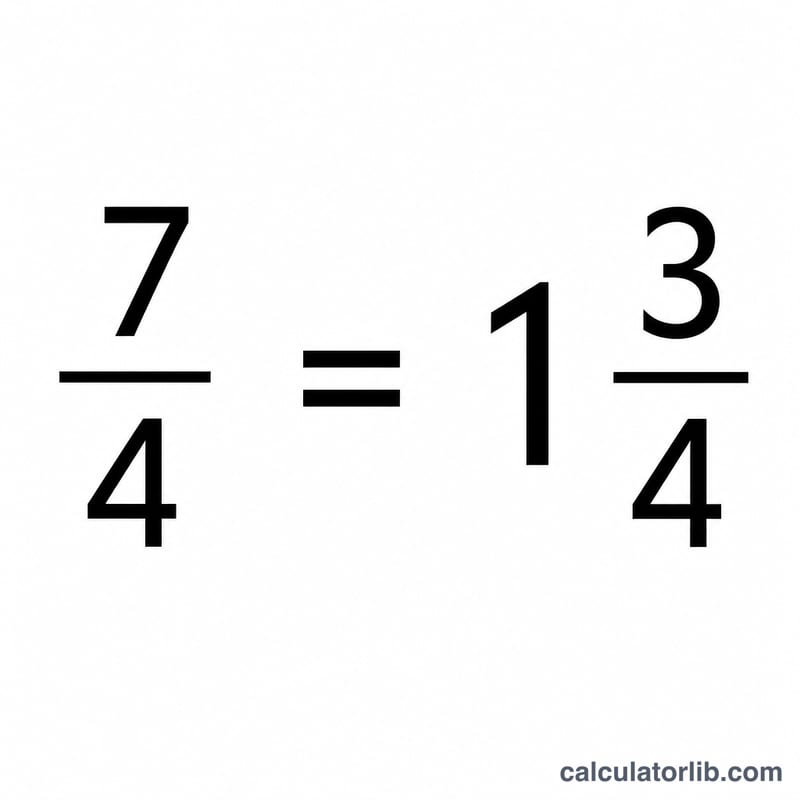
Enter the numerator (top number) and denominator (bottom number) of your fraction, then read the simplified result. Negative numbers are supported — the calculator keeps the correct sign and never divides by zero. The mixed-number row shows the whole part and the remaining proper fraction when the value is greater than one.
The formula explained
The key idea is the greatest common divisor. For a fraction \(a/b\), we compute \(\gcd(a, b)\) using the Euclidean algorithm: repeatedly replace \((a, b)\) with \((b,\ a \bmod b)\) until the second value becomes zero. The last non-zero value is the GCD. Dividing both \(a\) and \(b\) by this GCD yields the smallest equivalent fraction:
$$\frac{a}{b} = \frac{a \div \gcd(a,b)}{b \div \gcd(a,b)}$$
Worked example
Take 24/36. The GCD of 24 and 36 is 12. Dividing both gives \(24 \div 12 = 2\) and \(36 \div 12 = 3\), so
$$\frac{24}{36} = \frac{24 \div 12}{36 \div 12} = \frac{2}{3}$$
Since the numerator is smaller than the denominator, the mixed number is simply 2/3 with a whole part of 0.
FAQ
What if the fraction is already in lowest terms? The GCD will be 1, so the fraction is returned unchanged.
Can I enter an improper fraction? Yes. For example 9/6 simplifies to 3/2, shown as the mixed number 1 1/2.
What happens with negative values? The sign is preserved on the numerator while the denominator stays positive, matching standard convention.