
What this calculator does
This tool adds or subtracts two fractions and returns the answer as a fully simplified (reduced) fraction along with its decimal equivalent. Enter the numerator and denominator of each fraction, choose addition or subtraction, and the calculator handles finding a common denominator and reducing the result for you.
How to use it
Type the first fraction's numerator and denominator, pick the operation (add or subtract), then enter the second fraction. The calculator computes a single combined fraction and simplifies it. Negative numerators and improper fractions (numerator larger than denominator) are fully supported.
The formula explained
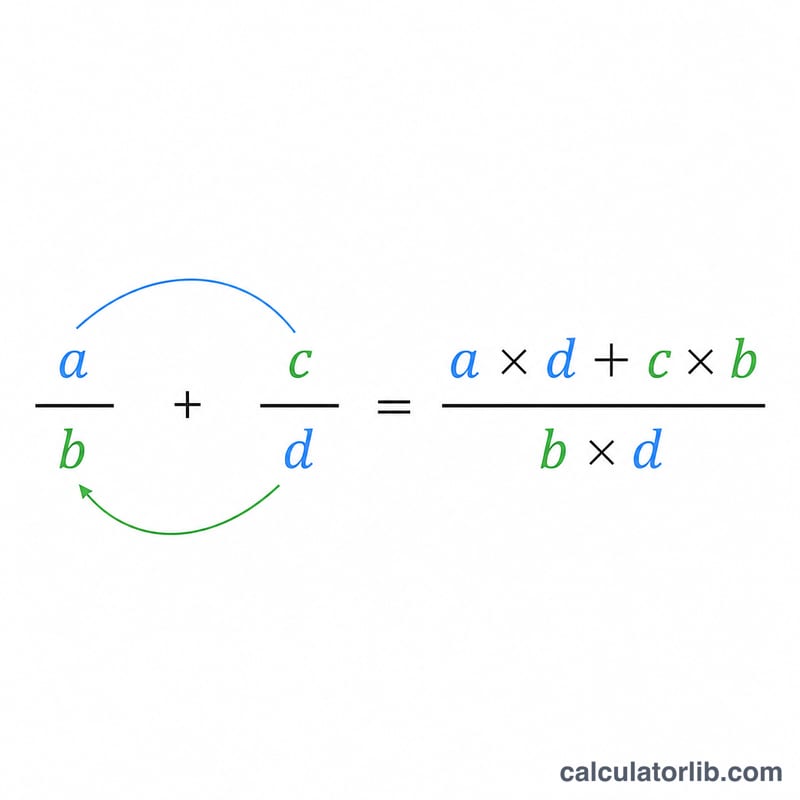
To combine two fractions you put them over a common denominator. The simplest common denominator is the product of the two denominators, \(b \cdot d\). So \(a/b\) becomes \(\frac{a \cdot d}{b \cdot d}\) and \(c/d\) becomes \(\frac{c \cdot b}{b \cdot d}\). Now both share the same bottom number, so you just add or subtract the tops:
$$\frac{a}{b} \pm \frac{c}{d} = \frac{a \cdot d \pm c \cdot b}{b \cdot d}$$
Finally, the result is reduced by dividing the numerator and denominator by their greatest common divisor (GCD), found with the Euclidean algorithm:
$$\frac{n}{m} = \frac{n / \gcd(n,m)}{m / \gcd(n,m)}$$
Worked example
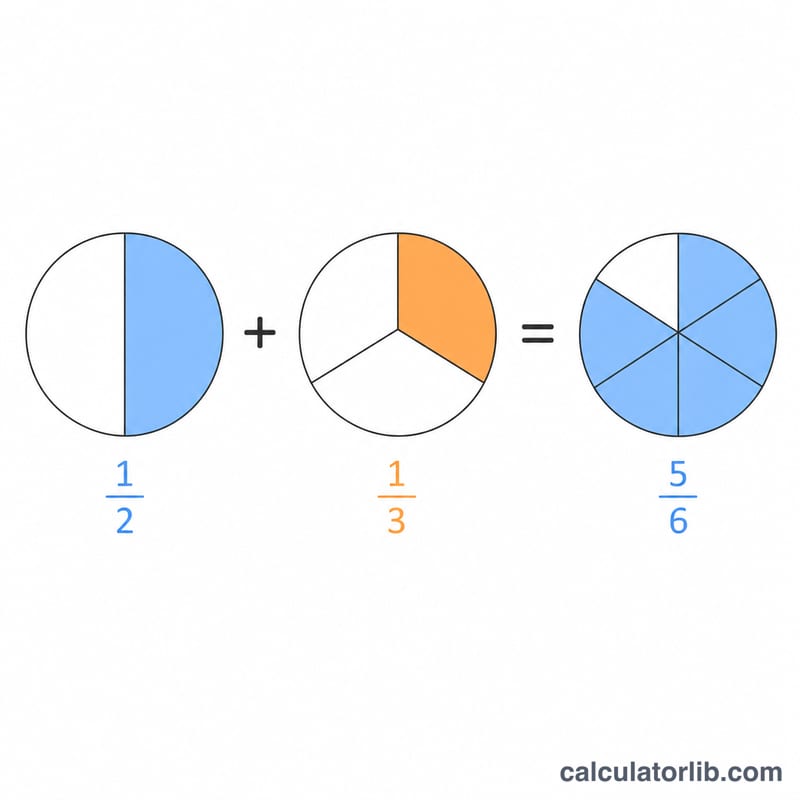
Add \(\frac{1}{2} + \frac{1}{3}\). Using the formula:
$$\frac{1 \cdot 3 + 1 \cdot 2}{2 \cdot 3} = \frac{3 + 2}{6} = \frac{5}{6}$$
The GCD of 5 and 6 is 1, so \(\frac{5}{6}\) is already in lowest terms. As a decimal that is about \(0.8333\).
Subtraction example:
$$\frac{3}{4} - \frac{1}{2} = \frac{3 \cdot 2 - 1 \cdot 4}{4 \cdot 2} = \frac{6 - 4}{8} = \frac{2}{8}$$
which reduces to \(\frac{1}{4}\) after dividing by GCD \(2\).
Definitions & Glossary
Understanding the vocabulary of fractions makes adding and subtracting them much clearer. The terms below describe each part of a fraction and the steps this calculator uses to produce a reduced answer.
- Numerator — the top number of a fraction. It counts how many equal parts you have. In \(\frac{3}{4}\), the numerator is 3.
- Denominator — the bottom number of a fraction. It tells how many equal parts make up one whole. In \(\frac{3}{4}\), the denominator is 4. A denominator can never be 0.
- Proper fraction — a fraction whose numerator is smaller than its denominator, so its value is less than 1 (for example \(\frac{2}{5}\)).
- Improper fraction — a fraction whose numerator is equal to or larger than its denominator, so its value is 1 or greater (for example \(\frac{7}{4}\)). Sums of two fractions are often improper.
- Common denominator — a single denominator shared by two or more fractions. You can only add or subtract fractions once they share one. This tool uses the product of the two denominators, \(b\cdot d\), as a guaranteed common denominator; the result is then reduced.
- Lowest terms (simplest form) — a fraction in which the numerator and denominator share no common factor other than 1, such as \(\frac{2}{4}\) reduced to \(\frac{1}{2}\).
- GCD (Greatest Common Divisor) — the largest whole number that divides both the numerator and denominator exactly. Dividing both by their GCD reduces a fraction to lowest terms. The GCD is also called the GCF or HCF.
- Euclidean algorithm — an efficient method for finding the GCD of two numbers by repeated remainder. Replace the larger number with the remainder of dividing the two; repeat until the remainder is 0. The last nonzero remainder is the GCD. For example, \(\gcd(8,12)\): \(12 \bmod 8 = 4\), then \(8 \bmod 4 = 0\), so the GCD is 4. This tool runs this algorithm to simplify every result.
Common Fraction-to-Decimal Reference Table
The decimal value of a fraction is simply its numerator divided by its denominator. The table below lists the most frequently used fractions with their decimal equivalents. A bar over a digit (or the note "repeating") indicates the decimal repeats forever.
| Fraction | Decimal | Notes |
|---|---|---|
| \(\frac{1}{2}\) | 0.5 | Exact |
| \(\frac{1}{3}\) | 0.3333… | Repeating (0.3̅) |
| \(\frac{2}{3}\) | 0.6667… | Repeating (0.6̅) |
| \(\frac{1}{4}\) | 0.25 | Exact |
| \(\frac{3}{4}\) | 0.75 | Exact |
| \(\frac{1}{5}\) | 0.2 | Exact |
| \(\frac{2}{5}\) | 0.4 | Exact |
| \(\frac{3}{5}\) | 0.6 | Exact |
| \(\frac{4}{5}\) | 0.8 | Exact |
| \(\frac{1}{6}\) | 0.1667… | Repeating (0.16̅) |
| \(\frac{5}{6}\) | 0.8333… | Repeating (0.83̅) |
| \(\frac{1}{8}\) | 0.125 | Exact |
| \(\frac{3}{8}\) | 0.375 | Exact |
| \(\frac{5}{8}\) | 0.625 | Exact |
| \(\frac{7}{8}\) | 0.875 | Exact |
| \(\frac{1}{9}\) | 0.1111… | Repeating (0.1̅) |
| \(\frac{1}{10}\) | 0.1 | Exact |
| \(\frac{1}{16}\) | 0.0625 | Exact |
As a worked check, adding \(\frac{1}{4}\) and \(\frac{1}{8}\): the common denominator is 8, giving \(\frac{2}{8}+\frac{1}{8}=\frac{3}{8}=\) 0.375, matching the table.
FAQ
Do the denominators have to match? No. The calculator automatically finds a common denominator, so you can combine fractions like \(\frac{2}{5}\) and \(\frac{7}{8}\) directly.
Will it simplify the answer? Yes. Every result is reduced to lowest terms using the greatest common divisor.
Can I use negative numbers? Yes. Enter a negative numerator (or denominator) and the calculator keeps the sign and outputs a positive denominator in the simplified result.