
What Is Average Velocity?
Average velocity is the total displacement of an object divided by the total time taken. Unlike speed, velocity is a vector quantity, meaning it has both magnitude and direction. A positive value indicates motion in the positive direction, while a negative value indicates motion in the opposite direction. This calculator works in any consistent unit system; the defaults use meters and seconds, giving a result in meters per second (m/s).
How to Use This Calculator
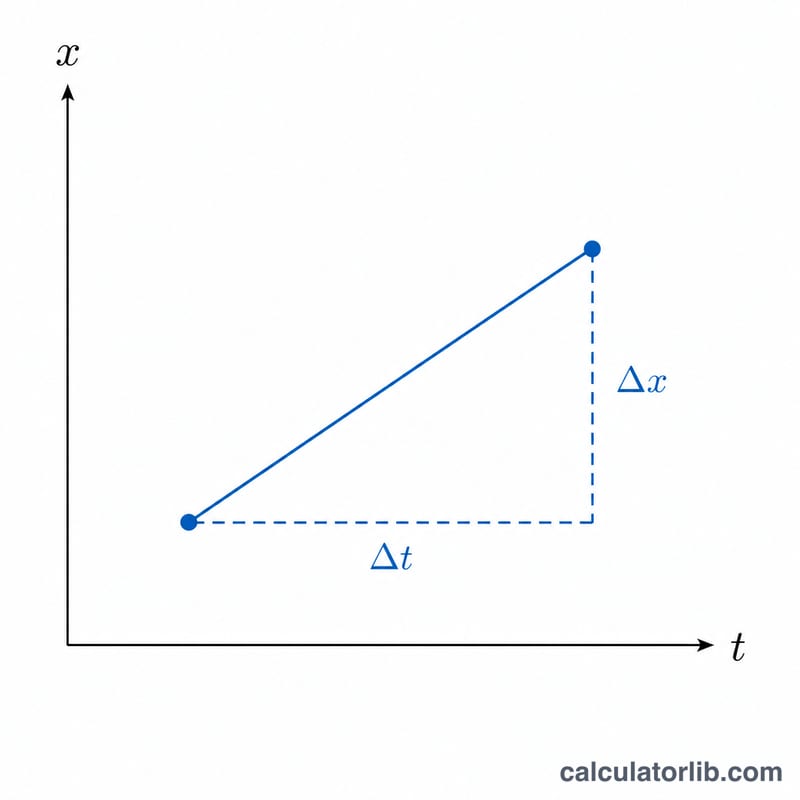
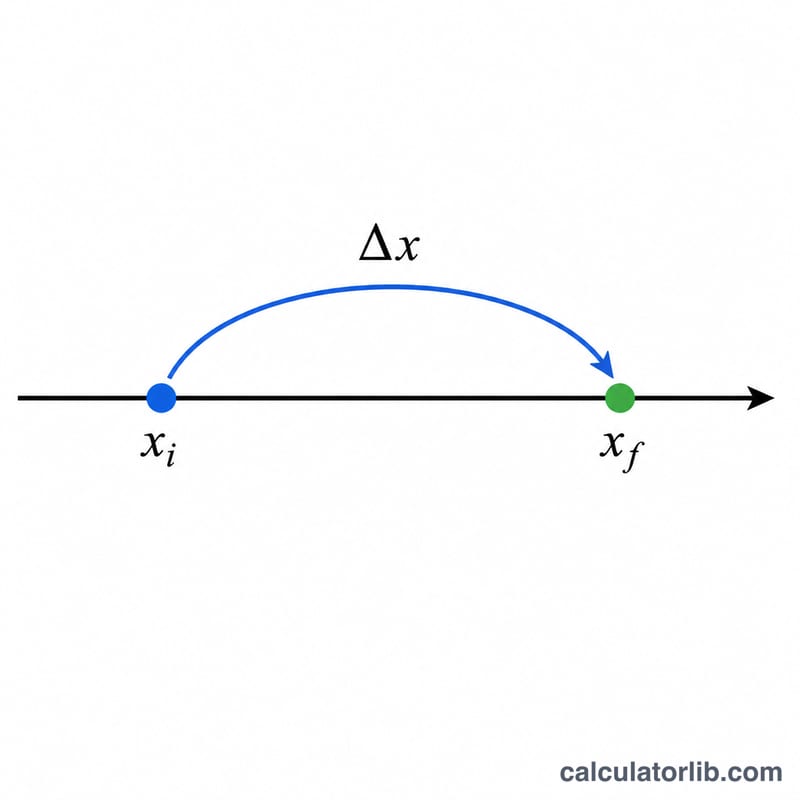
Enter the object's initial position (\(x_i\)) and final position (\(x_f\)) in meters, then enter the initial time (\(t_i\)) and final time (\(t_f\)) in seconds. The tool computes the displacement \(\Delta x\), the elapsed time \(\Delta t\), and divides them to find the average velocity. Make sure the final time is different from the initial time — a zero time interval is undefined.
The Formula Explained
The equation is $$v_{avg} = \frac{\Delta x}{\Delta t} = \frac{x_f - x_i}{t_f - t_i}$$ The numerator is the net change in position (displacement, not total distance), and the denominator is the change in time. Because displacement can be negative, the sign of the answer tells you the overall direction of travel.
Worked Example
Suppose a car starts at position 0 m at time 0 s and reaches 100 m at time 10 s. Displacement = \(100 - 0 = 100\) m. Time interval = \(10 - 0 = 10\) s. Average velocity = $$\frac{100}{10} = 10 \text{ m/s}$$
Velocity Unit Conversions
Average velocity is computed in SI units as metres per second (m/s), but it is often reported in other units. The table below gives exact and rounded conversion factors for the most common speed units. The base relationship is \(1\ \text{m/s} = 3.6\ \text{km/h}\) (since there are 3600 seconds in an hour and 1000 metres in a kilometre).
| From | m/s | km/h | mph | ft/s | knots |
|---|---|---|---|---|---|
| 1 m/s | 1 | 3.6 | 2.23694 | 3.28084 | 1.94384 |
| 1 km/h | 0.27778 | 1 | 0.62137 | 0.91134 | 0.53996 |
| 1 mph | 0.44704 | 1.60934 | 1 | 1.46667 | 0.86898 |
| 1 ft/s | 0.30480 | 1.09728 | 0.68182 | 1 | 0.59248 |
| 1 knot | 0.51444 | 1.85200 | 1.15078 | 1.68781 | 1 |
Worked equivalences for a single value: a velocity of 1 m/s equals exactly 3.6 km/h, approximately 2.237 mph, about 3.281 ft/s, and roughly 1.944 knots. To convert a result from this calculator into km/h, multiply the m/s value by 3.6; to convert into mph, multiply by 2.23694.
For example, an average velocity of \(10\ \text{m/s}\) is \(10 \times 3.6 = 36\ \text{km/h}\) and \(10 \times 2.23694 \approx 22.37\ \text{mph}\).
FAQ
Is average velocity the same as average speed? No. Average speed uses total distance traveled, while average velocity uses net displacement. For motion that reverses direction, they differ.
Can the result be negative? Yes. A negative average velocity means the object's net movement was in the negative direction of your coordinate axis.
What units does it use? The labels show meters and seconds (m/s), but the math works for any consistent units — just interpret the output accordingly.