
What Is the Bid-Ask Spread?
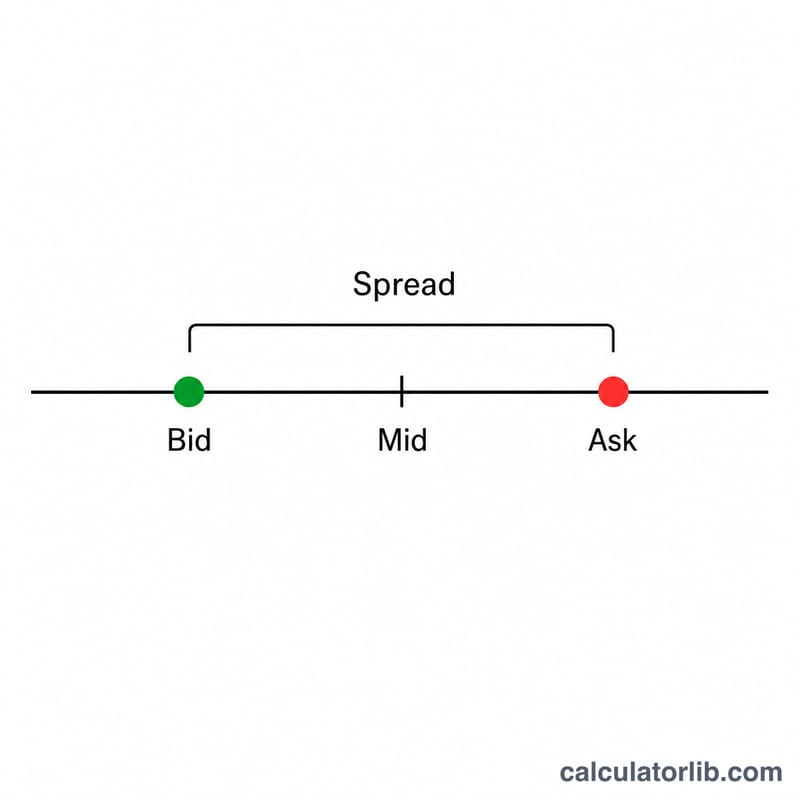
The bid-ask spread is the difference between the highest price a buyer is willing to pay (the bid) and the lowest price a seller will accept (the ask). It is a core measure of liquidity and transaction cost in any traded market — stocks, forex, options, crypto, or commodities. A narrow spread means a liquid, actively traded asset; a wide spread signals lower liquidity and a higher implicit cost to enter and exit a position.
How to Use This Calculator
Enter the current bid price and the current ask price exactly as quoted. The calculator instantly returns the absolute spread, the spread as a percentage of the ask, the spread in basis points (1 bp = 0.01%), and the midpoint price — a fair-value reference often used for pricing and mark-to-market.
The Formula Explained
The absolute spread is simply \(\text{Ask} - \text{Bid}\). To compare assets at different price levels, we normalize it: $$\text{Spread\%} = \frac{\text{Ask} - \text{Bid}}{\text{Ask}} \times 100$$ Multiplying the percentage by 100 again converts it to basis points. The midpoint is \(\frac{\text{Bid} + \text{Ask}}{2}\).
Worked Example
Suppose a stock is quoted with a bid of 99.50 and an ask of 100.00. The absolute spread is $$100.00 - 99.50 = 0.50$$ The spread percentage is $$\frac{0.50}{100.00} \times 100 = 0.5\%$$ or 50 basis points. The midpoint is $$\frac{99.50 + 100.00}{2} = 99.75$$
Typical Bid-Ask Spreads by Asset Class
The bid-ask spread is the gap between the highest price a buyer will pay (bid) and the lowest price a seller will accept (ask). It is computed as \(\text{Spread} = \text{Ask} - \text{Bid}\), and is commonly expressed as a percentage of the midpoint or in basis points (1 bp = 0.01%). The figures below are general market observations for liquid trading conditions; actual spreads vary widely with volatility, time of day, order size, and venue.
| Asset class | Typical spread (%) | Typical spread (bps) |
|---|---|---|
| Large-cap stocks (e.g. mega-cap blue chips) | 0.01% – 0.05% | 1 – 5 |
| Small-cap stocks | 0.2% – 1%+ | 20 – 100+ |
| Major forex pairs (EUR/USD, USD/JPY) | ~0.01% – 0.03% | 1 – 3 |
| Exotic forex pairs (e.g. USD/TRY, USD/ZAR) | 0.1% – 0.5%+ | 10 – 50+ |
| Liquid crypto (BTC, ETH on major venues) | 0.01% – 0.1% | 1 – 10 |
| Illiquid crypto / small altcoins | 0.5% – 5%+ | 50 – 500+ |
| Listed equity options | 0.5% – 5%+ (of contract price) | 50 – 500+ |
| Liquid ETFs (broad-market) | 0.01% – 0.1% | 1 – 10 |
As a rule of thumb, higher trading volume and tighter competition among market makers push spreads down, while low liquidity, high volatility, and wider price uncertainty push them up.
Interpreting Your Spread Result
The spread is both a liquidity signal and an implicit transaction cost. A narrow spread (a few basis points or less) generally indicates an actively traded, liquid market where many buyers and sellers compete closely on price. A wide spread indicates thinner liquidity, greater price uncertainty, or elevated volatility, and means you pay more simply to enter and exit.
Implicit cost. When you buy at the ask and immediately sell at the bid, you lose the full spread even before any commission. This is the round-trip cost. For example, a quote of 10.00/10.02 has a one-way cost of about \(0.02/10.01 \approx 0.20\%\) from the midpoint, and a round-trip cost of roughly \(0.02/10.01 \times 100 \approx 0.40\%\) of the traded value, since you cross half the spread on entry and half on exit relative to fair value — or the full spread measured bid-to-ask.
Midpoint as fair value. The midpoint \((\text{Bid} + \text{Ask})/2\) is the conventional reference for an instrument's "fair" price at a given moment, because it sits halfway between what buyers and sellers are quoting. Many cost and slippage measures are calculated as the distance of your fill price from this midpoint. A fill closer to the midpoint than to the far side of the spread represents better execution.
Basis points for comparison. Converting the spread to basis points makes it easy to compare instruments of very different price levels. A 50 bps spread on a $100 stock and a 50 bps spread on a $25,000 crypto quote represent the same relative cost even though the dollar figures (0.50 vs 125) differ greatly.
This is general educational information about how spreads are measured and what they imply, not personal trading or investment advice.
FAQ
Why divide by the ask and not the bid? Dividing by the ask is the most common convention because traders typically buy at the ask; some desks use the midpoint instead. This tool uses the ask.
What is a "good" spread? Highly liquid large-cap stocks often have spreads under 0.05%, while thinly traded or volatile assets can exceed 1%. Lower is generally cheaper to trade.
What are basis points? One basis point equals 0.01%, so a 0.5% spread equals 50 bps. Traders use bps for precise comparison of small spreads.