
What is the v = u + at calculator?
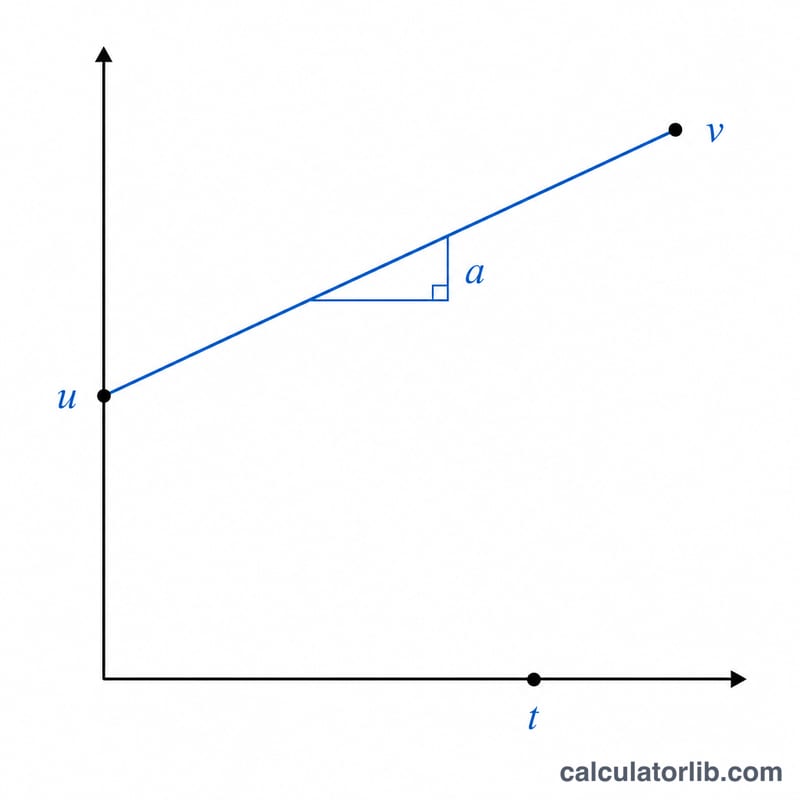
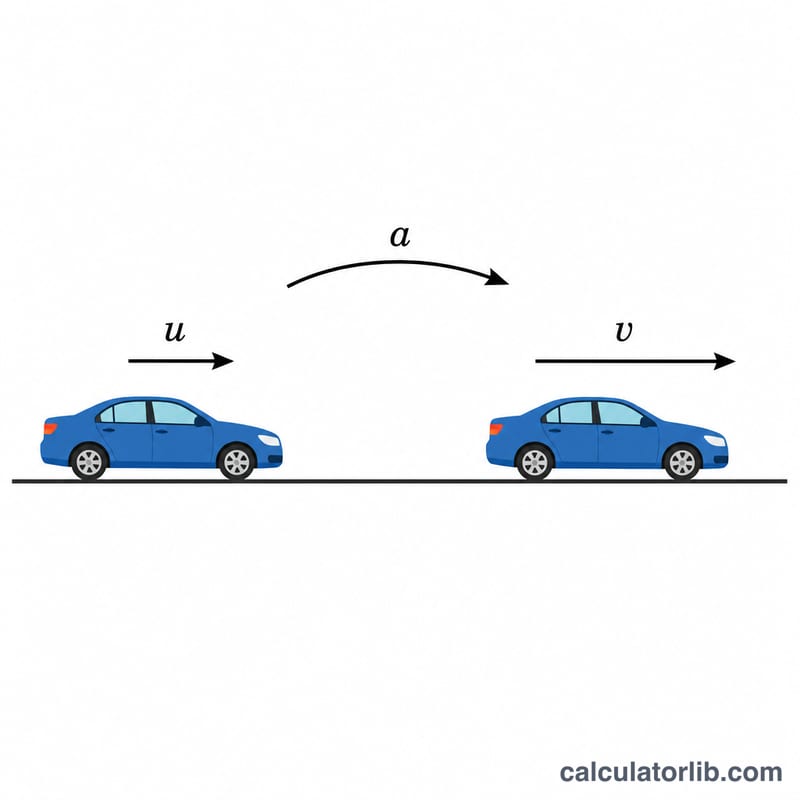
This calculator solves the first equation of motion for uniformly accelerated (constant-acceleration) linear motion: \(v = u + a \cdot t\), where v is the final velocity, u is the initial velocity, a is the acceleration, and t is the elapsed time. Give it any three of the four quantities and it returns the fourth, with full support for mixed units (m/s, km/h, mph, knots, etc.).
How to use it
First choose what you want to find from the "Choose a Calculation" dropdown — final velocity, initial velocity, acceleration, or time. Enter the three known values and pick a unit for each from its dropdown. Optionally set a significant-figures rounding level. The result is shown in the unit currently selected for the variable being solved.
The formula explained
The base equation rearranges algebraically into four forms:
$$v = u + a \cdot t \quad | \quad u = v - a \cdot t \quad | \quad a = \frac{v - u}{t} \quad | \quad t = \frac{v - u}{a}$$Internally every input is converted to SI units (meters and seconds) before computing, then the answer is converted back to your chosen unit. Note that solving for acceleration requires time ≠ 0, and solving for time requires acceleration ≠ 0.
Worked example
Suppose a car starts from rest (\(u = 0 \text{ m/s}\)) and you want the time to reach 60 mph at a constant 3 m/s². Convert 60 mph to 26.8224 m/s, then $$t = \frac{26.8224 - 0}{3} = 8.9408 \text{ s},$$ about 8.94 seconds.
FAQ
Can I use negative values? Yes. Velocity and acceleration are signed components along a line, so a negative result simply indicates the opposite direction (e.g. deceleration).
Why must time be non-zero when finding acceleration? Because \(a = \frac{v - u}{t}\) divides by t; dividing by zero is undefined.
Does this work for free fall? Yes — set a to the gravitational acceleration (about 9.81 m/s²) and the equation gives the velocity at any time, assuming constant acceleration and ignoring air resistance.