
What Is the Pitot Tube Velocity Calculator?
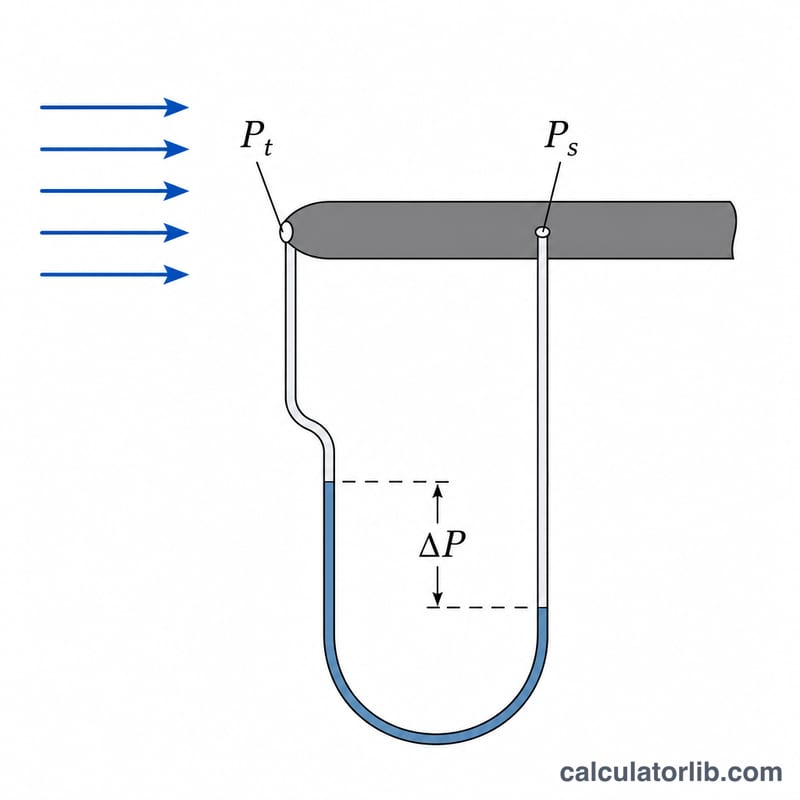
A pitot tube measures fluid flow velocity by comparing the stagnation (total) pressure at its tip with the static pressure of the undisturbed flow. The difference between these two readings is the dynamic pressure, ΔP. This calculator converts that pressure difference and the fluid density into a flow velocity, expressed in m/s, km/h, and mph. It is widely used in aircraft airspeed indicators, HVAC duct measurements, and laboratory wind tunnels.
How to Use It
Enter the differential pressure ΔP in pascals (Pa) — this is the reading from your pressure transducer or manometer. Then enter the density ρ of the moving fluid in kg/m³. For air at sea level and 15 °C, ρ ≈ 1.225 kg/m³; for water, ρ ≈ 1000 kg/m³. Click calculate to get the velocity instantly.
The Formula Explained
The relationship comes from Bernoulli's equation for incompressible flow. Dynamic pressure equals \(\tfrac{1}{2}\rho v^2\), so rearranging for velocity gives:
$$v = \sqrt{\dfrac{2 \cdot \text{ΔP (Pa)}}{\text{ρ (kg/m³)}}}$$
where \(v\) is velocity (m/s), \(\Delta P\) is differential pressure (Pa), and \(\rho\) is fluid density (kg/m³). This assumes incompressible, low-speed flow (Mach < 0.3 for air) and ignores probe losses.
Worked Example
Suppose a pitot tube in air (ρ = 1.225 kg/m³) reads a differential pressure of 500 Pa. Then $$v = \sqrt{\frac{2 \times 500}{1.225}} = \sqrt{816.33} \approx 28.57 \text{ m/s},$$ which is about 102.9 km/h or 63.9 mph.
FAQ
What density should I use? Use the density of the flowing fluid at its actual temperature and pressure. Air density changes with altitude and temperature, so use a corrected value for accurate airspeed.
Does this work for high-speed (compressible) flow? No. Above roughly Mach 0.3 in gases, compressibility matters and you need the compressible pitot equation.
How do I get ΔP? It is the difference between the total pressure port and the static pressure port of the pitot-static system, typically read by a differential pressure sensor.