
What the Angular Velocity Calculator Does
This calculator measures how fast something rotates. You enter the angle an object has turned through and the time it took to turn, and the tool returns the rotational speed in three useful units at once: degrees per second, radians per second, and revolutions per minute (RPM). It's a handy tool for physics students, mechanical engineers, and anyone working with wheels, motors, gears, or spinning machinery.
The Inputs You Provide
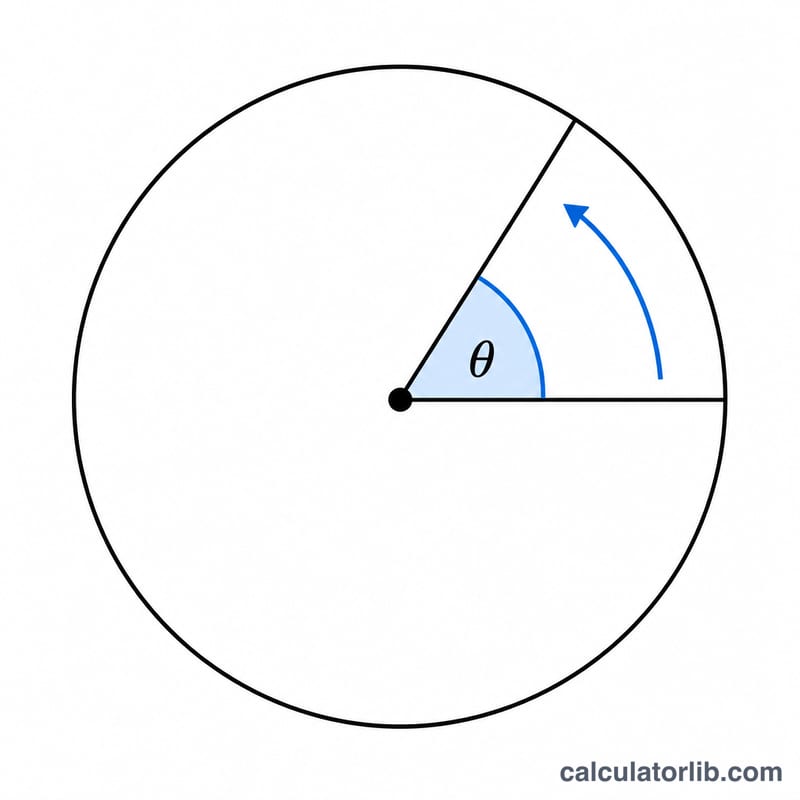
- Angle (in degrees): the total angular distance the object rotated through, measured in degrees. One full turn is 360°.
- Time (in seconds): how long, in seconds, the rotation took.
The Formula Explained
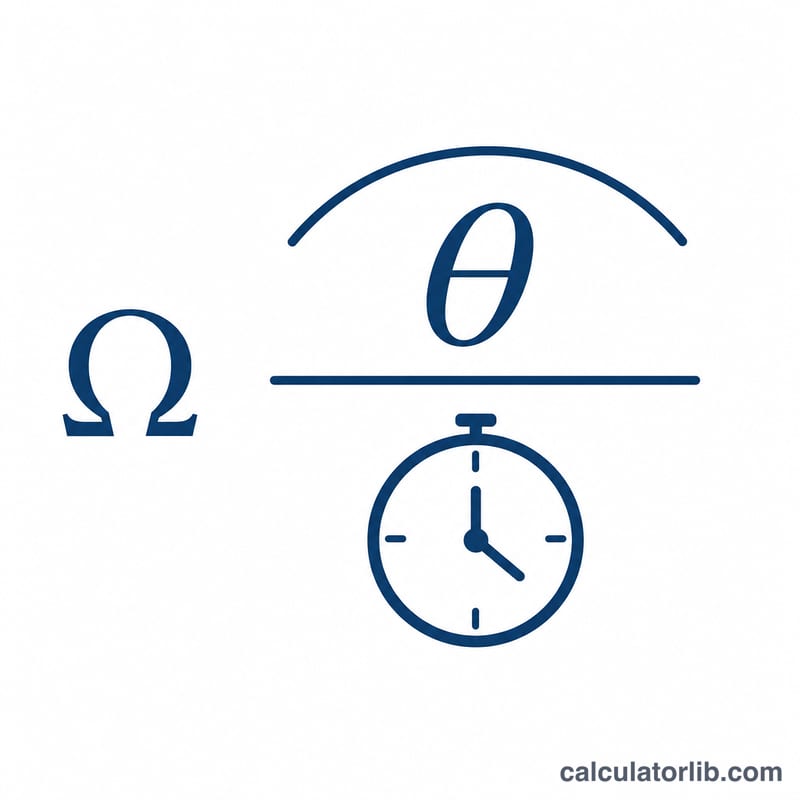
Angular velocity is simply angle divided by time. The calculator works through these steps:
$$\omega = \frac{\text{Angle (}^{\circ}\text{)}}{\text{Time (s)}}$$- Degrees per second: \(\text{angle} \div \text{time}\)
- Radians per second: the degrees-per-second result converted to radians (multiply by \(\pi/180\), since \(180^{\circ} = \pi\) radians)
- Revolutions per minute (RPM): \((\text{degrees per second} \div 360) \times 60\), because 360° is one full revolution and there are 60 seconds in a minute
Worked Example
Suppose a wheel turns through 720 degrees in 4 seconds.
- Angular velocity = \(720 \div 4 = \mathbf{180}\) degrees per second
- In radians = \(180 \times (\pi/180) \approx \mathbf{3.142}\) radians per second
- RPM = \((180 \div 360) \times 60 = \mathbf{30}\) revolutions per minute
So the wheel spins at 180°/s, about 3.14 rad/s, or 30 RPM.
Key Terms & Variables
The terms below define the quantities used when calculating rotational motion. Understanding the units of each is essential because angular velocity can be expressed in either degrees per second or radians per second.
- Angular velocity (\(\omega\))
- The rate at which an object rotates or revolves about an axis — that is, how fast the angular position changes with time. It is defined as \(\omega = \dfrac{\Delta\theta}{\Delta t}\). Common units are radians per second (rad/s), degrees per second (°/s), or revolutions per minute (RPM). In SI units the radian per second is standard.
- Angular displacement (\(\theta\))
- The angle through which an object moves on a circular path, measured from its starting position. It is the rotational analogue of linear distance. Units are radians (rad) or degrees (°), where one full turn equals \(360^{\circ}\) or \(2\pi\) rad.
- Period (\(T\))
- The time required to complete one full revolution (one cycle of rotation). Measured in seconds (s). It relates to angular velocity by \(\omega = \dfrac{2\pi}{T}\).
- Frequency (\(f\))
- The number of complete revolutions per unit time, equal to the reciprocal of the period: \(f = \dfrac{1}{T}\). Measured in hertz (Hz), where 1 Hz = 1 revolution per second. It relates to angular velocity by \(\omega = 2\pi f\).
- Radian (rad)
- The SI unit of plane angle, defined as the angle subtended at the centre of a circle by an arc equal in length to the radius. A full circle contains \(2\pi \approx 6.2832\) radians, so \(1\ \text{rad} = \dfrac{180^{\circ}}{\pi} \approx 57.2958^{\circ}\).
- Revolution (rev)
- One complete turn around a circular path, equal to \(360^{\circ}\) or \(2\pi\) radians. Rotational speeds are often quoted in revolutions per minute (RPM); note that \(1\ \text{RPM} = \dfrac{2\pi}{60}\ \text{rad/s} \approx 0.10472\ \text{rad/s}\).
- Tangential velocity (\(v = \omega r\))
- The linear speed of a point on a rotating body, directed tangent to its circular path. It equals the angular velocity (in rad/s) multiplied by the radius \(r\) (the distance from the axis), giving units of metres per second (m/s). For a given \(\omega\), points farther from the axis move faster.
Frequently Asked Questions
Why convert to radians? Most physics equations — such as those for linear velocity (\(v = \omega r\)) and rotational kinetic energy — require angular velocity in radians per second, so the calculator does the conversion for you automatically.
What is the difference between degrees per second and RPM? Both describe rotation rate. Degrees per second counts angular distance each second, while RPM counts how many complete turns occur in one minute. The tool shows both so you can use whichever unit suits your project.
Can I enter more than 360 degrees? Yes. If an object makes several full turns, enter the total accumulated angle (for example, two full turns = 720 degrees). The calculator handles values of any size.