
What Is Gravitational Potential Energy?
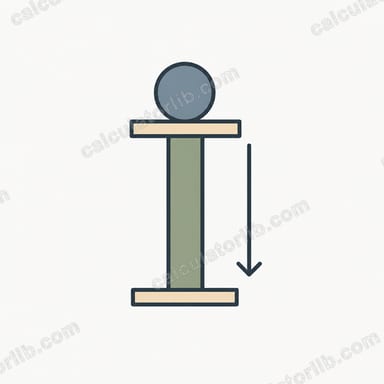
Gravitational potential energy (GPE) is the energy an object stores because of its position in a gravitational field. Lift a book onto a shelf and you give it potential energy; let it fall and that energy converts into motion. This calculator computes GPE from three inputs — mass, height, and gravitational acceleration — and returns the result in joules (J), the SI unit of energy. The physics applies universally, not to any single country.
The Formula
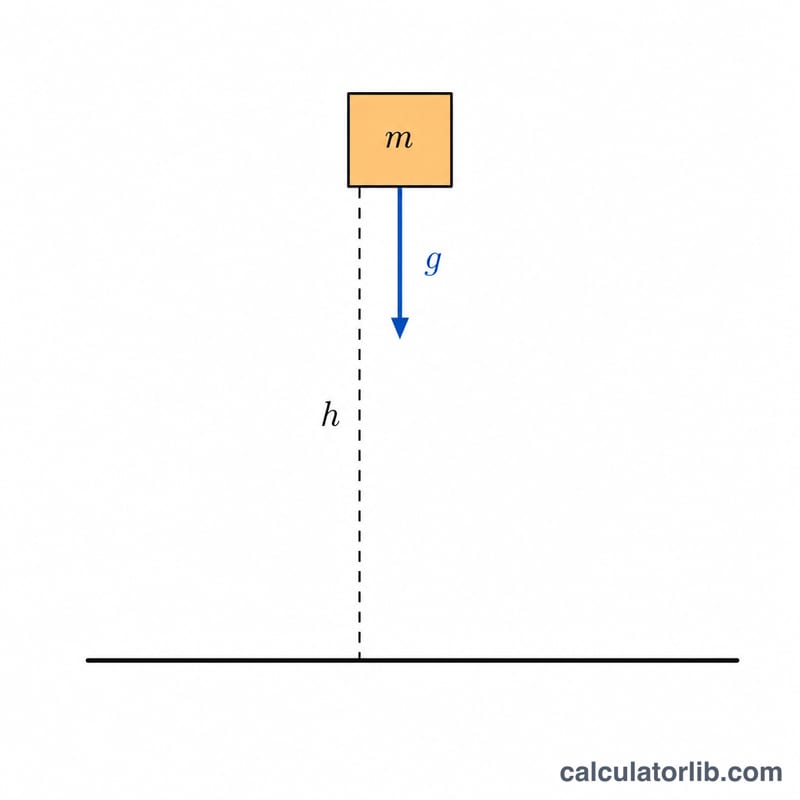
The energy is given by:
$$PE = m \cdot g \cdot h$$- \(m\) = mass of the object in kilograms (kg)
- \(g\) = gravitational acceleration in metres per second squared (m/s²)
- \(h\) = height above the reference point in metres (m)
On Earth's surface, \(g\) is approximately 9.81 m/s². On the Moon it is about 1.62 m/s², and on Mars roughly 3.72 m/s², so the same object stores different amounts of potential energy on different worlds.
How to Use the Calculator
- Enter the object's mass in kilograms.
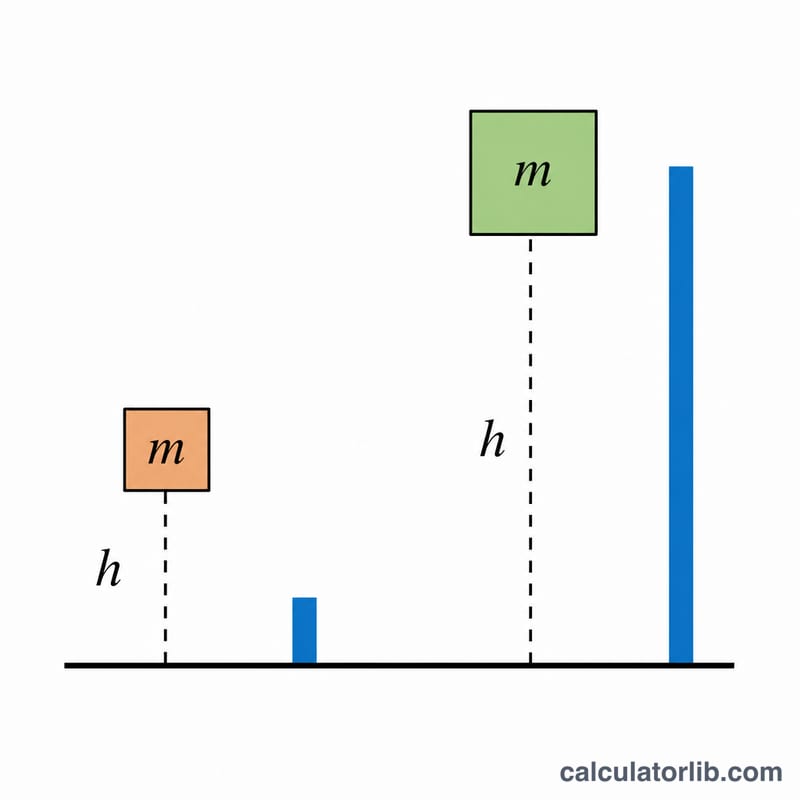
- Enter the height in metres, measured from your chosen zero level (often the ground).
- Enter the value of \(g\), or keep the Earth default of 9.81 m/s².
- Read off the potential energy in joules.
Remember that height is always relative — you decide where "zero" is. The same object can have different GPE depending on whether you measure from the floor or from the basement.
Worked Example
Suppose a 2 kg textbook sits on a shelf 1.8 m above the floor on Earth:
$$PE = m \cdot g \cdot h = 2 \times 9.81 \times 1.8$$$$PE = 35.32 \text{ joules}$$That 35.3 J would be released as kinetic energy if the book fell to the floor.
Frequently Asked Questions
Can potential energy be negative? Yes, if the object sits below your chosen reference point. Only differences in GPE are physically meaningful, so the sign simply reflects which way the object would move.
What happens to the energy when the object falls? It converts to kinetic energy (\(\frac{1}{2}mv^2\)). Ignoring air resistance, all the GPE becomes motion energy at the moment of impact.
Why use 9.81 and not 10? 9.81 m/s² is the accepted average value of Earth's gravity. Using 10 is a quick approximation that introduces about a 2% error.