
What Is Muzzle Energy?
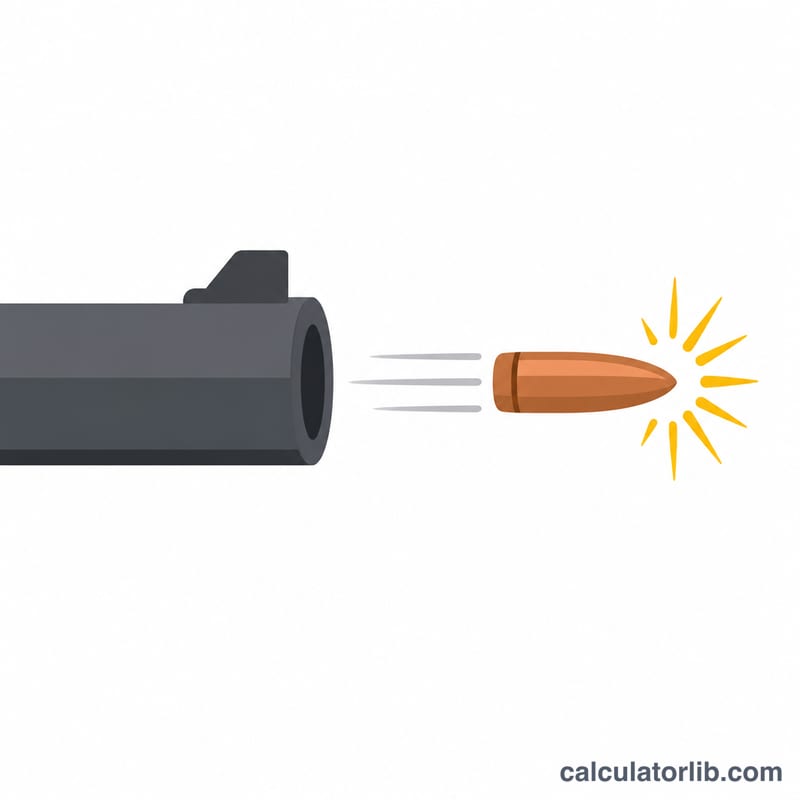
Muzzle energy is the kinetic energy a bullet carries the instant it leaves the barrel. It is a core figure in ballistics and shooting because it indicates how much work a projectile can do on a target — influencing penetration, terminal performance, and recoil. This calculator uses the customary U.S. units common in American shooting sports: bullet weight in grains and muzzle velocity in feet per second (fps), producing energy in foot-pounds (ft-lb).
How to Use the Calculator
Getting a result takes only two inputs, both of which appear on most ammunition boxes or load data:
- Bullet weight (grains): The mass of the projectile. Common values range from about 35 gr for small .22 rounds to 180 gr or more for hunting rifle bullets.
- Muzzle velocity (fps): The speed of the bullet leaving the barrel, often listed by the manufacturer or measured with a chronograph.
Enter both numbers and the calculator instantly returns the muzzle energy in foot-pounds.
The Formula Explained
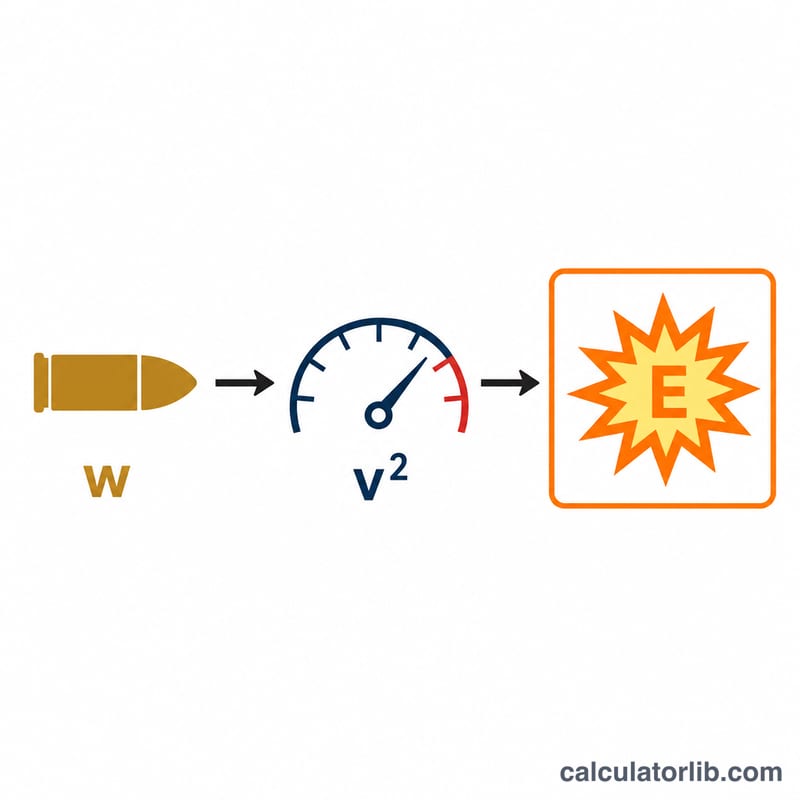
Muzzle energy is derived from the classic kinetic energy equation \(KE = \tfrac{1}{2}mv^2\). When using grains and fps, the constant 450,240 converts the units so the answer comes out in foot-pounds:
- $$\text{Energy (ft-lb)} = \frac{\text{Bullet Weight} \times \text{Velocity}^2}{450{,}240}$$
The constant accounts for the conversion of grains to pounds (7,000 grains per pound) and the gravitational factor used to relate mass and weight. Note that velocity is squared, so speed has a far larger effect on energy than weight.
Worked Example
Consider a standard 9mm load with a 115-grain bullet traveling at 1,180 fps:
- Velocity squared: \(1{,}180 \times 1{,}180 = 1{,}392{,}400\)
- Multiply by weight: \(115 \times 1{,}392{,}400 = 160{,}126{,}000\)
- Divide by 450,240: \(\approx 356 \text{ ft-lb}\)
So this cartridge delivers roughly 356 foot-pounds at the muzzle.
Frequently Asked Questions
Does more muzzle energy mean a better cartridge? Not always. Energy is one factor; bullet design, expansion, and accuracy also matter for terminal performance.
Why is velocity more important than weight? Because velocity is squared in the formula, doubling speed quadruples energy, while doubling weight only doubles it.
Can I use this for metric units? This tool expects grains and fps. For grams and meters per second you would need a different conversion constant.