
What Is the Capacitor Energy Calculator?
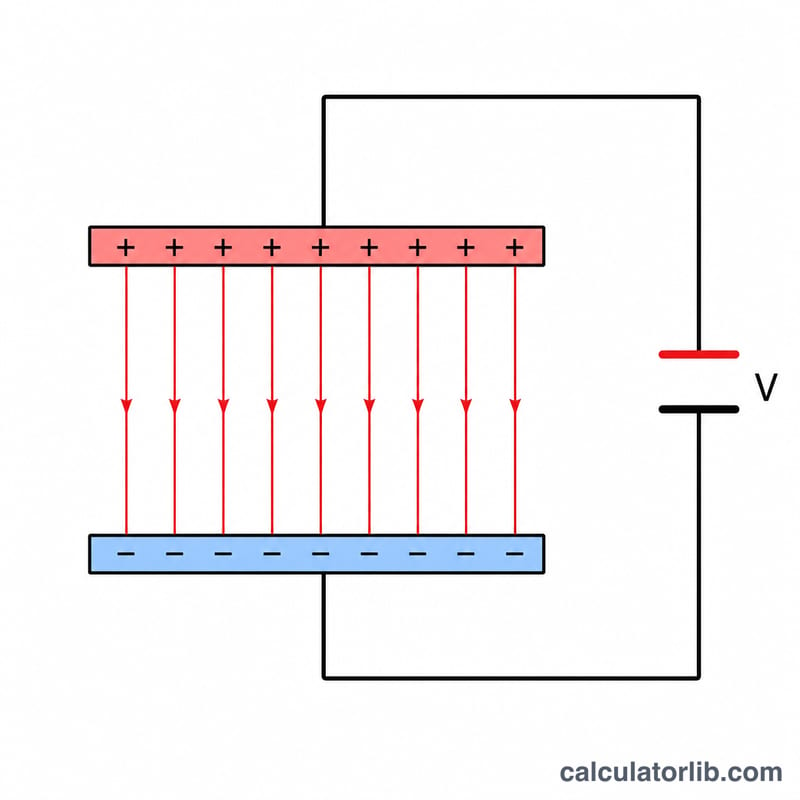
A capacitor stores electrical energy in the electric field between its plates. This calculator tells you exactly how much energy (in joules) a capacitor holds when charged to a given voltage. Enter the capacitance and the voltage, and it returns both the stored energy and the stored charge. The tool applies universal physics and works with any unit system as long as you use SI units (farads and volts).
How to Use It
Enter the capacitance in farads (F). Remember that real-world capacitors are often rated in microfarads (µF) or nanofarads (nF): 1 µF = 0.000001 F and 1 nF = 0.000000001 F. Then enter the voltage in volts (V). Press calculate to see the energy in joules and the charge in coulombs.
The Formula Explained
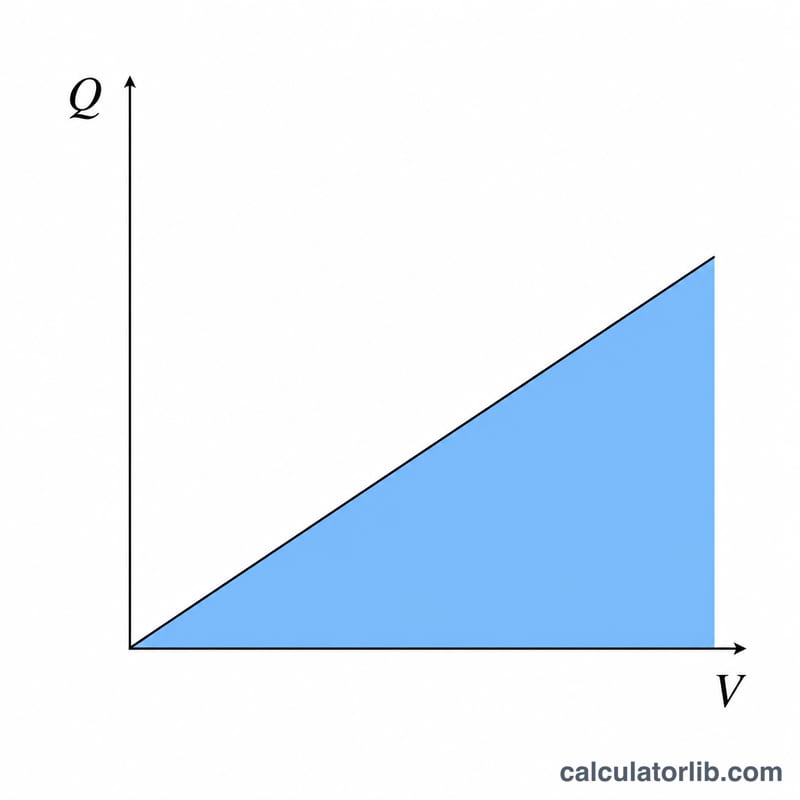
The energy stored in a capacitor is given by $$E = \frac{1}{2} \cdot C \cdot V^{2}$$ Energy grows linearly with capacitance but with the square of voltage — so doubling the voltage quadruples the stored energy. The charge held is \(Q = C \cdot V\), measured in coulombs.
Worked Example
Suppose a capacitor of 0.001 F (1000 µF) is charged to 12 V. The energy is $$E = \frac{1}{2} \times 0.001 \times 12^{2} = 0.5 \times 0.001 \times 144 = 0.072 \text{ J}$$ The stored charge is \(Q = 0.001 \times 12 = 0.012 \text{ C}\).
FAQ
Why is voltage squared? Because the work done to move charge onto the plates increases as the voltage rises, the total integrated energy depends on \(V^{2}\).
What units should I use? Use farads and volts for an answer in joules. Convert µF to F by dividing by one million first.
Can this be used for supercapacitors? Yes — supercapacitors simply have very large capacitance (often several farads), so they store far more energy at the same voltage.