
What is the Capacitor Charge Time Calculator?
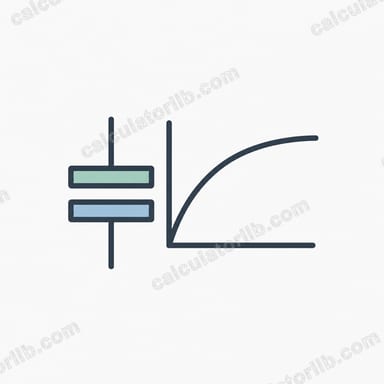
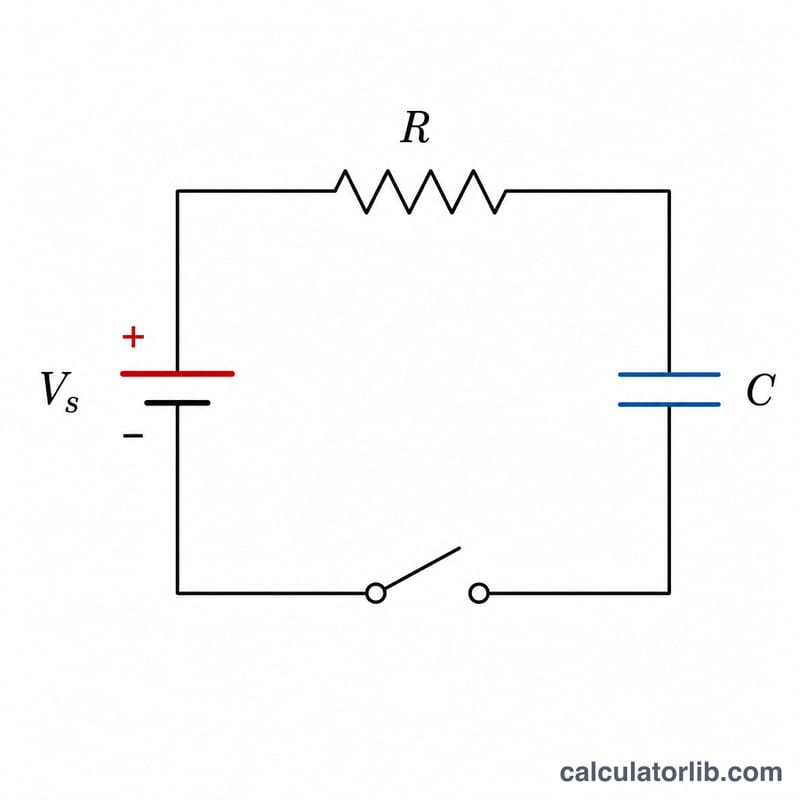
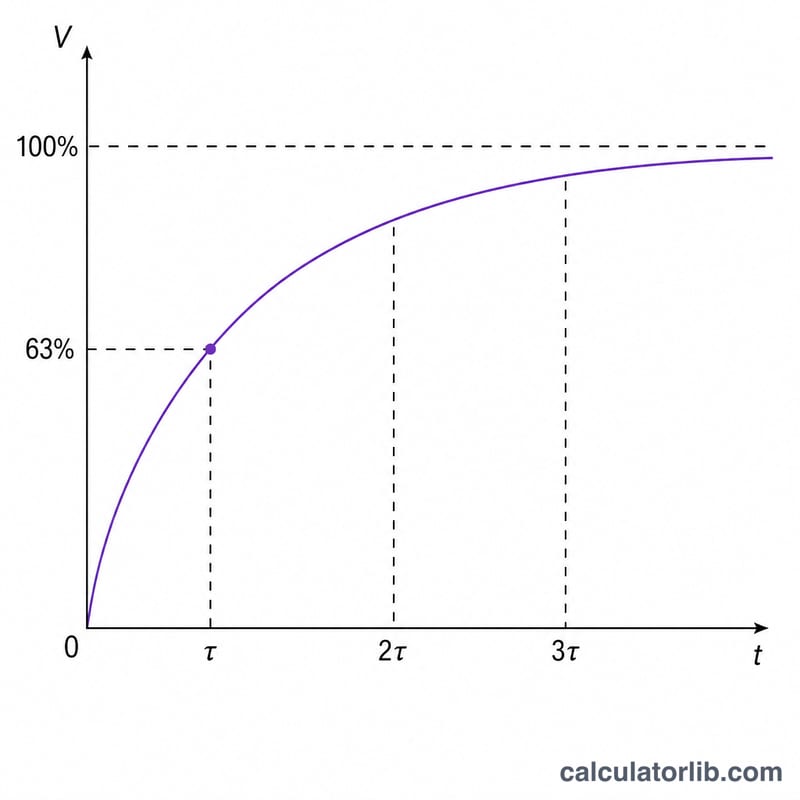
This tool models how a capacitor charges through a resistor in a simple RC (resistor–capacitor) circuit. When a DC supply is connected, the capacitor voltage rises exponentially toward the supply voltage. This calculator returns the voltage at any chosen moment, the circuit's time constant, the percentage charged, and an estimate of the time required to reach nearly full charge.
How to use it
Enter the supply voltage (Vs) in volts, the series resistance (R) in ohms, the capacitance (C) in microfarads (µF), and the elapsed time (t) in seconds. The calculator converts microfarads to farads automatically and applies the exponential charging equation.
The formula explained
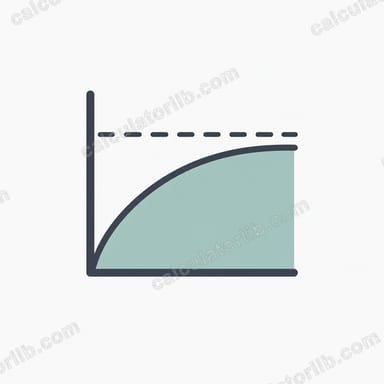
The capacitor voltage follows $$V(t) = \text{V}_s \left( 1 - e^{-t/RC} \right)$$ The product \(RC\) is the time constant \(\tau\), measured in seconds. After one time constant the capacitor reaches about 63.2% of the supply voltage, and after five time constants (\(5\tau\)) it is roughly 99.3% charged — considered "fully charged" for practical purposes.
Worked example
Suppose Vs = 12 V, R = 1,000 Ω, and C = 100 µF (0.0001 F). The time constant $$\tau = 1000 \times 0.0001 = 0.1 \text{ s}$$ After \(t = 0.1\) s (one \(\tau\)), $$V(t) = 12 \times \left( 1 - e^{-1} \right) = 12 \times 0.6321 \approx 7.585 \text{ V}$$ or about 63.2% of the supply.
FAQ
Why convert µF to farads? The formula uses SI units, so microfarads must be divided by 1,000,000.
When is the capacitor "fully" charged? Mathematically it never reaches 100%, but after \(5\tau\) it is over 99% charged, which is treated as full.
Does this work for discharging? No — this calculator models charging. Discharge follows \(V(t) = \text{V}_s \, e^{-t/RC}\).