
What Is the Time Constant?
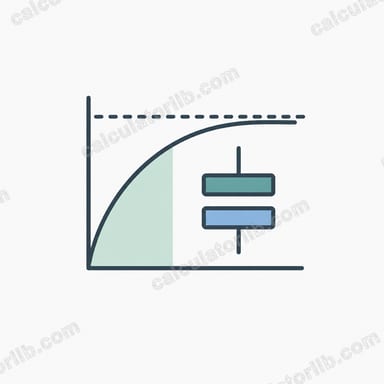
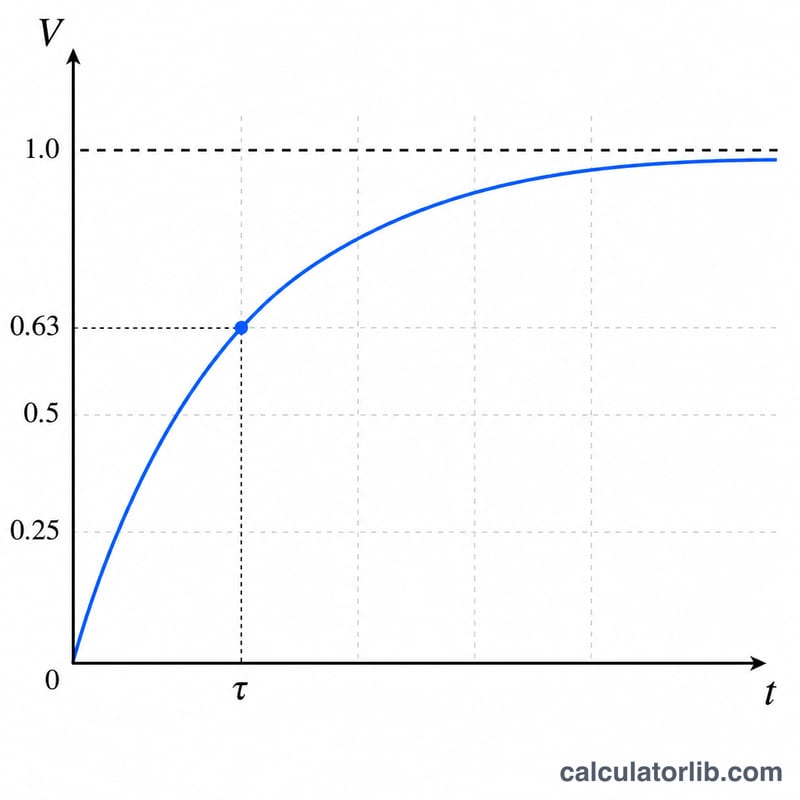
The time constant (τ, the Greek letter tau) describes how quickly a first-order RC or RL circuit charges, discharges, or otherwise responds to a step change in voltage or current. It is the time required for the response to reach about 63.2% of its final value (or to fall to 36.8% of its initial value). After 5 time constants (5τ) the circuit is considered to have reached steady state — more than 99% complete.
How to Use This Calculator
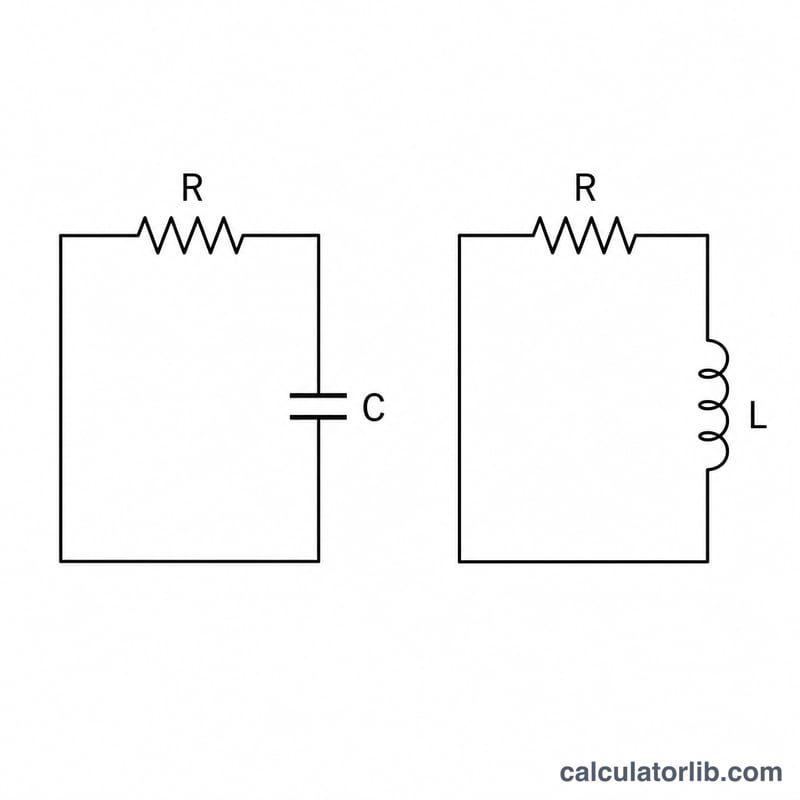
Select your circuit type. For an RC circuit, enter the resistance R in ohms and the capacitance C in farads. For an RL circuit, enter the resistance R in ohms and the inductance L in henries. The calculator returns τ in seconds, milliseconds and microseconds, plus the 5τ settling time. Remember to convert sub-units first: 1 µF = 0.000001 F, 1 nF = 0.000000001 F, and 1 mH = 0.001 H.
The Formula Explained
For a capacitor charged through a resistor, \(\tau = R \cdot C\). A larger resistance limits current flow and a larger capacitance stores more charge, so both slow the response. For an inductor in series with a resistor, \(\tau = L/R\). Here a larger inductance opposes current change more strongly (slower), while a larger resistance dissipates energy faster (quicker decay).
Worked Example
Suppose R = 1000 Ω and C = 1 µF (0.000001 F). Then $$\tau = 1000 \times 0.000001 = 0.001 \text{ s} = 1 \text{ ms}.$$ The capacitor reaches 63.2% of its target voltage in 1 ms, and is essentially fully charged after 5τ = 5 ms.
FAQ
Why 63.2%? Because \(1 - e^{-1} \approx 0.632\). After one time constant the exponential charging curve has covered that fraction of the total change.
What does 5τ mean? It is a common rule of thumb for when a circuit is "settled" — after 5τ the response is within ~0.7% of its final value.
Does it work for any units? Yes, as long as you use base SI units (ohms, farads, henries). The output is then in seconds; the calculator also shows ms and µs for convenience.