
What is the Hagen-Poiseuille Pressure Drop Calculator?
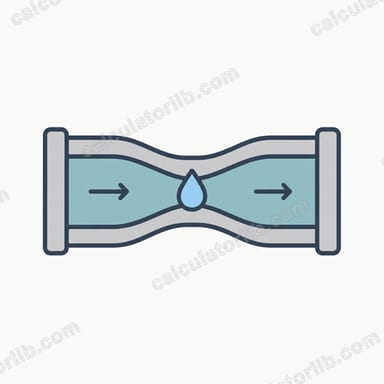
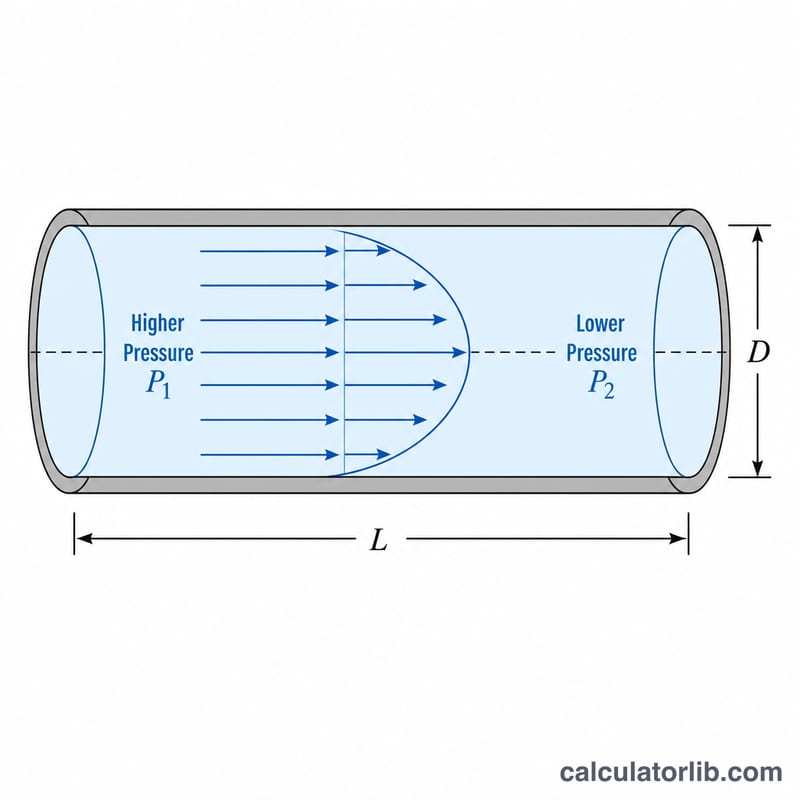
This tool computes the pressure drop (ΔP) experienced by a fluid as it flows through a straight, circular pipe under laminar conditions. It is based on the Hagen-Poiseuille equation, a cornerstone of fluid mechanics used by engineers designing piping, microfluidic channels, hydraulic lines and medical tubing. The calculator is universal — it uses SI units and applies anywhere.
How to use it
Enter four values: the fluid's dynamic viscosity \(\mu\) in pascal-seconds (\(\text{Pa}\cdot\text{s}\)), the pipe length \(L\) in metres, the volumetric flow rate \(Q\) in cubic metres per second (\(\text{m}^3/\text{s}\)), and the inner diameter \(D\) in metres. The calculator returns the pressure drop in pascals, kilopascals and bar, plus the mean flow velocity so you can sanity-check whether the flow is truly laminar.
The formula explained
The Hagen-Poiseuille equation is $$\Delta P = \frac{128 \, \mu \, L \, Q}{\pi \, D^{4}}$$ Notice that pressure drop scales linearly with viscosity, length and flow rate, but inversely with the fourth power of diameter. This strong dependence means even a small reduction in pipe diameter dramatically increases the pressure needed to maintain flow — halving the diameter raises the pressure drop sixteen-fold.
Worked example
For water (\(\mu = 0.001 \ \text{Pa}\cdot\text{s}\)) flowing at \(Q = 0.0001 \ \text{m}^3/\text{s}\) through a pipe of length \(L = 10 \ \text{m}\) and diameter \(D = 0.02 \ \text{m}\):
$$\Delta P = \frac{128 \times 0.001 \times 10 \times 0.0001}{\pi \times 0.02^{4}} = \frac{0.000128}{\pi \times 1.6\times10^{-7}} \approx 254.6 \ \text{Pa} \ (\text{about } 0.255 \ \text{kPa}).$$
FAQ
When is the equation valid? Only for steady, laminar, incompressible, Newtonian flow in a straight circular pipe (Reynolds number below ~2300). For turbulent flow use the Darcy-Weisbach equation instead.
Does it include fittings or bends? No — it covers straight-pipe friction only. Add minor losses for elbows, valves and entrances separately.
What units should I use? Strict SI units (\(\text{Pa}\cdot\text{s}\), \(\text{m}\), \(\text{m}^3/\text{s}\), \(\text{m}\)) give pressure in pascals. Mixing units will produce incorrect results.