
What is the SGPA to Percentage Calculator?
This tool is primarily used in India (notably by Visvesvaraya Technological University, VTU, and many affiliated institutions). It converts your SGPA (Semester Grade Point Average) into an equivalent percentage using the widely adopted formula \(\text{Percentage} = (\text{SGPA} \times 10) - 7.5\). Because some universities use a slightly different rule (such as \(\text{SGPA} \times 9.5\)), always confirm the official conversion method recommended by your own institution before relying on this number.
How to use it
Enter your SGPA on a 0–10 scale (decimals are allowed, e.g. 8.75) and the calculator instantly returns the equivalent percentage. The result is clamped to a minimum of 0% to avoid negative values for very low SGPA inputs.
The formula explained
The conversion multiplies your SGPA by 10 to scale it to a 0–100 range, then subtracts a fixed correction factor of 7.5. The subtraction accounts for the gap between the grade-point scale and the actual marks distribution, which is why a perfect 10 SGPA maps to 92.5% rather than 100%.
$$\text{Percentage} = \left( \text{SGPA} \times 10 \right) - 7.5$$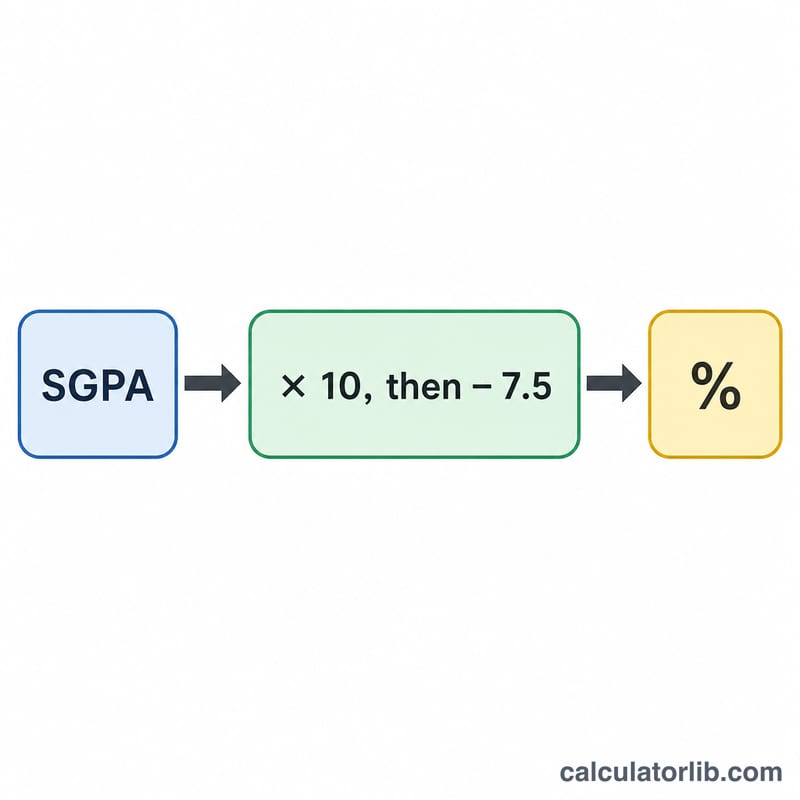
Worked example
Suppose your SGPA is 8.5. Multiply: \(8.5 \times 10 = 85\). Subtract 7.5:
$$85 - 7.5 = 77.5\%$$So an SGPA of 8.5 corresponds to an equivalent percentage of 77.5%.
FAQ
Is this the same as CGPA to percentage? No. SGPA is for a single semester; CGPA averages all semesters. The same \((\times 10 - 7.5)\) formula is, however, often applied to CGPA too.
What does a 10 SGPA convert to? \((10 \times 10) - 7.5 = 92.5\%\).
Does every university use this formula? No. Some use \(\text{SGPA} \times 9.5\) or a custom table. Check your university's official guideline.