
What the Percentage Decrease Calculator Does
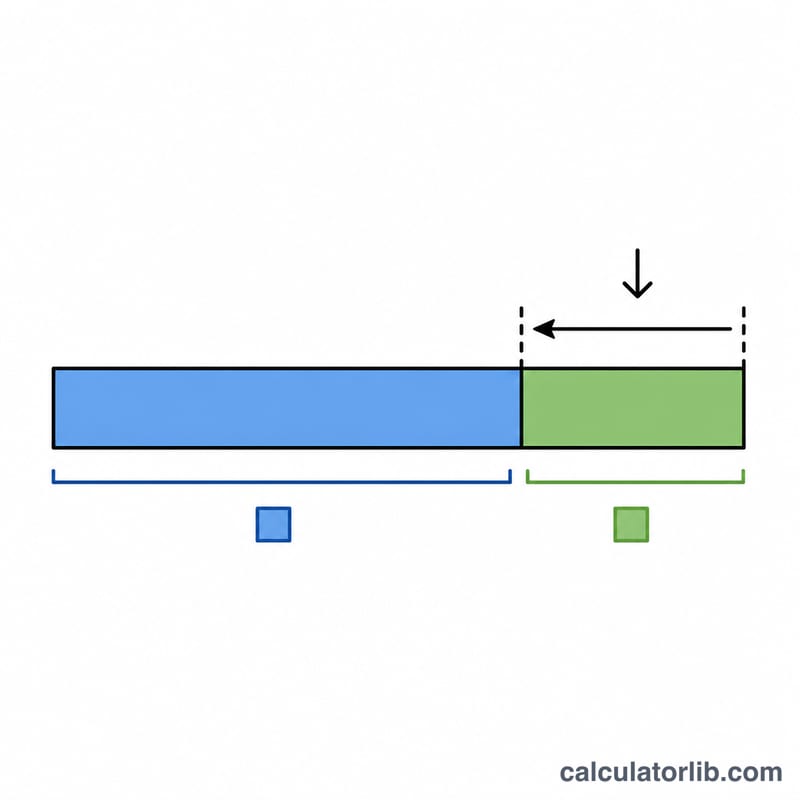
This calculator tells you how much smaller one number is than another, expressed as a percentage. You enter an Original Value (the starting figure) and a New Value (the figure it dropped to), and the tool instantly returns the percent decrease between the two. It's handy for tracking price drops, salary cuts, weight loss, declining sales, falling temperatures, or any situation where a number has gone down over time.
How to Use It
- Original Value — the number you started with, before the decrease.
- New Value — the number you ended with, after the decrease.
Press calculate and the tool shows the raw difference, the percentage decrease, and a multiplier (New Value ÷ Original Value) that tells you what fraction of the original remains.
The Formula Explained
The percentage decrease is calculated as:
$$\text{Percentage Decrease} = \frac{\text{Original Value} - \text{New Value}}{\left|\text{Original Value}\right|} \times 100$$First the calculator finds the difference (Original − New). It then divides that by the absolute value of the original — using the absolute value keeps the math sensible even if the original number is negative. Multiplying by 100 converts the result into a percentage. A positive result means a genuine decrease; a negative result means the value actually increased.
The multiplier is computed separately as New ÷ Original. For example, a multiplier of \(0.8\) means the new value is 80% of the original.
Worked Example
Suppose a jacket was priced at 200 and is now 150.
- Difference = \(200 - 150 = 50\)
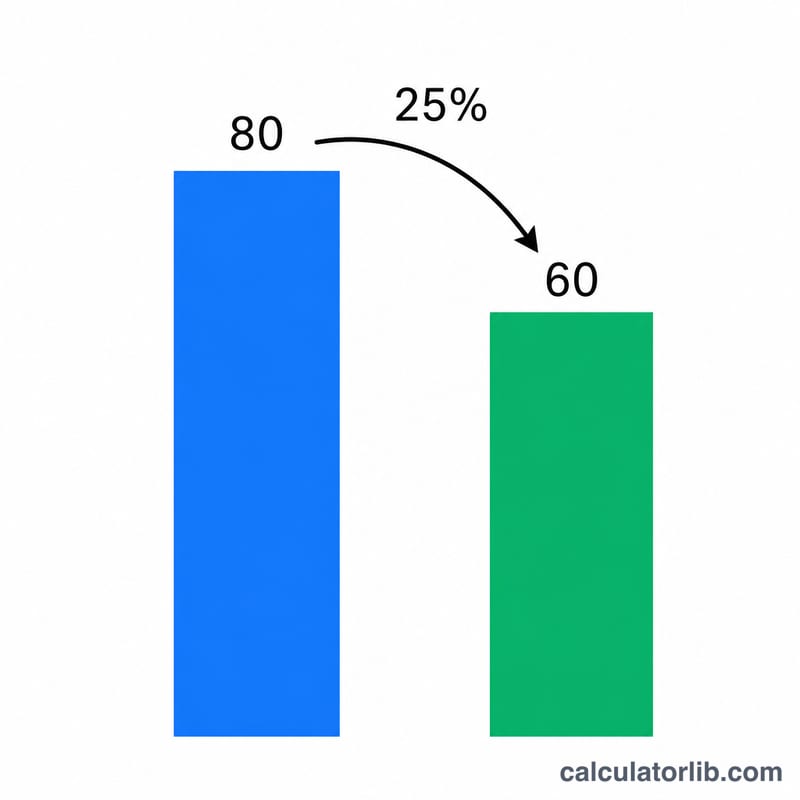
- Percentage Decrease = \(\left(50 \div 200\right) \times 100 = \mathbf{25\%}\)
- Multiplier = \(150 \div 200 = 0.75\) (the new price is 75% of the original)
So the jacket's price fell by 25%.
Frequently Asked Questions
What if the new value is larger than the original? The result will be negative, which signals an increase rather than a decrease. For instance, going from 100 to 120 returns −20%.
Why does the formula use the absolute value of the original? Dividing by the absolute value prevents a negative starting number from flipping the sign of your result unexpectedly, keeping the percentage meaningful.
Is percentage decrease the same as percentage change? They use the same calculation. "Decrease" simply assumes the value went down, so the answer is usually positive when the number shrinks.
Related percentage calculators
- Percent Change Calculator — increase or decrease from an old value to a new one.
- Percentage Increase Calculator — how much a value went up, in percent.
- Percentage Difference Calculator — compare two numbers with no before/after.
- Percent Error Calculator — measured value vs. a known true value.