
What the LCD Calculator Does
The LCD Calculator finds the least common denominator for a set of fractions — the smallest number that every denominator divides into evenly. This is the value you need to add, subtract, or compare fractions, since all of them must share the same denominator before the operation makes sense. You can enter ordinary fractions like 1/4, whole numbers like 5, or several values at once.
How to Use It
Type your fractions into the input box, separated by commas, for example: 1/4, 3/8, 5/6. The calculator scans the text, splits it on commas, trims spaces, and keeps only entries that match the pattern a/b (a fraction) or c (a whole number). Anything that doesn't fit that pattern is ignored, so stray text won't break the result.
- Fractions: entered as
numerator/denominator— only the denominator is used. - Whole numbers: treated as having a denominator of 1.
- Separator: always a comma between values.
The Formula Explained
The LCD is simply the least common multiple (LCM) of all the denominators. The calculator extracts the denominator from each entry (using 1 for plain integers), then combines them pairwise: \(\operatorname{lcm}(a, b, c) = \operatorname{lcm}(\operatorname{lcm}(a, b), c)\). The LCM of two numbers is found from their greatest common divisor:
$$\operatorname{lcm}(a, b) = \frac{a \times b}{\gcd(a, b)}$$The general formula for the least common denominator is:
$$\text{LCD} = \operatorname{lcm}\left(d_1, d_2, \dots, d_n\right)$$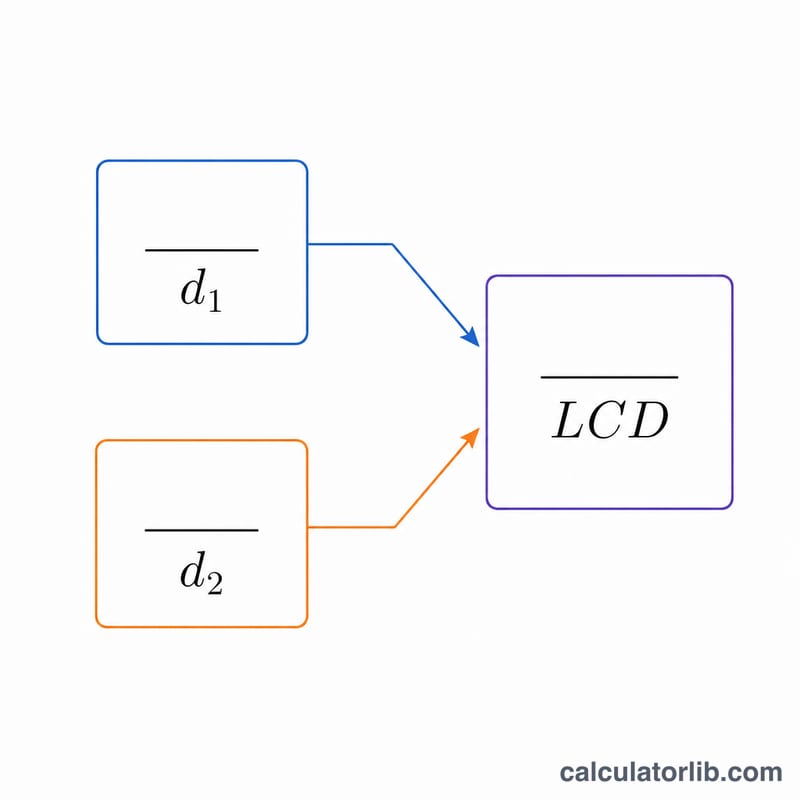
Worked Example
Suppose you enter 1/4, 3/8, 5/6. The denominators are 4, 8 and 6.
- \(\operatorname{lcm}(4, 8) = 8\)
- \(\operatorname{lcm}(8, 6) = \dfrac{8 \times 6}{\gcd(8, 6)} = \dfrac{48}{2} = 24\)
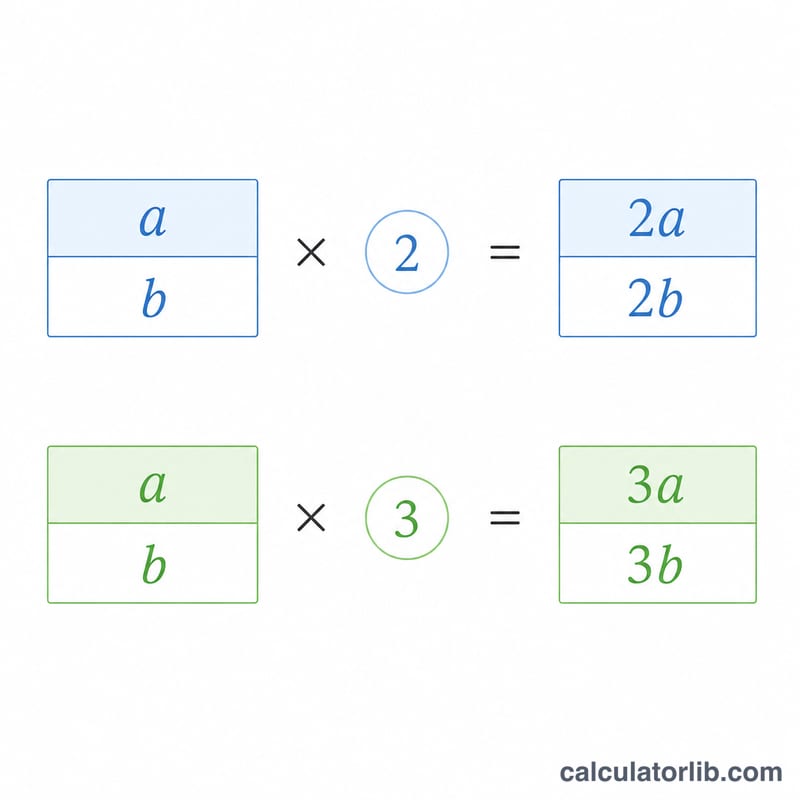
So the least common denominator is 24. You could then rewrite the fractions as 6/24, 9/24 and 20/24 to add or compare them.
Frequently Asked Questions
Does the numerator affect the LCD? No. The LCD depends only on the denominators, so the calculator uses just the part after each slash.
What if I enter a whole number like 5? A whole number is treated as 5/1, giving it a denominator of 1, which never changes the LCM.
Is the LCD the same as the LCM? Yes — the least common denominator of a set of fractions is exactly the least common multiple of their denominators.