
What the GCF Calculator Does
The Greatest Common Factor (GCF) — also called the greatest common divisor (GCD) — is the largest whole number that divides evenly into every number in a set. This calculator takes a list of integers you type in and instantly returns the single biggest factor they all share. It is handy for simplifying fractions, reducing ratios, factoring algebra problems, and splitting quantities into equal groups.
How to Use It
There is just one input field, labelled numbers. Enter two or more whole numbers separated by commas, for example 24, 36, 60. The tool then:
- Splits your text on each comma and trims any extra spaces.
- Keeps only valid integers — it matches the pattern
-?\d+, so negative numbers are accepted but decimals, fractions and stray text are ignored. - Calculates the GCF across all the valid numbers and shows the result.
Because non-integer entries are simply filtered out, a tidy comma-separated list gives the most reliable answer.
The Formula Behind It
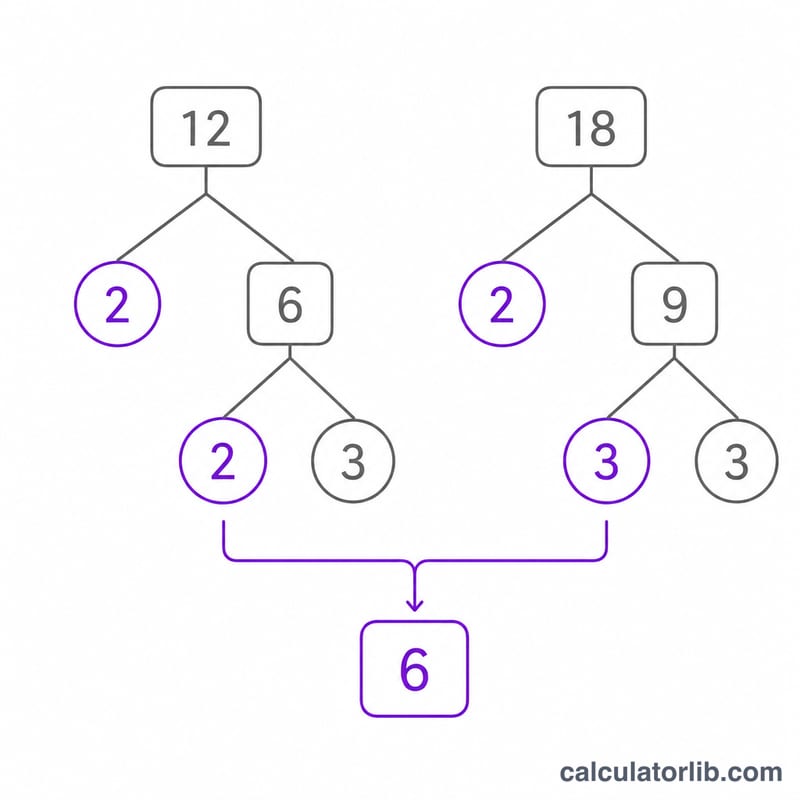
The calculator does not test every possible divisor. Instead it applies the Euclidean algorithm to two numbers at a time and "folds" the list together. In plain terms it computes:
$$\text{GCF} = \gcd\left(\text{Numbers}\right)$$- GCF(a, b) using the classic gcd routine.
- Then GCF(that result, c), then GCF(that result, d), and so on for the whole list.
This works because the GCF of several numbers equals the GCF of the running result and the next number — an efficient, well-proven approach.
Worked Example
Suppose you enter 24, 36, 60:
- \(\gcd(24, 36) = 12\)
- \(\gcd(12, 60) = 12\)
So the calculator returns 12. You can confirm it: \(24 \div 12 = 2\), \(36 \div 12 = 3\), and \(60 \div 12 = 5\), all whole numbers, and no larger value divides all three.
FAQ
Can I enter just one number? Yes — the GCF of a single number is that number itself, since it is its own largest factor.
What about negative numbers? Negatives are allowed. The GCF is always reported as a positive value, because divisibility ignores sign (for example, \(\gcd(-8, 12) = 4\)).
Why was my decimal ignored? The tool only reads whole integers. Any value with a decimal point, or non-numeric text, is filtered out before the calculation, so stick to integers separated by commas.