
What this calculator does
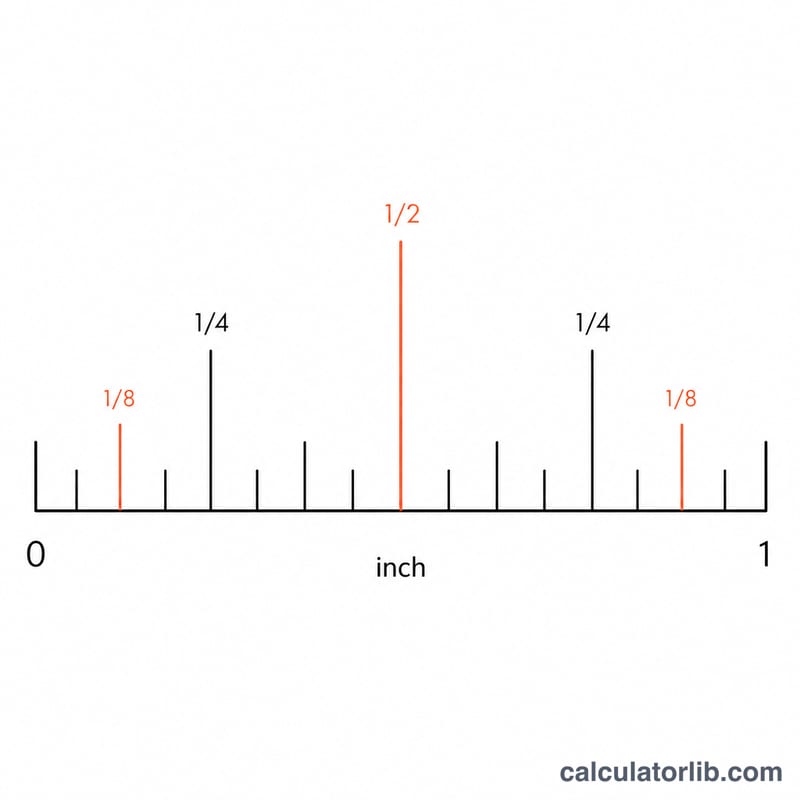
The Round to the Nearest Fraction Calculator snaps any decimal number to the closest fraction with a denominator you choose — halves, quarters, eighths, sixteenths, thirty-seconds, or sixty-fourths. It is ideal for woodworking, machining, sewing, construction, and any task that uses an inch ruler marked in fractional increments rather than decimals.
How to use it
Enter the decimal value you want to round, then pick the fractional precision (for example "nearest 1/16"). The calculator returns the rounded decimal, the equivalent mixed fraction in lowest terms, and the rounding difference so you know exactly how much was added or removed.
The formula explained
To round a value \(x\) to the nearest \(1/d\), multiply \(x\) by the denominator \(d\), round that product to the nearest whole number, then divide by \(d\) again:
$$\text{Rounded} = \frac{\operatorname{round}\!\left(\text{Value} \times \text{Denominator}\right)}{\text{Denominator}}$$A larger denominator gives finer precision. The fractional part is then reduced by dividing the numerator and denominator by their greatest common divisor, so \(8/16\) displays as \(1/2\).
Worked example
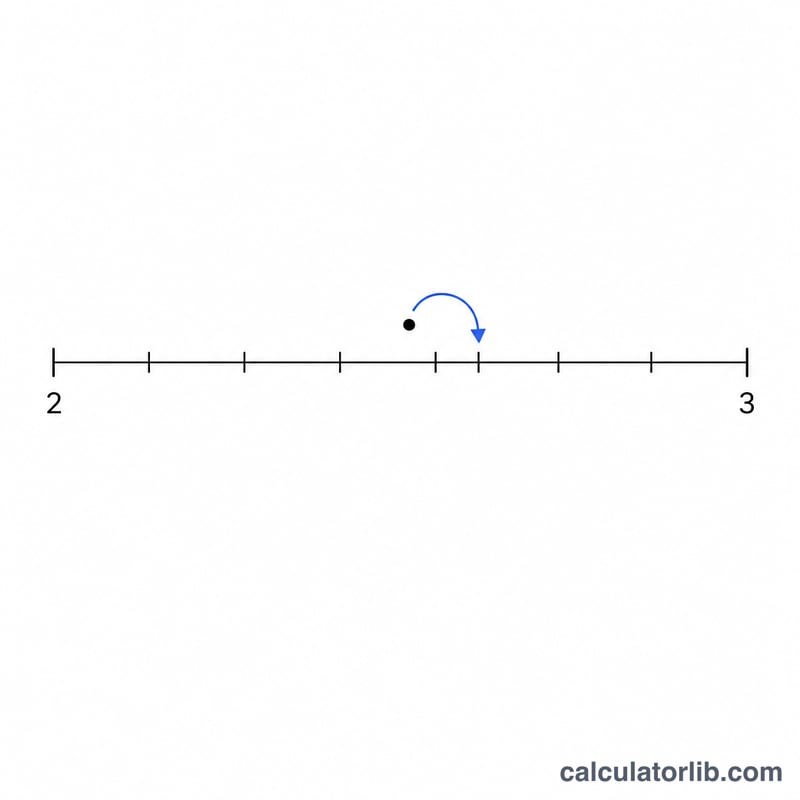
Round 3.3 to the nearest 1/16. Multiply: \(3.3 \times 16 = 52.8\). Round: \(53\). Divide:
$$53 / 16 = 3.3125$$As a mixed number that is 3 5/16 (since \(53 - 48 = 5\)). The rounding difference is \(3.3125 - 3.3 = 0.0125\) inch.
FAQ
How is a tie (exactly halfway) handled? The calculator rounds halves to the nearest even/up using standard round-half-up behavior of the rounding function, so 1/32 of an inch ties move to the next sixteenth.
Can it round negative numbers? Yes. The whole part keeps the sign and the fraction is shown as a positive numerator over its denominator.
Why reduce the fraction? Rulers and plans are read in lowest terms — 4/8 is easier to find as 1/2 — so the result is always simplified.